Polizeitruppe in the Colonies
The Polizeitruppe of
German East Africa,
Cameroon,
Togo,
New
Guinea and Samoa were intended
to perform police duties in the colonies but were armed and
had some limited military training and so did take part in
putting down local rebellions. The other ranks were locally recruited, while officers and
senior NCOs were German. The Polizeitruppe were commanded
directly by the colonial governor rather than the
Schutztruppe commander. Note that the The
Landespolizei of German South West Africa were
recruited, organised and uniformed upon completely different
lines from the other colonies.Because
of the very few numbers of German personnel employed by the
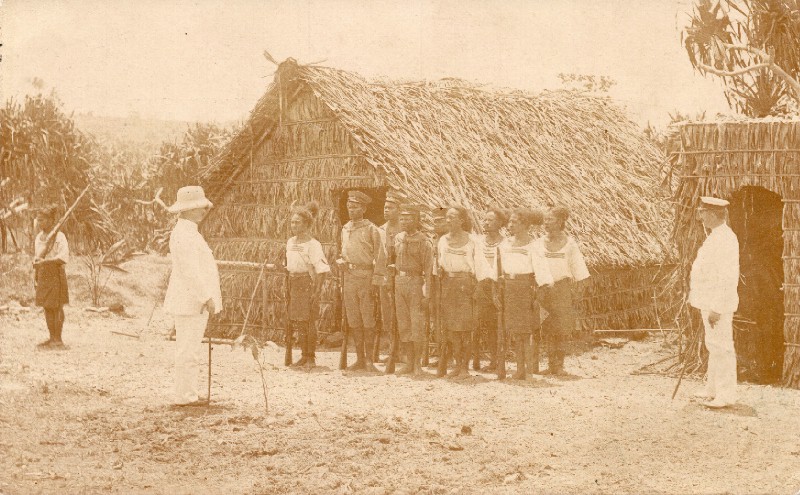
Polizeitruppe and thus the lack of clear period photos or
remaining uniforms, it is very difficult to confirm
all the details of the uniforms as described in the few sets
of uniforms regulations we have available or described. The
sometimes partial descriptions we do have are the
regulations passed by the Imperial Colonial Office
(Reichskolonialamt) for the
German East African Polizeitruppe 27 October 1906, 16 March 1912 as well as 8 July and 1 October
1910 (both referred to in Deutsches Kolonial-Lexikon, Band
3, 1920 P72-73), and also 30 July 1912 (Deutsches
Kolonialblatt XXIII 1912, P925), the Togo Polizeitruppe of
31 August 1908 and 4 September 1914, the Cameroon and Togo
Polizeitruppe of 8 May 1913 (Deutsches Kolonialblatt XXIV
1913, P464), the New Guinea Polizeitruppe of
13 April 1912 confirming green as the colony colour and the
regulations for Army Officers
Seconded to the Colonies of 1912 (Deutsches Kolonialblatt
XXIII 1912, P925-6). These uniform regulations
were all very well researched and helpfully pointed out to me by Klaus Ahlf.
German Officers of
the Polizeitruppe
The Polizeitruppe were usually commanded
in military matters by a small number of military officers. In
German East Africa and Cameroon, these were seconded from
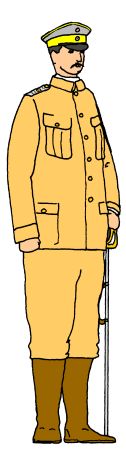
the local Schutztruppe, and wore standard Schutztruppe
officers uniforms. In Togo and New Guinea regular army
officers were seconded to the colonies to command the
Polizeitruppe. They wore Schutztruppe khaki and white
tropical uniforms without the Schutztruppe blue piping.
Their tropical helmets, peaked caps and Südwester hats had a
small state cockade below the Imperial one. They wore the
shoulder straps, lace belts and swords of their home units.
From 1912, officers in Togo were entitled to wear yellow as
a facing colour on their peaked caps and Südwester hats,
while those in New Guinea could wear green. No army officers
were seconded to Samoa, though if they were, they were
entitled from 1912 to use pink as a facing colour. It is not
sure how much these new colony colour uniforms were issued
before the outbreak of the First World War.
German
Polizeimeister NCOs
While the officers commanding the
Polizeitruppe came from military backgrounds, the NCOs
commanding each police station had pervious police
experience in Germany, and had also completed their
obligatory military service. These personnel then were
technically civilian officials (Beamte) in the colony rather than
members of the military.
There was generally only one
rank of Police NCO in the colonies, usually
titled as Polizeimeister (or sometimes Polizeiwachtmeister
in German East Africa or Polizeisergeant in 1890s Togoland).
In Cameroon, there was a specially titled
Exerziermeister to train the African police solders, but this
title was not distiguished by special insignia.
Uniforms
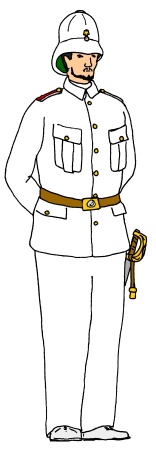
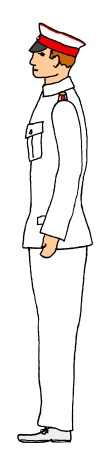
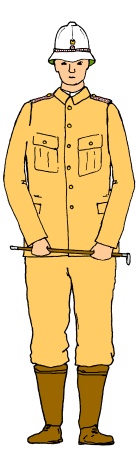
These Police Sergeants wore the white and khaki tropical uniforms of the
Schutztruppe but without the Schutztruppe blue piping. The
buttons of the tunic were in brass and bore the Imperial
eagle of colonial officials, rather than the steel buttons
of the Schutztruppe with the Imperial crown. The uniform
regulations for Togo, list their buttons as silvered which
contradicts the regulations for both Togo and Cameroon which
have them as brass. Trousers were
matching white or khaki, with some sergeants wearing riding
breeches. Footwear was as for the Germans in
the Schutztruppe, usually white leather shoes with the white
parade uniform and brown leather ankle boots sometimes with
leather gaiters, with the khaki field uniform. They
had no grey home uniform.
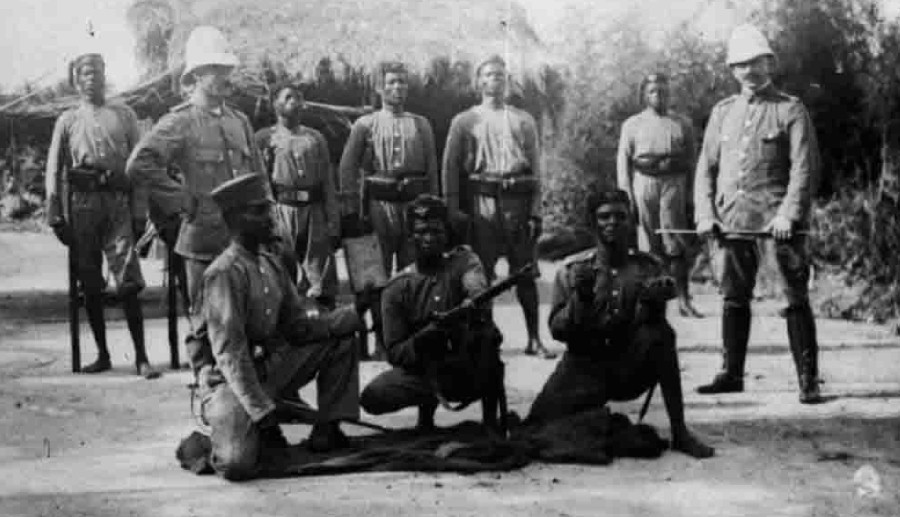
Period photographs
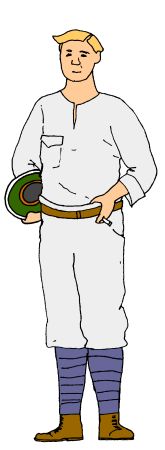
show quite a lax attitude towards uniforms worn by the
Polizeimeister in distant outposts. Many did not wear their shoulder
boards or carry a sword on duty. Some are seen in
shirtsleeves in tropical climates and others even just
wearing civilian suits on the Micronesian Islands.
Shoulder Boards
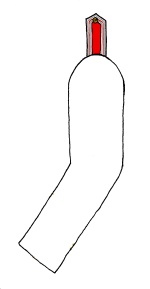
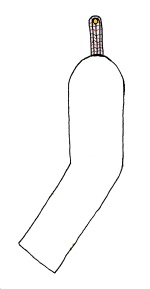
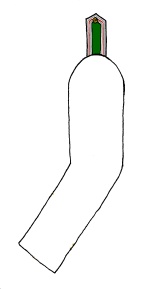
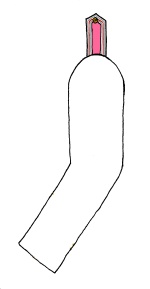
The shoulder boards of the tunic were red with
silver lace down either side with vertical threads of black,
red and black down the lace. From 1912, these shoulder
boards were authorised in green and
pink in New Guinea and Samoa respectively (though there is
some doubt as to if or how often these new shoulder boards
were worn).
Polizeitruppe NCOs in Togo wore the Hussar-style shoulder
straps of the Schutztruppe NCOs in black, white and red threads.
Peaked Cap and Südwester
Hat
The Polizeimeister wore the grey peaked
field cap or Südwester hat with a single Imperial cockade
and piping and hatband in red, although in reality the
Südwester hat was rarely worn. Above the cockade on the
field cap a brass Imperial eagle badge was authorised though
not always worn. White
tropical field caps were also worn, likewise with red hatbands and
piping. From 1912, the new colony colours were authorised as
yellow for Togo, green for New Guinea and pink for Samoa
(though as mentioned above it is not certain how often these
new colours were used).
Tropical Helmet
A tall white tropical helmet
was authorised with a small NCOs Imperial cockade at the front.
From 31 August 1908, a small brass imperial eagle was added
above the cockade for NCOs in German East Africa.
This was probably also done in the other colonies, as
confirmed by the Cameroon and Togo Polizeitruppe regulations
of 1913. A khaki cover could be worn over the white tropical
helmet. From 4 September 1912, a
black/silver/red twisted cord was worn around the hatband
of the tropical helmet for the rank of Wachtmeister in German East Africa,
this practice was presumably authorised in the other colonies
though was not always followed.
Equipment and Weapons
A brown leather belt was worn with the same naval belt
buckle as worn by Schutztruppe NCOs. Polizeimeister
were
entitled to carry a Schutztruppe senior NCO sword with brown
Faustriemen and gold sword knot. The 1913 regulations for
Cameroon and Togo authorise a more practical kS98 bayonet to
replace the sword, and it may well be that missing
regulations recommended the same for the NCOs of other
colonies before the First World War. Privately purchased or issue pistols were most likely
carried in action.
The First World War
When the First World War
broke out, the Polizeitruppe of German East Africa and
Cameroon (with their German NCOs) were incorporated into the
Schutztruppe. The Polizeitruppe of Togo and New Guinea (with
their German NCOs) became the backbone of defence in their
colonies, though neither were reliable fighting forces and
were not able to conduct sustained resistance. Samoa and its
tiny Polizeitruppe surrendered without a fight.
|
|
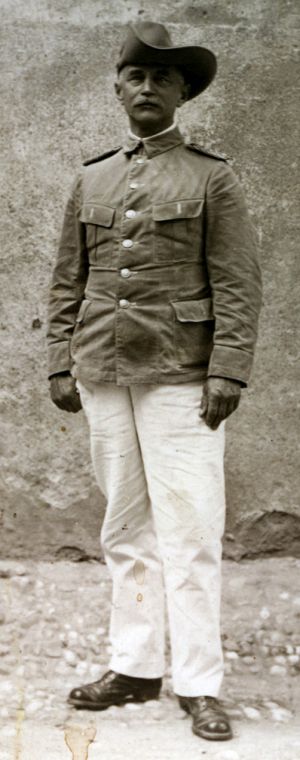
Major
Hans-Georg von
Doering,
French POW camp, Dahomey, 1916
He was the deputy governor and military commander of the
Polizeitruppe of Togo in
1914.
He wears the Schutztruppe 1896 khaki tunic without piping and with the shoulder straps of an
army
major. Note the Südwester hat probably with yellow edging for
Togo.
Photo from
Wikipedia
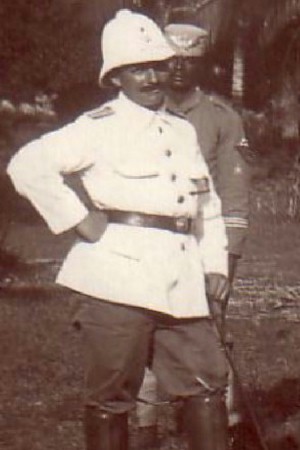
Wachtmeister
German
East African Polizeitruppe
He wears the white tropical uniform without piping, but with red
shoulder boards edged in silver lace, brass buttons and a leather other
ranks belt. His tropical helmet has a small
Imperial cockade and a brass Imperial eagle. He wears khaki riding
breeches and brown leather boots and gaiters. He appears to
be armed with a sword, though it cannot clearly be seen from this angle.
Photo
©
Tobias Weber
|
_(14762028654)polizeitruppe%20from%20wikimediamed.jpg)
_(14762028654).jpg)