|
The Diary of John Cloke, Royal
Navy
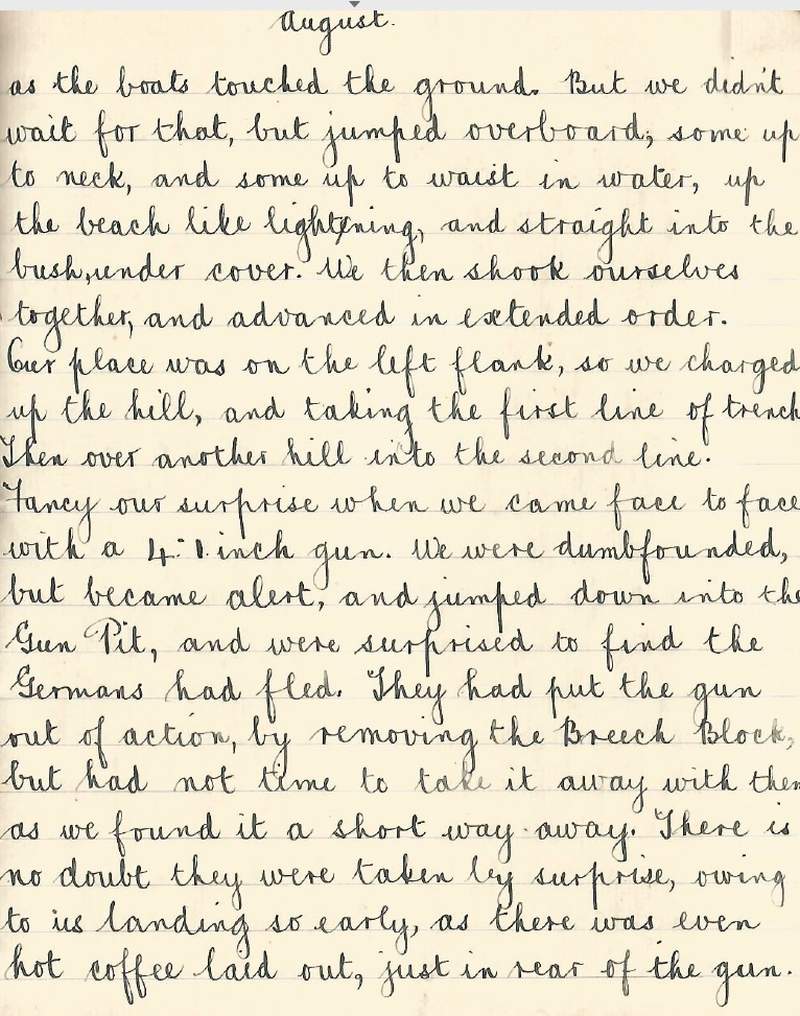
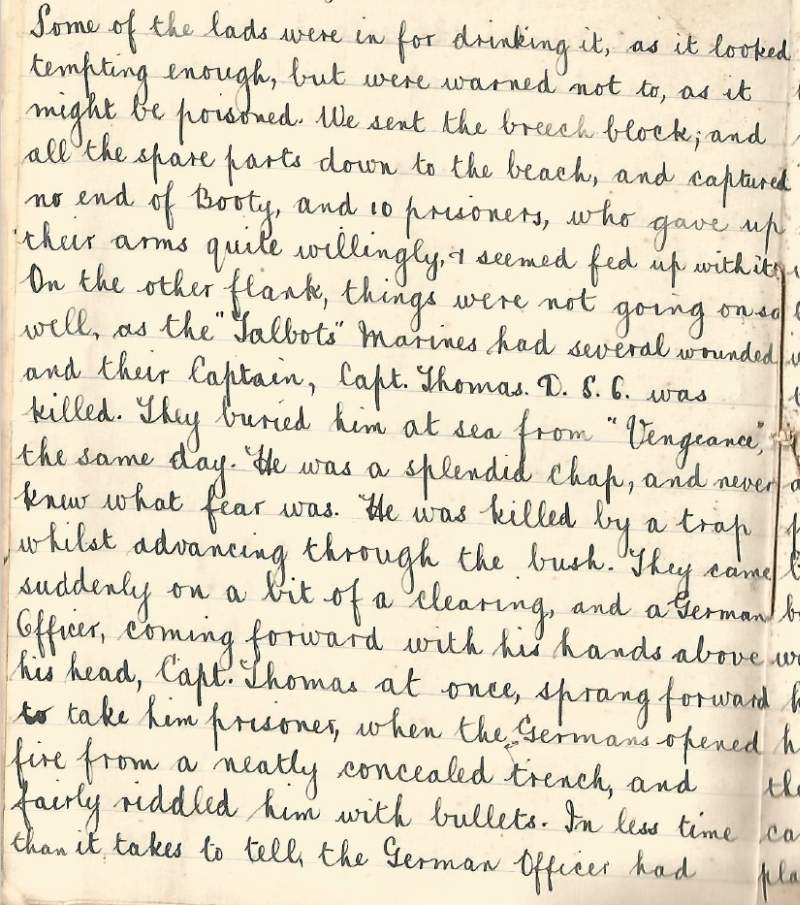
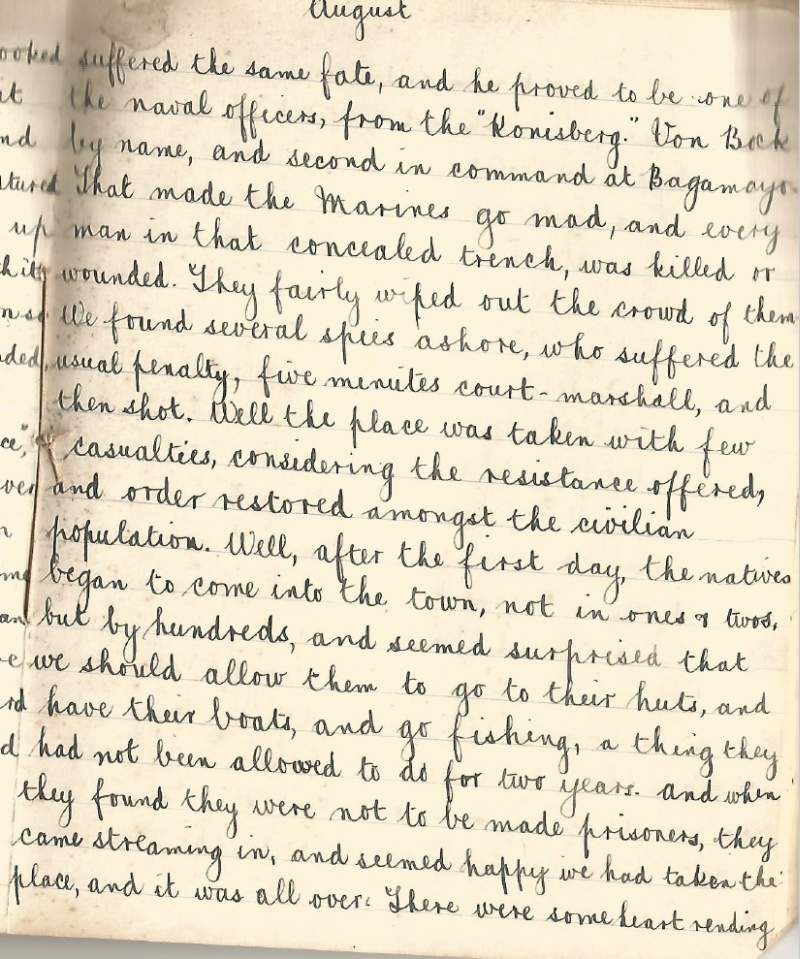
On these three pages John Cloke, a
sailor on board HMS Vengeance describes the Capture of
Bagamoyo by landing parties from the Veageance and other
ships of British Royal Navy at daybreak on 15 August
1916. See here for more on the
Capture of Bagamoyo)
Notes on the Diaries
There are several
interesting points that John Cloke raises in his diary
that are worth noting.
Assault of Bagamoyo-
Cloke confirms what other witnesses such as Sergeant
Voigt and Rating Clegg reported, in that the assault on
the German positions at Bagmoyo was very rapid and very
successful. The Germans were taken by surprise and did
not have time to put up much resistance or even finish
their coffee!
Breech Block- Cloke
tells us that the British sailors recovered the breech
block not far from the gun itself but that they took the
breech block down to the beach (presumably to be taken
back onto one of the Royal Navy ships). He doesn't
mention taking the gun to the beach. In photographs of
this gun seen later in Zanzibar, it is still missing
it's breech block so it would seem the two were never
put back together.
Poisoned Coffee-
Cloke says they found hot coffee with the gun-
"There is no doubt they
were taken by surprise, owing to us landing so early, as
there was even hot coffee laid out, just in rear of gun.
Some of the lads were in for drinking it, as it looked
tempting enough, but were warned not to, as it might be
poisoned."
This is an interesting
fear. William Clegg, another British sailor at Bagamoyo
says they went into action without breakfast and having
rushed into action up the beach, they would certainly
have been in the mood for a strong coffee. But they
hesitated as they thought it might be poisoned.
The British newspapers
had spread many stories of fictitious German atrocities
such as bayoneting babies in Belgium, shooting drowning
sailors at sea and training bees to attack in East
Africa. Having read such reports themselves, these
British sailors would have been on full alert for any
more murderous German schemes and their paranoia played
out here.
In retrospect it seems
very unlikely that if the Germans had fled under machine
gun fire, even discarding the all-important breech block
in their haste, that they probably wouldn't have had
time to be poisoning coffee in case their attackers
drank it. Those vital minutes might have been better
spent firing back at the British, disabling the gun more
permanently or simply running further away!
The Death of Bock-
Cloke describes how an officer from the Königsberg named
Bock, offered a false surrender to draw the British in
to a trap. Such an action was against the code of war
but was also very risky as Bock and his men fatally
found out. It is impossible to know for sure but Cloke's
version of events may have been mistaken, encouraged by
his already stated suspicion of German actions.
The German officer in
question was not a Königsberg officer but a regular
Schutztruppe officer, Hauptmann Wilhelm Bock von Wölfingen.
He had been
commissioned into the 117th Hessian Leib-Infantry
Regiment in 1899 and transferred to the Schutztruppe in
1907. At the time of his death at Bagamoyo he was in
command of the 3. Schützen Kompagnie of the Schutztruppe
for German East Africa.
Shooting of German Defenders- After suspecting
the Germans of foul play, Cloke describes how the
British then dealt with the remaining German defenders-
"they fairly wiped out the crowd of them". After
suspecting one false surrender the British were in no
mood to risk another it seems- "every man in that
concealed trench was killed or wounded".
Shooting of Spies-
Cloke also says "We found several spies ashore who
suffered the usual penalty, five minutes court marshal
and shot". Again it impossible to know how guilty
these suspected spies were but given the German's
surprise and hasty retreat it seems unlikely that they
would have had time to organise a network of spies to
spring up as soon as they departed. The British
behaviour sounds unnervingly similar to German actions
in occupied Belgium and France early in the war.
Overall it is interesting to
see how on the one hand fuelled by stories of German
foul play, Cloke and his comrades suspect poisoned
coffee, false surrenders and spies around them, and
other the other hand see nothing wrong with showing no
quarter to the German defenders and then executing a
number of local civilians without resorting to a fair
trial.
John Cloke (1881-1953)
was born and raised in the Cornish fishing village of
Mevagissey and joined the merchant navy in 1899. After three
years service, he returned to Cornwall to become a
fisherman and raise a family. On 4 August 1914, he
joined the Royal Naval Reserve and
served on HMS Illustrious in the North Sea and as part
of the Cape Squadron on board HMS Vengeance. Later while
on service in England, he suffered a paralysis of the
lower limbs, caused by myelitis, a disease of his spinal
cord and on 11 October
1917, was discharged from the navy as "medically unfit for further service".
He returned to his family in Cornwall and recovered
enough to resume his fishing trade. He later ran the
family home as a 'bed and breakfast' hotel and took
tourists on boat trips around Mevagissey Bay.
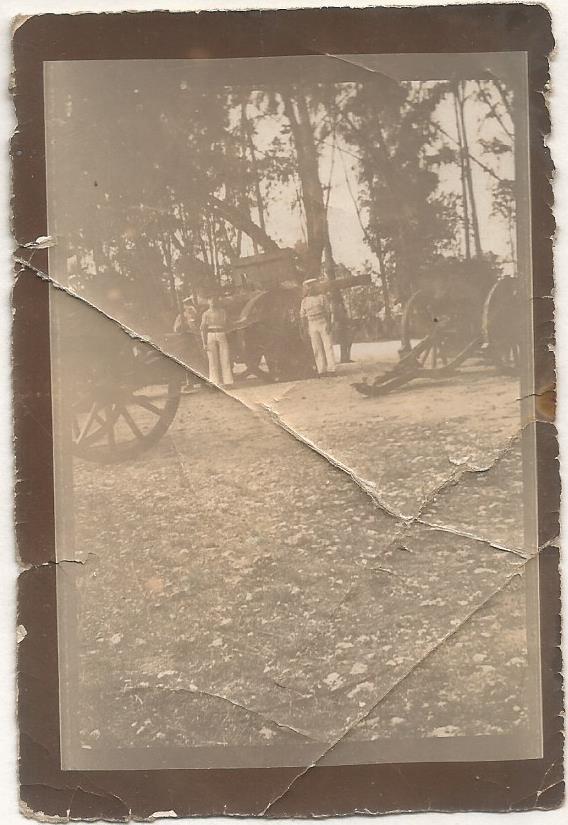
John Cloke and other
British sailors with German guns captured at Bagamoyo,
1916
Photo © Belinda
Griffiths
|