THE MYSTERY OF THE KÖNIGSBERG GUNS
IN GERMAN EAST AFRICA DURING THE FIRST WORLD WAR
by Chris Dale, Bob Wagner, Oliver Eicke and Holger Kotthaus
 

The Bagamoyo-Hove Gun
"Captured by the ships company of HMS Vengeance at Bagamoyo after a warm reception and no breakfast!"
Able Seaman William Clegg, HMS Vengeance Crew, British Royal Navy
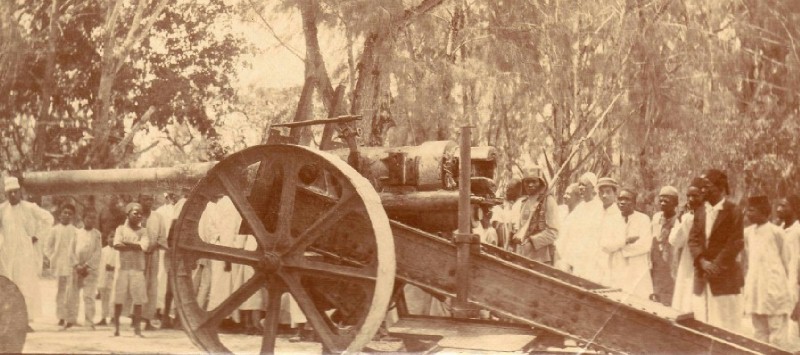

Gun in Zanzibar shortly after its capture, August 1916
Photo © William Thomas Clegg / Bob William Green

Deployment to Dar Es Salaam
This gun was originally one of the turreted guns on the SMS Königsberg. It therefore had a flange on the barrel to hold a small shield which would fit inside the turret.
The flange is clearly seen in several photographs of the gun.

The gun was commanded by Leutnant d.R. d. Matr.Art. Dr. Paul Friedrich, a naval reserve artillery officer. It was one of the five guns (along with the guns later destroyed or captured at Kondoa-Irangi, Mkuyuni, Kibata and Mahiwa) originally deployed to defend Dar Es Salaam from a fixed position on its pivot mount from July 1915.

Deployment to Bagamoyo
General Smut's South African and British Offensive had begun in March 1916 around Kilimanjaro capturing Kahe and Moshi. In April General van Deventer had reached Kondoa-Irangi where he was temporarily held in checked by von Lettow-Vorbeck's Schutztruppe and the onset of the rainy season. In June Smuts had captured Handeni and the following month van Deventer resumed his advance on Dodoma. The Germans were slowly being pushed south towards their Central Railway line.

The port of Bagamoyo had been the original capital of German East Africa until 1891 but was now a far less important town than the new capital of Dar Es Salaam. Dar Es Salaam had a better deep water harbour and since 1905 had been the eastern terminus of the Central Railway. Nevertheless, being on the coast directly opposite the British Protectorate of Zanzibar, Bagamoyo was vulnerable to attack and a British landing there would force the Schutztruppe to retreat further towards their crucial Central Railway line.

In preparation to defend against a possible assault by the Royal Navy, one of the 10.5cm SMS Königsberg guns at Dar Es Salaam was fitted with one of the new Krupp carriages and gun shields that had arrived on the SS Marie and sent to the port of Bagamoyo in August 1916.

Von Lettow-Vorbeck's risk in transferring the gun to Bagamoyo was that this now left only two of the original five guns to defend Dar Es Salaam itself from British warships, two of the guns having earlier left for Kondoa-Irangi and the Northern Front.

The Storming of Bagamoyo
On 15 August 1916 British ships bombarded the town and landed sailors from the besieging ships along with soldiers from the Zanzibar company of the Kings African Rifles. They stormed Bagamoyo and captured the gun (after the Germans had removed the breech block).
Rudolf Viehweg, one of the sailors of the SMS Königsberg described how he was told about the fall of Bagamoyo and its guns (the Königsberg 10.5cm and a 3.7cm Revolver Cannon from SMS Möwe) by an eyewitness to the events-

"After the meal of roast chicken on a skewer and mohogo (cassava), the boys had mutton and rice, we all sat together with the exception of those posted to the telephone hut. Bwana Voigt, a humorous Sergeant d. R., then told of the conquest of Bagamoyo:

"On 14 August at 3 o'clock in the morning I awoke to a message from the telephone- "Ship!". Nothing had been seen but the rattle of anchor chains had clearly been heard. The artillery and Hauptmann von Bock was notified. He came immediately and yet could not see anything even with binoculars. Everything was in place. The defenders were the 3. Schützenkompanie- 25 Europeans and 160 askaris with '71 rifles under Hauptmann von Bödicker (sic. Bodecker) with semi-trained Ruga-Ruga and some askaris from the Abteilung Bagamoyo under chief mechanic Bachmann with 15 whites and 30 blacks. All in all there were 60 whites and 300 blacks."
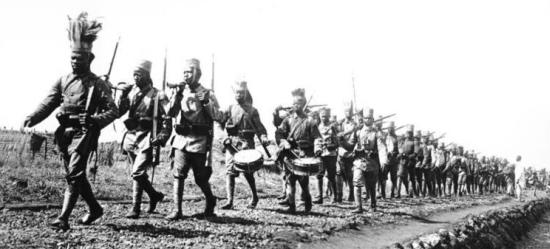

German Schutztruppe Askaris on the March, c1916
Photo by Walther Dobbertin from Bundesarchiv / Wikimedia

"However, the Abteilung Bagamoyo was not here, but two hours on the road to Ruvu. A half-platoon of the 3. Schützenkompanie with a machine gun was three hours north of the Wami ferry. The six kilometre long beach front was defended by the following troops- to the South was the 10.5 cm gun with a half platoon of askaris as cover; another platoon of askaris was below the Boma; the Northern flank was held by Hauptmann von Bödicker with his people. The force was too weak to resist.

At to 5 o'clock cannon and machine gun fire opened up. The English took their boats to the beach in three groups. The landing party in the centre was repulsed three times with the help of the gun. A direct hit put the revolver gun out of action. On the left flank, the English were already ashore and had overwhelmed the gunners along with the cover. Machine gun fire opened on the 10.5cm gun from three sides. Then the call went up- "Save yourselves if you can!"

No other solution was possible here; thus the Tommies captured the cannon. On the right flank the Ruga Ruga had thrown in the towel after the first shells and fled into the grain fields. Hauptmann von Bödicker with some askaris defended himself to the last. The English conquered the customs building. Both captains by now had already fallen. The battle raged until 4pm. Every street was defended with heavy losses on both sides. When darkness fell, our troops moved back to Kuvimu, two hours from Bagamoyo'' So Bwana Voigt finished his report."
(Quotation from P128-129 "Unter Schwarz-weiss-rot in fernen Zonen; Erlebnisse eines Matrosen auf dem Kreuzer Königsberg sowie im Feldzug 1914-18 in DOA" by Rudolf Viehweg, published by Buchhandel Krüger & Co, Leipzig 1933)

In 'Navy Everywhere' by Conrad Gato, the action at Bagamoyo is described- "As soon as our men had landed, Sub-Lieutenant Manning was sent in charge of a machine-gun section to rush the hill and capture the 4.1. This he did very skilfully, taking cover as soon as he reached the top of the rise, and peppering the Germans relentlessly, until they abandoned their gun and took to their heels."
(Quotation from P158 "Navy Everywhere" by Conrad Gato, EP Dutton & Co., New York 1919 at Archive.org and Naval-History.net)
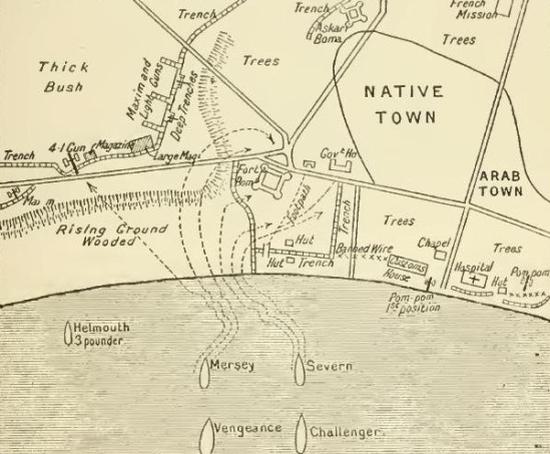

Storming of Bagamoyo, 15 August 1916
Note the 4.1" Königsberg Gun to the left of the map with a clear and dangerous view over the landing ships.

(Map originally from "Navy Everywhere" by Conrad Gato, EP Dutton & Co., New York 1919

John Cloke,  a British sailor who took part in the assault described the storming in his diary- "... the boats touched the ground. But we didn't wait for that but jumped overboard, some up to neck, and some up to waist in water, up the beach like lightning, and straight into the bush, under cover. We then shook ourselves together, and advanced in extended order. Our place was on the left flank, so we charged up the hill into the second line.

"Fancy our surprise when we came face to face with a 4.1 inch gun. We were dumbfounded, but became alert, and jumped down into the Gun Pit, and were surprised to find the Germans had fled. They had put the gun out of action, by removing the Breech Block, but had not time to take it away with them as we found it a short way away. There is no doubt they were taken by surprise, owing to us landing so early, as there was even hot coffee laid out, just in rear of gun.

"Some of the lads were in for drinking it, as it looked tempting enough, but were warned not to, as it might be poisoned. We sent the breech block: and all the spare parts down to the beach, and captured no end of booty, and ten prisoners, who gave up their arms quite willingly."
(Quotation from John Cloke's unpublished diaries, 1916. Click here for the full text of John Cloke's diaries related to the assault on Bagamoyo and alleged war crimes.)
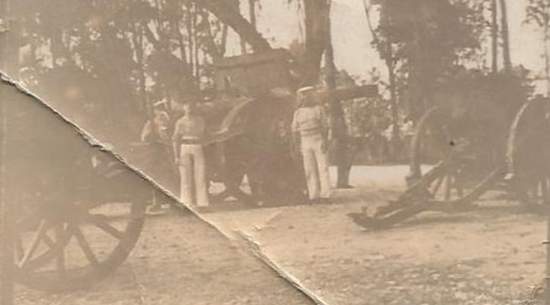

Photograph of the German guns captured at Bagamoyo
The 10.5cm Königsberg gun is in the centre surrounded by British sailors.
(Photo © Belinda Griffiths, John Cloke's Great Granddaughter)

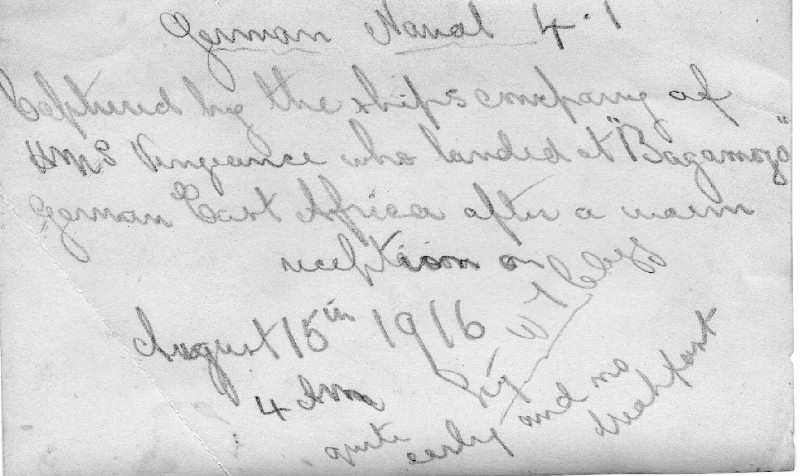
Another British sailor William Clegg, who also took part described it more briefly on a postcard- "German Naval 4.1 (was) captured by the ships company of HMS Vengeance who landed at "Bagamoyo" German East Africa after a warm reception on August 15th 1916 4am quite early and no breakfast".
(Quotation from a postcard written by William Clegg, 1916)

The ship's log for the HMS Vengeance, ship's log for the morning of 15 August records-
"03.24am: Stopped let go port anchor in 9 fathoms veered to 3 shackles off Bagamoyo.
04.40am: Landing party of 24 marines, 123 seamen, 11 native boys under the command of commander Watson R.N. left ship.
05.30am: Monitors and small craft opened fire on beach. Shore returning fire: H.M.S. ‘Vengeance’ & ‘Challenger’ firing to right of town: Landing party occupied Governors house and hoisted Union Jack."
(Quotation from HMS Veangeance Ships Log 1916 on NavalHistory.net)

By the 21 August the HMS Vengeance had moved on to bombard the remaining Königsberg gun positions at Dar Es Salaam.
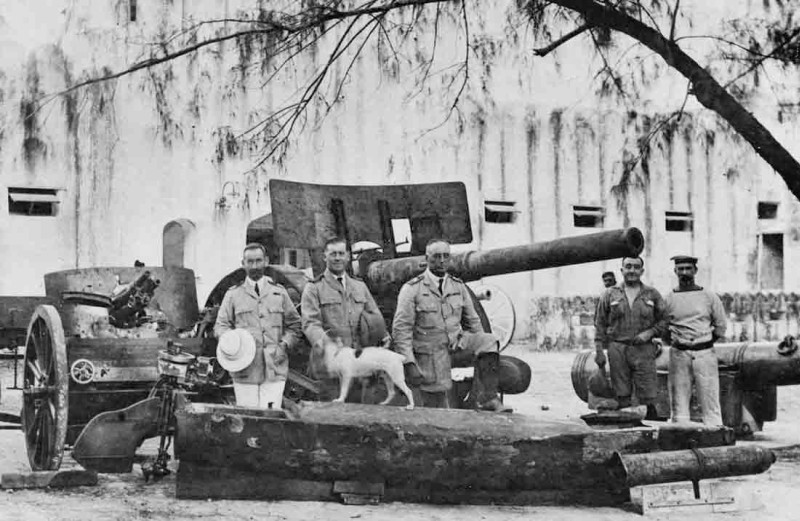

Captured German Guns with three Senior British officers in Zanzibar, 1916
From left to right they are: Sir Horace Byatt later governor of Tanganyika, Comander RJN Watson who led the landing party at Bagamoyo and Admiral Sir Edward Charlton commander of the British Royal Navy Cape of Good Hope Station. In the background are the walls of the
Old Fort in Zanzibar.
Photo from Australian War Memorial

Post War Display
The gun at Bagamoyo had therefore become the fourth of the ten 10.5cm Königsberg guns to be put out of action  Unlike other 10.5cm Königsberg guns the German gun crew had not had time under machine gun fire to dynamite the gun before abandoning it. They had simply removed the breech block and run. This was then the most intact Königsberg gun to be captured and as such was a fine trophy.

It was initially believed and commonly reported (for example in Kevin Patience's very helpful book, 'Königsberg- An East African Raider') that the Gun on display at Fort Jesus in Mombasa was the one captured at Bagamoyo. At first glance this seemed quite plausible, both had barrel flanges and Krupp carriages. On closer inspection, the Mombasa gun did not have the aiming sight, elevation mechanism and gun shield that were captured in Bagamoyo, though these could have possibly been discarded before it was displayed at Fort Jesus.

However 'Navy Everywhere' by Conrad Gato seemed to doubt that this gun went to Mombasa. Gato, served in the Royal Navy during the First World War and soon afterwards published several volumes of the history of the Royal Navy in the Fist World War. Gato records the gun at Bagamoyo and where it went next-

"In addition to the gun, over 80 rounds of ammunition were found in the magazine nearby and a few days later both gun and ammunition were shipped to Zanzibar, where they were on view to admiring crowds of natives. In the autumn of 1918 this gun was exhibited in the Mall near the north door of the Admiralty."
(Quotation from P158 Footnote "Navy Everywhere" by Conrad Gato, EP Dutton & Co., New York 1919 at Archive.org and Naval-History.net)

There are a series of photos in the Imperial War Museum collection that are captioned as the Königsberg gun captured at Bagamoyo. We initially assumed the building in the background then to be the German Boma or possibly the old Arab Fort at Bagamoyo but closer examination of these photos showed that it was actually the Old Portuguese Fort at Zanzibar. This seemed to support Gato's story of the gun going from Bagamoyo.

The photos from Zanzibar show that the gun was put on display alongside various ancient cannons and other recently captured German war material including the damaged 37cm revolver cannon captured at Bagamoyo and a curious canoe with improvised torpedoes attached. Local crowds gathered and British officers had their photograph taken with the trophy.

Gato's account of the gun then going from Zanzibar to the Mall in London, would also explain the photograph showing a Königsberg gun in the collection of the Imperial War Museum in London in the 1920s. Indeed further searches showed in the Imperial War Museum's accession register that a gun from the SMS Königsberg was acquired from the Admiralty on the 24 July 1918.
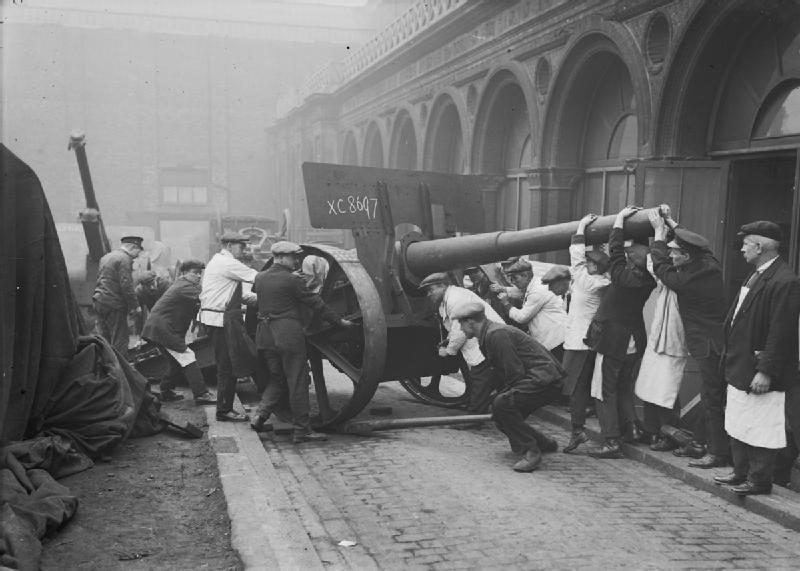

10.5cm SMS Königsberg Gun in London, England 1924
Photo © Imperial War Museum

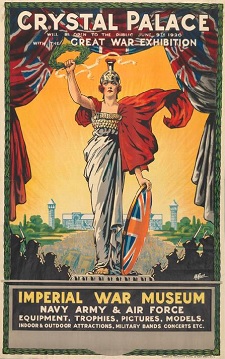
The gun was displayed at the Imperial War Museum's original site at Crystal Palace which opened on 9 June 1920 but in 1924 the museum moved to a smaller premises at the Imperial Institute in South Kensington and the gun could no longer be displayed. The museum then needed to dispose of much of its collection (including possibly also a gun from the German ship Nachtigal, captured in Cameroon which had also previously been in the museum's collection but has not been seen since). A document in the Imperial War Museum's entitled 'Trophies: Naval, Disposals' refers to "Correspondence and associated papers relating to the disposal of items held by the Naval Section of the Museum. 6 subfolders as follows: ... 2 Gun from the German Cruiser Konigsberg. 1927-1928"
(Quotation from Imperial War Museum Archives)

Around that time Viscount Francis Curzon, a Captain in the Royal Naval Volunteer Reserve requested the gun for display at their headquarters in Hove, Sussex. His request was granted on 17 April 1928 and three days later it arrived by train at Hove Railway station and was taken to the RNVR headquarters at the Hove Coast Guard Station.

The arrival of the prestigious gun in Hove caused quite a stir in the Sussex Daily News at the time- "The RNVR Battery at Hove, already proud of its war relics, has been still further enriched by the addition of a gun, which played an important part in East Africa during the Great War. Through the instrumentality of Captain Viscount Curzon, the Battery has secured from the War Museums Committee possession of a 4.2 gun, which is believed to have wrought considerable havoc in the course of the destruction of the German cruiser Königsberg in German East Africa.

The ship like the notorious Emden found some strange hiding-places. She cruised around the Pacific, traversed the rivers, and hid behind the towering palms with which the waters in this part of the world abound, and from these secluded spots she sent raiding parties into the most unexpected quarters.

It was while in one of these obscure spots that the Königsberg was discovered, and her commander immediately decided upon an action, which must be commended for its cleverness. He had the gun – now in the safe keeping of the RNVR Battery at Hove – dismounted from the ship, placed on a gun carriage made from parts of the vessel, the wheels being portions of the engine, and transferred it to the shore for defensive purposes.

One remarkable feature of the gun is it has an axle about nine inches square, encased with steel strips to ensure greater strength – a feat of engineering under difficulties very credible to the ship’s crew. It is a matter of history that the Königsberg was eventually destroyed, and members of the Hove RNVR are naturally proud of this relic from a notable naval incident of the war."
(Quotation from an article from the Sussex Daily News, 21 April 1928)

The gun was displayed on the RNVR parade ground at hove along with its gun limber until the 1930s. The last known photograph of the gun is from 1934 and no sightings have been confirmed since then.

It may well be that the gun was scrapped during the Second World War along with many other trophies of the First World War. Ironically the last resting place of the gun in Hove was only a short walk from where one of the many characters who played a part in the sinking of the SMS Königsberg grew up.
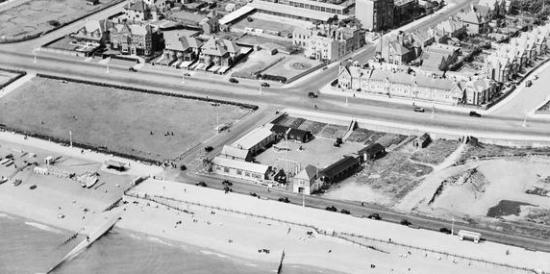

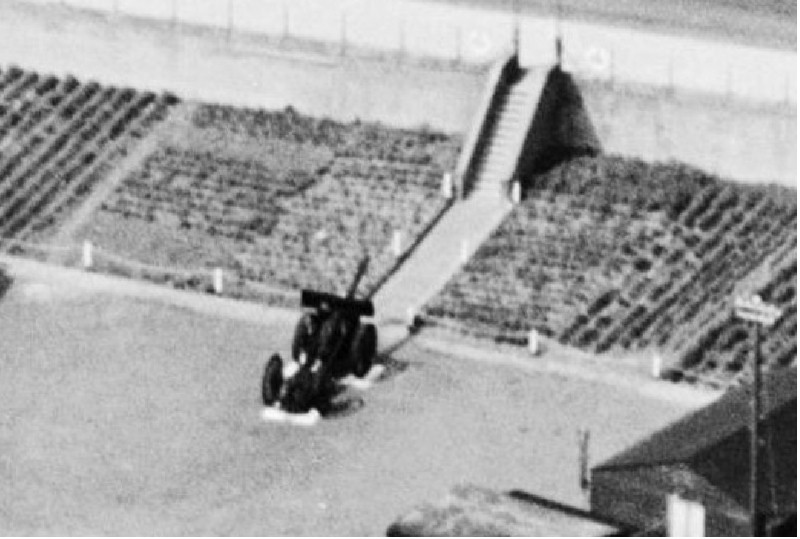
Hove from the Air 1933
In the centre of the photograph is the parade ground of the RNVR, the black shape in the middle of the parade ground is the Bagamoyo gun. This is one of the last known photographs of the gun.

Photo © Britain From Above

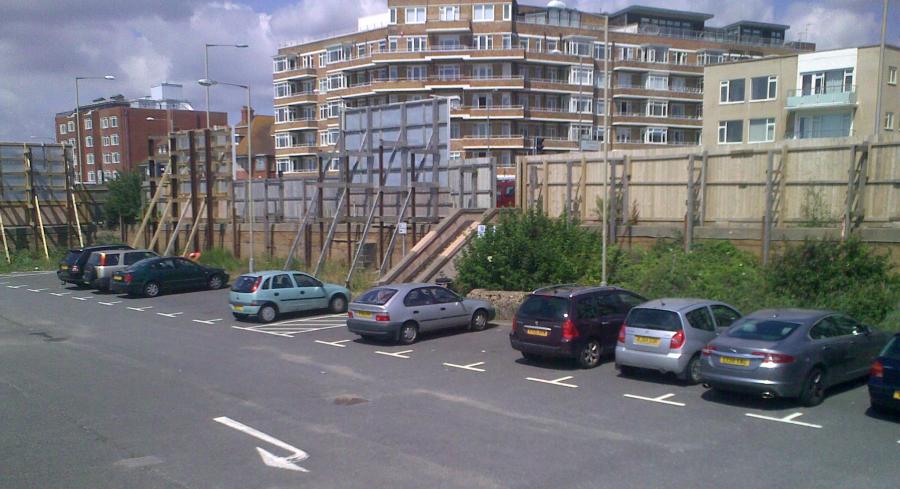
In the late 1930s a leisure centre was built next to the RNVR parade ground. During the Second War War this was used as a training base for naval officers as titled HMS King Alfred. After the war the base was returned to use as a public leisure centre and swimming baths, now known as the King Alfred Centre. The site of the former RNVR parade ground where the Königsberg gun captured at Bagamoyo, once stood is now the car park for the leisure centre. The area is due for redevelopment in 2017.


INTRODUCTION
Mystery of the Ten Guns
SMS Königsberg & WWI in East Africa
10.5cm SK L/40 Naval Guns
Deployment of the Guns on Land

HISTORIES OF THE TEN GUNS
The Railway Gun - Tanga to Kahe
'
Big Bertha' - Dar to Kondoa-Irangi
The Lake Victoria Gun - Mwanza
The Hove Gun - Dar to Bagamoyo
The River Gun - Dar to Mkuyuni
The SS Goetzen Gun - Kigoma to Korogwe
The Elephant's Foot Gun - Kigoma to Tabora
Apel's Gun - Dar to Kibata
Wenig's Gun - Dar to Mahiwa
The Last Gun - Tanga to Masasi
and the
Two 8.8cm Naval Guns

One 6cm Landing Gun


CONCLUSIONS
Last of the SMS Königsberg
Mystery of the Mombasa Gun
Mystery of the Pretoria Gun

WEBSITE
Return to Index Page
Credits, Sources and Links
On-Going Research Forum at AHF
Contact
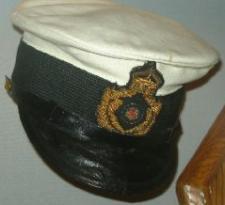
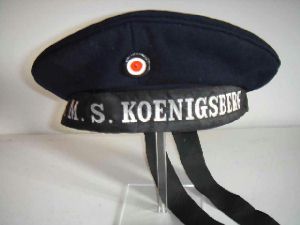
German Colonial Uniforms


Dr. Paul Friedrich
Paul Friedrich was born in Saxony and  entered service as an officer in the naval artillery in 1908. By 1914 he had left the navy and was a dentist in Dar Es Salaam. In November 1914 he was called up as a naval reserve officer (
Leutnant der Reserve der Matrosen Artillerie and given command of a Schutztruppe 4.7cm gun at Bukoba. On 22 March 1916 he was promoted to Oberleutnant der Reserve. He was gun commander of the 10.5cm Königsberg gun at Bagamoyo. In November 1916 he was badly wounded at Newala, and was later captured by the British. He was held while ill at Kahama and later at Dar Es Salaam. After the war he returned to Germany and officially left the navy in 1920 having been awarded the Prussian Iron Cross, 2nd class and the Saxon Knights Cross of the Order of Albrecht for his service in East Africa. He later became a dentist in Dresden.


Rudolf Viehweg
Viehweg was one of the sailors on board the SMS Königsberg and served throughout the campaign in East Africa being captured shortly before the end of the war and spending time as a prisoner of war in Malta. After the war he wrote his memoirs as "
Unter Schwarz-weiss-rot in fernen Zonen; Erlebnisse eines Matrosen auf dem Kreuzer Königsberg sowie im Feldzug 1914-18 in Deutsch Ost-Afrika" which were published in 1933.


Ernst von Bodecker
Bodecker was a retired army officer, who had originally been commissioned into the 2nd Prussian Grenadier Guards Regiment in 1898.  At the outbreak of war in 1914 he was a plantation owner in Mikindani in the south of German East Africa but soon rejoined the ranks as Hauptmann d. R. and company commander in the East African Schutztruppe. He was in charge of the German garrison at Bagamoyo in August 1916 and was killed in action during the town's defence.

(Photo from "Das Offizierskorps der Schutztruppe für Deutsch-Ostafrika im Weltkrieg 1914-1918" by Wolfgang-Eisenhardt Maillard and Jürgen Schröder)


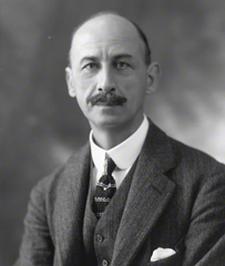
Sir Horace Byatt (1875-1933)
Horace Archer Byatt was born in London, graduated from Oxford University and went onto a career in the Colonial Office. From 1898 he served in Nyasaland, from 1905 in British Somaliland (which he was appointed commissioner of in 1911) and was given the job of Colonial Secretary in Gibraltar in 1914. In 1916 he was sent to German East Africa to act as administrator of the British controlled areas. In 1920 he was officially appointed as the first British colonial governor of Tanganyika. He later became Governor of Trinidad and Tobago 1924-29. Byatt also has the honour of having a subspecies of East African squirrel named after him. The Kilimanjaro bush squirrel is titled in Latin as;
Paraxerus vexillarius byatti.
(Photo
© National Portrait Gallery)


Commander RJN Watson

Watson served on HMS Vengeance under Captain Williams from December 1915, while she was being repaired in Devonport after serving in the Gallipoli campaign. Watson commanded the ship's landing parties that took Sandaani on 1 August 1916 and Bagamoyo on the 15th. The ship's log records that him and the landing party returned to the ship on the 20th. He transferred back to the home fleet at Dover after operations in East Africa and in April 1918 he commanded the monitor Lord Clive, during the Zeebrugge Raid and was mentioned in dispatches. After the war he transferred to the Australian navy and commanded the HMAS Melbourne.
(Photo from Australian War Memorial)


Admiral Sir Edward Charlton
(1865-1937)
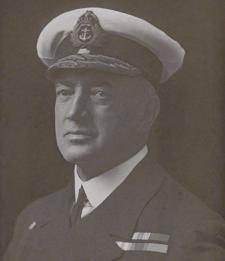
Edward Francis Benedict Charlton joined the Royal Navy in 1878 and first saw action in 1882 in the Anglo-Egyptian War. He was promoted through officer ranks, becoming Captain in 1903 and later Admiral. In the First World War his first command was that of minesweepers off the east coast of England. In 1916 he took command of the Royal Navy Cape of Good Hope Station, tasked with actions on the East African coast, from Admiral King-Hall. In this role he commanded the operations at Bagamoyo in August 1916. He was replaced as station commander by Admiral Edward Fitzherbert in May 1918 and retired from the Royal Navy in 1924.
(Photo © National Portrait Gallery)


Sultan
Khalifa II bin Harub
of Zanzibar (1879-1960)
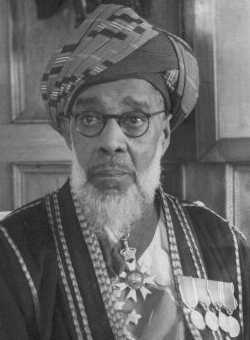
Zanzibar was a British Protectorate rather than a direct British Colony, therefore the Sultan of Zanzibar maintained nominal rule over the island. The rule of the Sultan was however purely with Britain's permission, as had been proven in 1896 when the Royal Navy conducted the shortest war in history as they bombarded the Sultan's Palace in protest at a new Sultan, Khalid bin Barghash seizing the throne of Zanzibar without Britain's approval. After thirty-eight minutes of naval bombardment, the Anglo-Zanzibar War officially ended when Sultan Khalid raised the white flag and fled to German East Africa. Future Sultans of Zanzibar proved to be much more compliant to Britain's demands. Sultan Khalifa reigned in Zanzibar from 1911 until his death in 1960. In 1964 a revolution forced the Sultan to abdicate this throne and Zanzibar joined the new Republic of Tanzania as a semi-autonomous region.
(Photo from RoyalArk)


Francis Curzon (1884-1964)
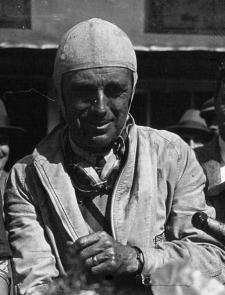
Curzon was born into the family of the Earls of Howe (a title he inherited in 1929). With the title of Viscount Curzon, he served in the Royal Navy and in 1907 was given command of the Royal Naval Volunteer Reserve in Hove. During the First World War he commanded the Naval Battalion Howe in Gallipoli and France and also served as Aide-de-Camp to King George V on occasion. After the war he resumed command of the Royal Naval Volunteer Reserve at Hove and pursued careers in politics and later racing cars. As a politician he served as Conservative ervative Member of Parliament for Battersea South from 1918. In Racing Car driving he won the famous Le Mans 24 hour race along with Tim Burkin in 1931 (the photograph above shows him after that victory). And as the commander of the Royal Naval Volunteer Revere in Hove it was he that arranged for the Königsberg gun to be transferred from the Imperial War Museum to their parade ground in Hove in 1928.
(Photo from Agence de presse Meurisse‏/ Bibliothèque nationale de France)


Poster for the Imperial War Museum at Crystal Palace, 1920
Image © Imperial War Museum


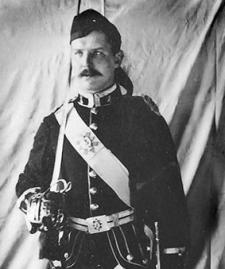
Gerard Hudson (1874-1948)
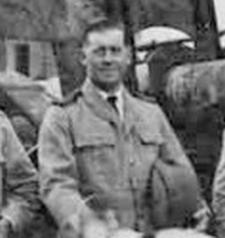
As a child, Gerard Hudson grew up at No 9 The Drive in Hove, literally just a walk around the corner from where the Bagamoyo gun was later displayed. He was an electrical engineer by trade and after qualifying, moved to South Africa to work as an engineer in the diamond mining industry. He also had a keen interest in aviation and in 1913, purchased two Curtiss Flying Boats in England and had them shipped to South Africa where they flew at Cape Town and Durban. After the outbreak of war, the two planes were requisitioned by the Royal Navy and used to spot the position of the SMS Königsberg in the Rufiji Delta. While the planes proved essential for the Royal Navy in destroying the Königsberg they also suffered severe wear and tear and damage from enemy gunfire. Nevertheless, the planes were returned to Hudson after their wartime use.

(Photo © Frank Du Plessis . This photograph most likely shows Hudson in the uniform of the Cape Town Highlanders Regiment. Biographical information on Hudson from an Article on MyBrightonAndHove by Frank du Plessis)


PHOTO GALLERY


10.5cm SMS Königsberg Gun in Zanzibar shortly after its capture at Bagamoyo, August 1916
Note the straight Krupp carriage fitting above the axle, the Krupp wheels with eight struts, the gun shield (in this photo only partially positioned), the aiming post on its left side and below it the fixed plate for gunners to stand on. All these are unique features of the Krupp carriages. The breech block has been removed by the Germans before they abandoned the gun. In the background are curious locals while an askari of the Zanzibar Company of the Kings African Rifles stands guard with an old Martini Henry rifle.

This photograph was in the collection of Able Seaman William Thomas Clegg RN who was a member of the Landing Party of HMS Vengeance that stormed Bagamoyo. The photo has kindly been shared with us by his grandson, Bob William Green.
Photo © William Thomas Clegg / Bob William Green


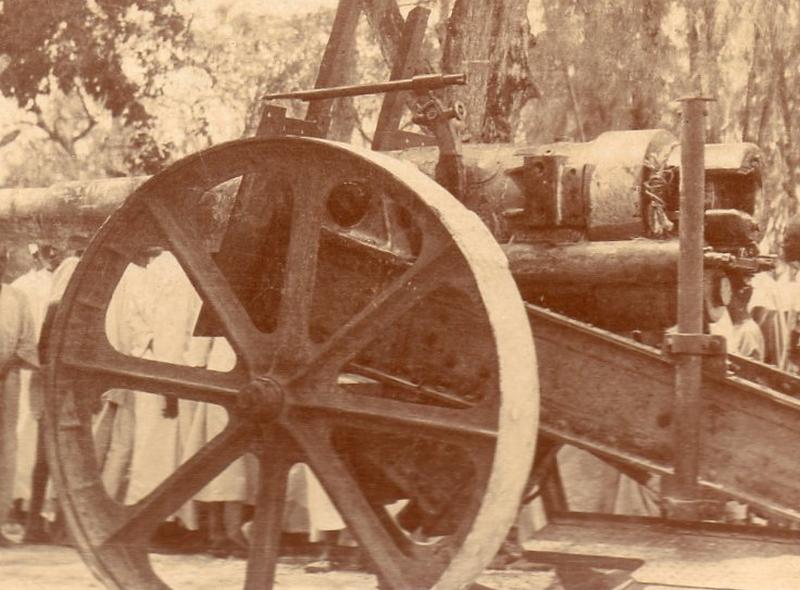
A close up of the 10.5cm SMS Königsberg Gun captured at Bagamoyo
This close up of the gun shows several interesting features: the Krupp wheel and straight carriage with its shield partially attached, the sighting arc on the near side, the recoil pistons below the barrel, the sighting post and gunner's platform on the right hand side. Note that the breech seems to be wrapped in string, which may be the gun's firing lanyard. Note also the left aiming sight still in position attached only its adjustable rear sighting arm. The forward part of the sighting arms was usually attached to the gun bucket on its original naval pivot stand. While the gun bucket and therefore the forward part of the sighting was retained on the Dar Es Salaam made gun carriages, the Krupp carriages had the trunions of the gun cradle mounted directly onto the carriage and so had no attachment for the forward sighting arm.
Photo © William Thomas Clegg / Bob William Green


Handwritten Notes on the Capture of the 10.5cm SMS Königsberg Gun at Bagamoyo
William Thomas Clegg's handwritten notes on the reverse of the photograph above. The cards reads "German Naval 4.1 Captured by the ships company of HMS Vengeance who landed at Bagamoyo German East Africa after a warm reception on August 15th 1916 4am quite early and no breakfast - Rtg WT Clegg". 4.1 refers to the calibre of 10.5cm in English inches.
Photo © William Thomas Clegg / Bob William Green


10.5cm SMS Königsberg Gun and other Captured Weapons at Zanzibar, 1916
This photograph shows British officers posing outside the Old Fort in Zanzibar with two German guns captured at Bagamoyo in August 1916. From left to right they are: Sir Horace Byatt later governor of Tangayika (Note the medal ribbon on his left breast. It is most likely includes the blue/red/blue ribbon of a Companion of the Order of St Michael and St George (CMG) which Byatt was awarded in 1912), Comander RJN Watson who led the landing party at Bagamoyo and Admiral Sir Edward Charlton commander of the British Royal Navy Cape of Good Hope Station. On the left of the photograph is the 3.7cm Revolver Canon, in the centre is the Königsberg gun, note the shield with sighting hole on the left side. The aiming sight can be seen through the sighting hole.

In the foreground is a very curious boat described in the original caption on the AWM website as "a native canoe captured at Lake Victoria Nyanza near Muvanja; a torpedo had been built into the body of the canoe and a detachable motor mounted on the stern". Could this photo be the inspiration for the fictional boat's armament in the film, 'African Queen'?
Photo from Australian War Memorial


Similar Use of Improvised Torpedoes in the 1951 Film "The African Queen" starring Humphrey Bogart and Audrey Hepburn
Image © United Artists


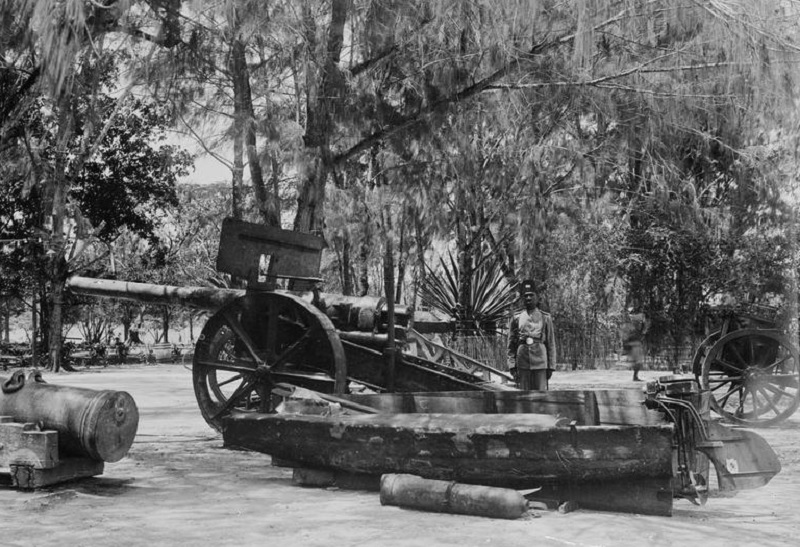
Another view of the Captured 10.5cm SMS Königsberg Gun at Zanzibar, August 1916
Once again details of the Krupp gun carriage can be seen clearly such as the eight strutted wheels, gun shield and sighting post. In the foreground is the canoe with its home made torpedo next to it. The crowds in the previous photos seem to have dissipated now and the gun is watched over only by an askari of the Zanzibar Company of the Kings African Rifles, wearing a red fez and khaki uniform.

Photo © Imperial War Museum


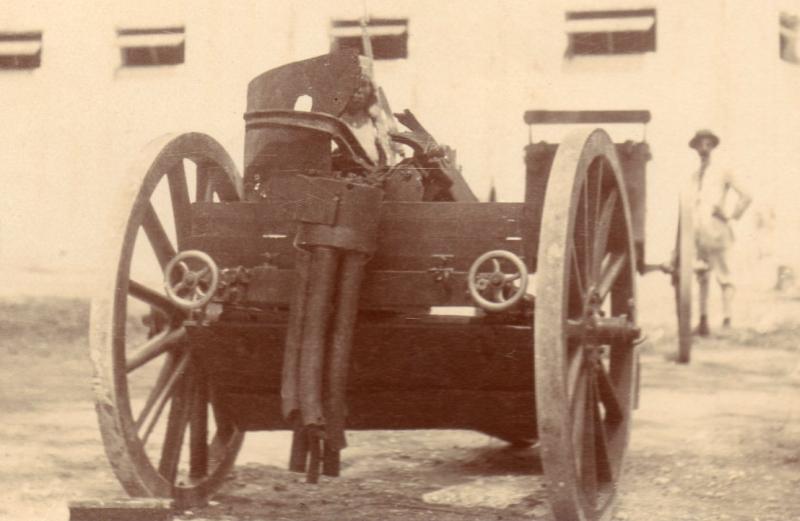
German Pom-Pom Gun that took a Direct Hit at Bagamoyo
The gun itself is a 3.7cm Hotchkiss Revolver cannon, from the SMS Möwe. Like the Königsberg guns it would have been originally pivot mounted while on board ship. It appears to have been temporarily mounted on the carriage for a C73 field gun of which the Schutztruppe in East Africa had a number since 1889. Unsurprisingly, many of the Schutztruppe's C73 guns had fallen out of repair in their twenty five years in Africa before the First World War broke out so there were gun carriages to spare. Attempts were made to mount the Königsberg's lighter 8.8cm guns on these carriages but the guns proved too powerful for the carriage to withstand. This carriage has some planks of wood fitted across the front which may have prevented the enemy seeing the gun crew but evidently did not protect the gun from a direct hit by a naval shell at Bagamoyo. This photograph was taken in Zanzibar.

Photo © William Thomas Clegg / Bob William Green


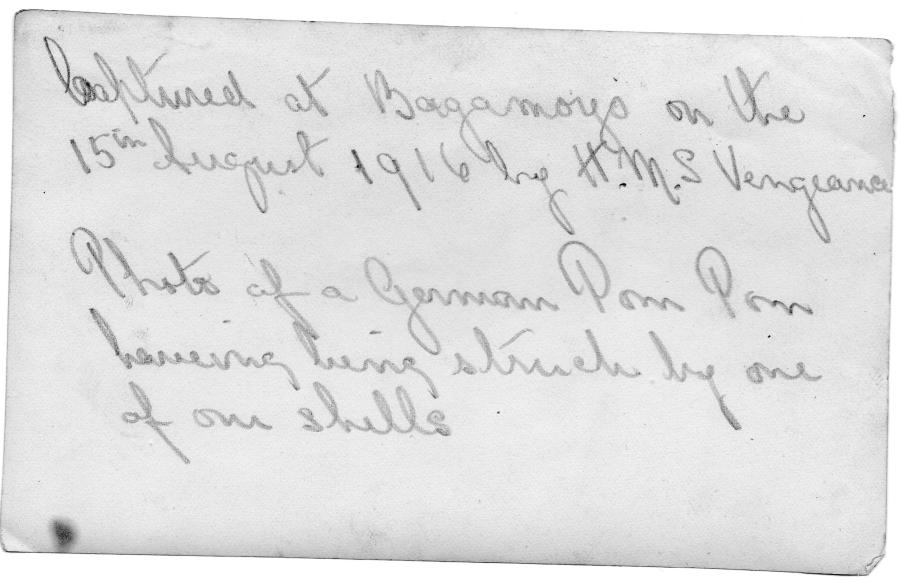
Handwritten Notes on the Pom-Pom Gun at Bagamoyo
William Thomas Clegg's handwritten notes on the reverse of the photograph above. The cards reads "Captured at Bagamoyo on the 15th August 1916 by the H.M.S. Vengeance. Photo of a German Pom Pom having been struck by one of our shells".
Photo © William Thomas Clegg / Bob William Green


The 10.5cm Gun Being Towed by Askaris and Sailors through Zanzibar after its Capture at Bagamoyo, August 1916
Photo © Imperial War Museum Collection


The Bagamoyo Gun in London, England 1924
This photograph was taken when the
Imperial War Museum moved its collection from its original location in Crystal Palace to its second location in South Kensington. It shows workmen manhandling the gun and gives an idea of the struggle involved in moving such a heavy weapon. Note this view of the gun clearly shows the Krupp shield, with aiming hole on the gun's left side and specially widened Krupp wheels. The straight Krupp carriage can also be made out as can the barrel flange.
Photo © Imperial War Museum


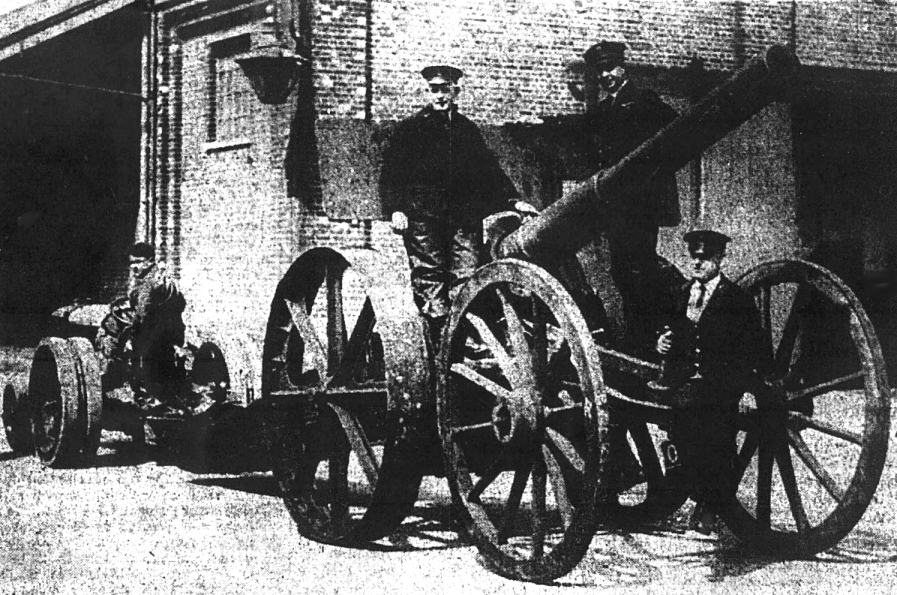
The Bagamoyo Gun in Hove, 19 April 1928
The caption to this photograph from the Sussex Daily News, 20 April 1928, erroneously describes the gun as being from the Boer war. "The above naval gun weighing seven tons, attached much attention in Hove yesterday during its removal from the railway station to the headquarters of the RNVR at the Hove coastguard station. It is a relic of the South African War."

This photo seems to have been taken at Hove Railway Station, before the gun was towed down the steeply sloping road to the RNVR station. The gun has no shield, yet it was seen before in London and afterwards on the RNVR parade ground with its shield. It may have been removed for the train journey as an un-streamlined danger to low bridges or other obstacles and then replaced on arrival at the parade ground.

On the right, in front of the gun is the gun limber. This would normally be placed under the other end of gun carriage to support its weight during transport. This gun carriage appears to have the old style Krupp wheels as used on the C73 canon that were in German East Africa and that may well be its origins. The Krupp carriages that arrived in German East Africa on board the SS Marie did not have limbers of their own and so limbers were improvised in Dar Es Salaam from other artillery and farm machinery. The gun was later displayed on the RNVR parade ground facing north with its limber in the correct place.

The man on the far right is wearing the uniform of the Southern Railway (See Still There Page on Samual Walder for another example of a South Railway uniform of the period) and may well be the station master. Standing on the gun above him, also to the right side of the photograph is a naval officer, presumably from the RNVR base at Hove, it may well be Captain Curzon and the face does look very similar to his. In the centre of the photo also standing on the gun is another man, probably from the RNVR. His left hand is above the curious question mark like marking on the barrel noted in other photographs taken in Bagamoyo and London. On the left of the photograph is a petrol driven tractor used to pull the gun. The driver of the tractor is wearing overalls and may be a locally hired hand.
Photo © Sussex Daily News


The Bagamoyo Gun in Hove, England 1933
This is one of the last known photographs of the Bagamoyo gun. It is a close up of a project conducted in the early 1930s when large parts of Britain were photographed from the air (another less clear photograph from the same project shows the gun the following year). The gun is seen on the RNVR parade ground on the seafront at Hove. Despite the blurred photo several details can still be made out, most notably the Krupp shield with aiming hole on its left side, specially widened wheels and its limber which has not been seen in other photos of the gun.
Photo © Britain From Above


King Alfred Centre Car Park in Hove, August 2014
This was formerly the Royal Navy Reserve parade ground. The Bagamoyo gun was once displayed to the left of this picture, in front of the steps which can be seen to be the same as those in the 1933 photograph above. Sadly there is no sign of the gun there today. And yes, I did search the undergrowth, just in case there were any discarded bits of rusty metal!

One point that should be noted is that the modern ground level is significantly higher that it was in the previous photograph from the 1930s, Notice that in  the 1930s photo there is a path sloping downwards a metre or two at the bottom of the steps. In the modern photo ground level starts at the bottom of the same set of stairs. The spoil from building works and digging the swimming pool of the King Alfred Leisure Centre in the late 1930s may account for the additional ground level but it may also be that the former SMS Königsberg gun captured at Bagamoyo is buried in there too. We have been in touch with several members of Brighton and Hove Council, the Sussex Archaeological Team and...Dave...of the...who are in charge of the upcoming development of the site.
Photo © Chris Dale

Comparison of Markings on the Barrel of the Gun


Zanzibar 1916


London 1924

Initially, it was believed that the gun captured at Bagamoyo was the one now on display at Mombasa. British archive records at the Imperial War Museum in London however showed that it had gone to England. This is further proven by comparing a curious marking that Bob Wagner first noticed on the right side of its barrel in the shape of a three (3) or a question mark (?). This same marking appears in photographs taken in Zanzibar, 1916 and in London, 1924.


Thanks, Sources and Links
Thanks on this page to Bob William Green (Grandson of Able Seaman William Thomas Clegg of the HMS Vengeance), Belinda Griffiths (Great-Granddaughter of John Cloke RN), Sarah Henning (Archivist at the Imperial War Museum, London), Judy Middleton (of the Hove History Blogspot), Monika Hammond, Johan Bakkes, David Smith of the Brighton Metal Detector Society, Ian Shurrock and Austen Hunter of the Brighton and Hove City Council, 

"Unter Schwarz-weiss-rot in fernen Zonen; Erlebnisse eines Matrosen auf dem Kreuzer Königsberg sowie im Feldzug 1914-18 in DOA" by Rudolf Viehweg, Buchhandel Krüger & Co, Leipzig 1933
"Das Offizierskorps der Schutztruppe für Deutsch-Ostafrika im Weltkrieg 1914-1918" by Wolfgang-Eisenhardt Maillard and Jürgen Schröder, Walsrode 2003
"Königsberg- A German East African Raider" by Kevin Patience, Zanzibar Publications, Bahrain 1997
"Meine Erinnerungen aus Ostafrika" by Paul von Lettow-Vorbeck, KF Koehler Verlag, Leipzig 1920
"Das Offizierskorps der Schutztruppe für Deutsch-Ostafrika im Weltkrieg 1914-1918" by Wolfgang-Eisenhardt Maillard and Jürgen Schröder, Walsrode 2003
"The First World War in Africa" by Hew Strachan, Oxford University Press 2004
Original Map from 'A Short History of the Great War' by AF Pollard, Methuen & Co, London 1920
"Navy Everywhere" by Conrad Gato, EP Dutton & Co., New York 1919 at Archive.org and Naval-History.net
The private notes of Able Seaman William Thomas Clegg RN, unpublished 1916
Diary of John Cloke RN, unpublished 1916. Click here for the full text of John Cloke's diaries related to the assault on Bagamoyo
Sussex Daily News, 20 & 21 April 1928

Article on the Bagamoyo Gun on the Hove History Blogspot by Judy Middleton
HMS Vengeance Ships Log, 1916 on NavalHistory.net
Photo of the Gun in Hove, 1933 on Britain From Above

Sultans of Zanzibar on RoyalArk.net
Uniforms of the Southern Railway on the Still There Page on Samual Walde
Article on MyBrightonAndHove by Frank du Plessis on Gerard Hudson
Axis History Forum Discussion on the SMS Königsberg Guns in English
Panzer Archiv Forum Discussion on the SMS Königsberg Guns in German


Main Page for MYSTERY OF THE KÖNIGSBERG GUNS
If you have more information or photos of the Königsberg Guns,
Please email us here

Unless otherwise specified all text and images on this website are © Chris Dale, Bob Wagner and Oliver Eicke 2006-16 and are not to be reproduced without prior permission.