|
THIS IS AN ON-GOING PROJECT
AND THIS WEBSITE IS STILL UNDER CONSTRUCTION. SOME
PAGES IN THE MENU BAR ON THE LEFT ARE AS YET
UNCOMPLETED.
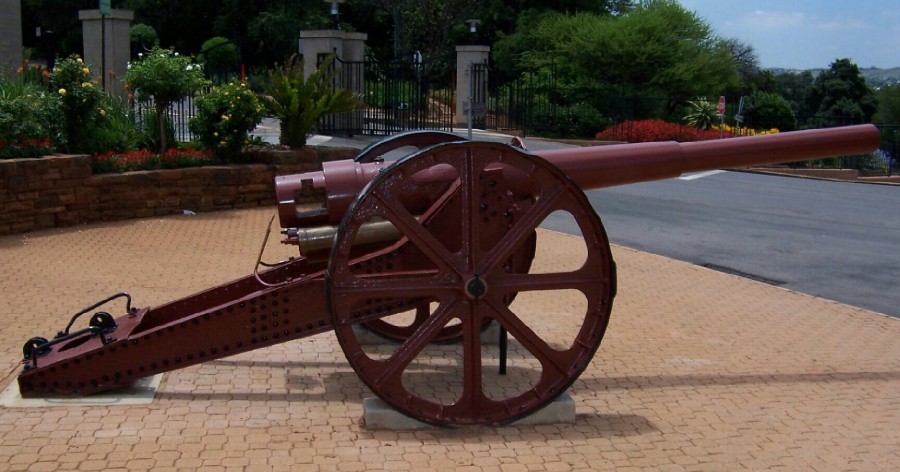
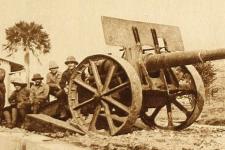
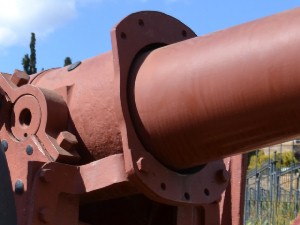
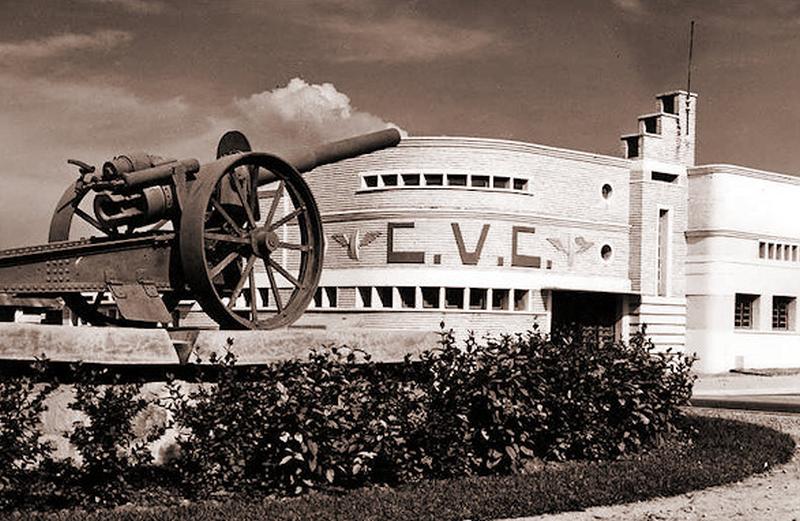
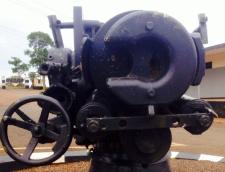
10.5cm SMS Königsberg Gun at Pretoria, South Africa
Photo © MC
Heunis
INTRODUCTION TO THE
MYSTERY OF THE TEN MISSING GUNS
by Chris Dale
Back in
2006, I was contacted by a South African researcher
named MC Heunis who had recently worked on a
restoration project on an old German naval gun. It
had originally been onboard
the SMS Königsberg in the East African campaign of the First
World War. He sent me some
photographs of the restored gun outside the Union
Buildings in Pretoria with a plaque stating that the
gun had been captured by South African forces at Kahe in March 1916.
It was a
widely documented fact that all ten 10.5cm guns
salvaged from the wreck of the German naval cruiser
SMS Königsberg in 1915 were converted to land use
and fought in the East African campaign until one by one they were all
destroyed or captured by the successful allied
offensives of 1916-17. This much was reported in
most general histories of the First World War in
East Africa.
When I briefly looked
into the subject, I saw that most sources (such as Kevin
Patience's very helpful book, 'Königsberg- An East African
Raider') said that two of the guns had survived into
the modern age, the one in Pretoria and another in
Mombasa, Kenya. Patience said the Mombasa gun was
captured at Bagamoyo in August 1916. A Google search
quickly showed me photos of this gun on display
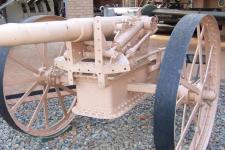
at Fort Jesus in Mombasa. The plaque next to the
Mombasa gun said that these naval guns were mounted
on improvised gun carriages made in Dar Es Salaam
for use on land.
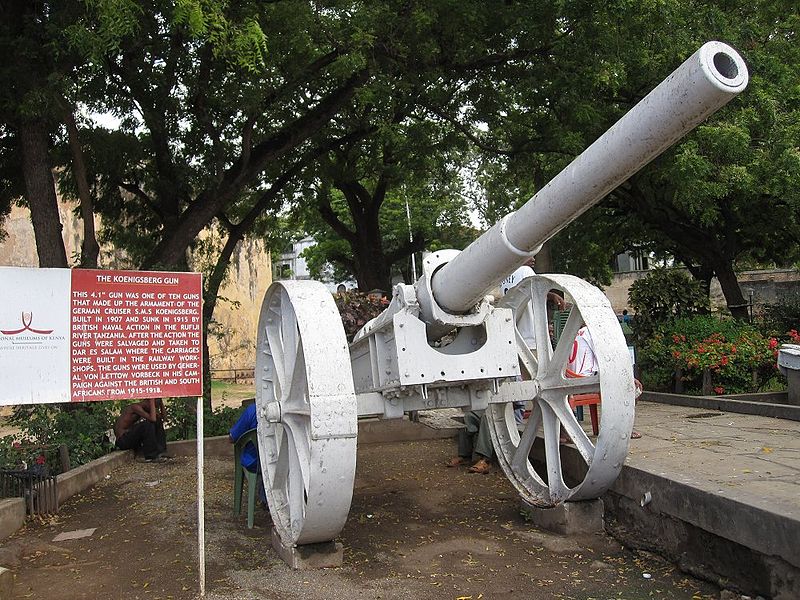
10.5cm SMS Königsberg Gun at Mombasa, Kenya
Photo by
Kiselev D at
WikiCommons
At that point I
thought the story of the guns was fairly straight
ahead and simple: there had been ten guns, eight of them
were now lost, while the two
that were captured at Kahe and Bagamoyo were now on
display in Pretoria and
Mombasa, respectively. I posted a short section on
my website at
GermanColonialUniforms.co.uk and sat back.
Soon afterwards I found that
this was not
such a simple open and shut case.
The first hint of a
problem arose when MC Heunis mentioned to me that
the plaque on the Pretoria gun claiming it to have
been captured at Kahe was probably wrong as the
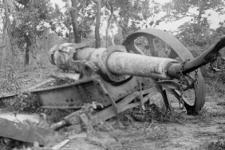
actual gun captured at Kahe in 1916 was blown up by
the Germans and the gun now in Pretoria is
relatively intact. This was an interesting aside but
it didn't strike me as too curious at the time. After all
small identification mistakes can easily be
made between ten identical guns, or so I thought.
A few months after I
first posted the Pretoria photos on my
website I received
an interesting email from Bob Wagner, a retired US army officer. He
had found and photographed a third Königsberg gun at Jinja,
Uganda back in 1998. That was excellent news and I
added his photo to my website alongside the known
Pretoria and Mombasa guns. Again I rested back but
Bob didn't stop there.
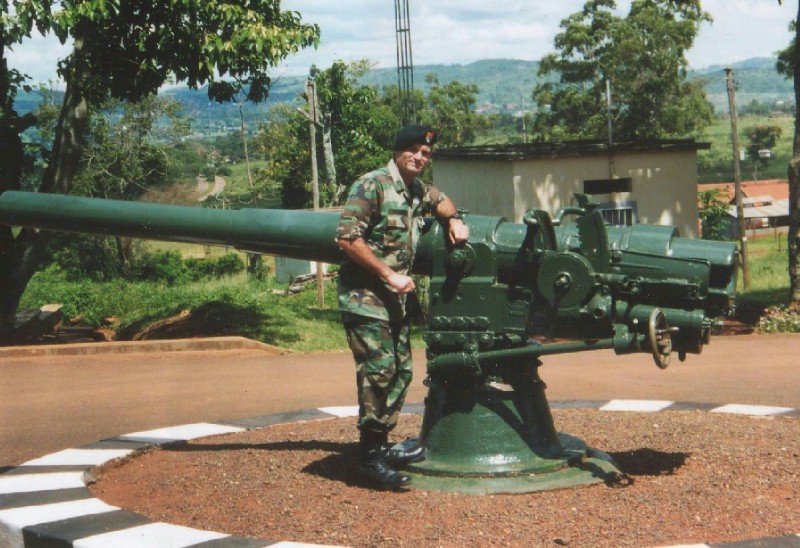
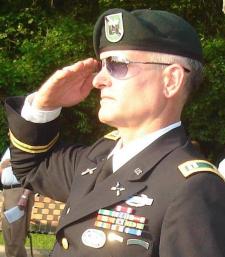
Bob Wagner with the
10.5cm SMS Königsberg Gun at Jinja,
Uganda
Photo © Bob Wagner
Bob had researched
further into the subject of these Königsberg guns
and came come up with three
further previously unknown major facts that contradicted
my previously known histories of the guns.
Firstly he had
seemingly proven that the gun on display at Mombasa
was not captured at Bagamoyo as previously reported.
He had evidence to show that the gun from Bagamoyo
went elsewhere.
Secondly, with his
keen military eye, he had noticed that the gun
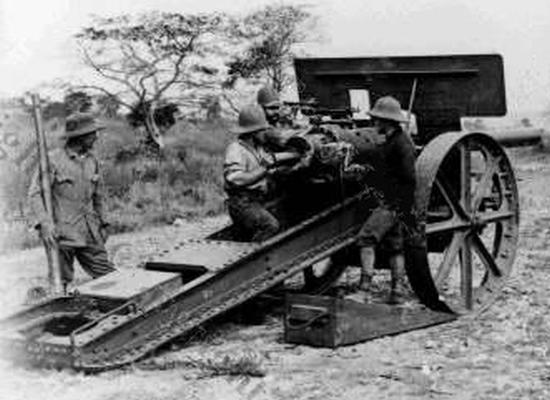
carriages for the guns at Pretoria and Mombasa did
not match each other and were of different origins.
The one at Mombasa was most likely German made
from its construction and the carriage in
Pretoria was improvised from differently sourced
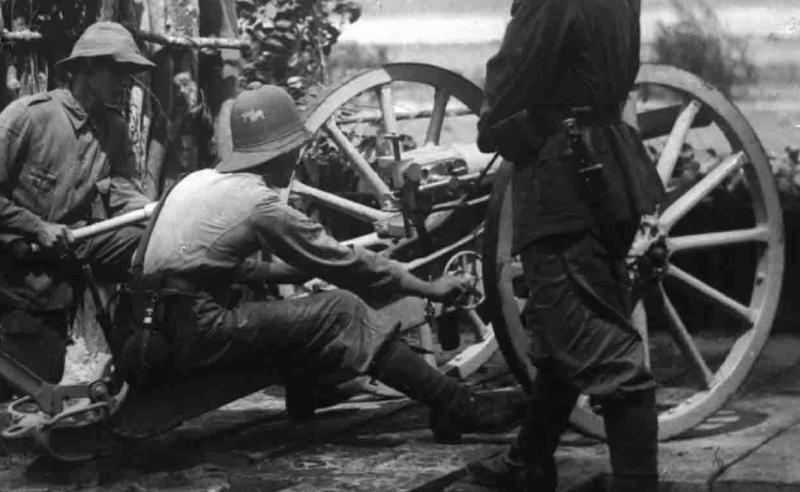
parts. Other wartime photographs of the
Königsberg guns showed a different gun carriage
design entirely. They were not all made in Dar
Es Salaam as the Mombasa plaque had said. Bob
had also spotted other ways to identify the
different guns from each other in wartime
photographs. Bob is very observant.
The third and perhaps most
interesting
piece of information was that he had found old photographs
proving that at least two more guns survived the
First World War, one in the former Belgian Congo and the
other in my hometown of London, England!
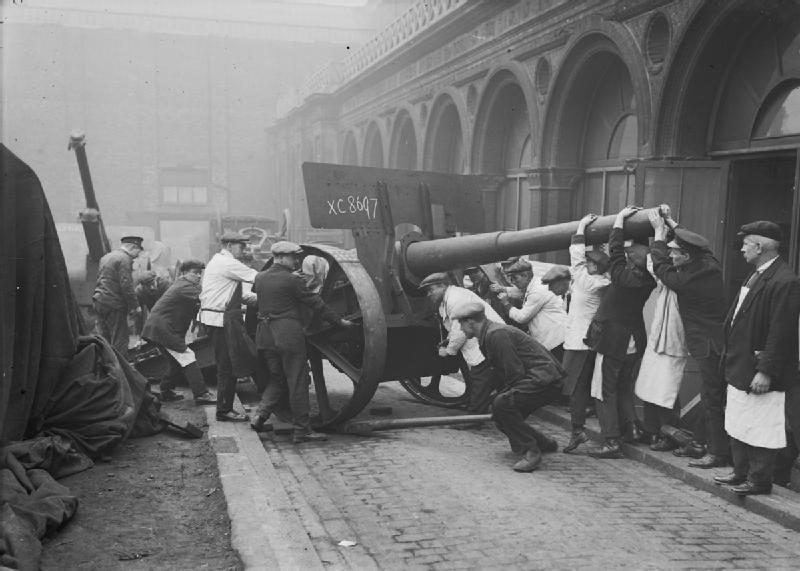
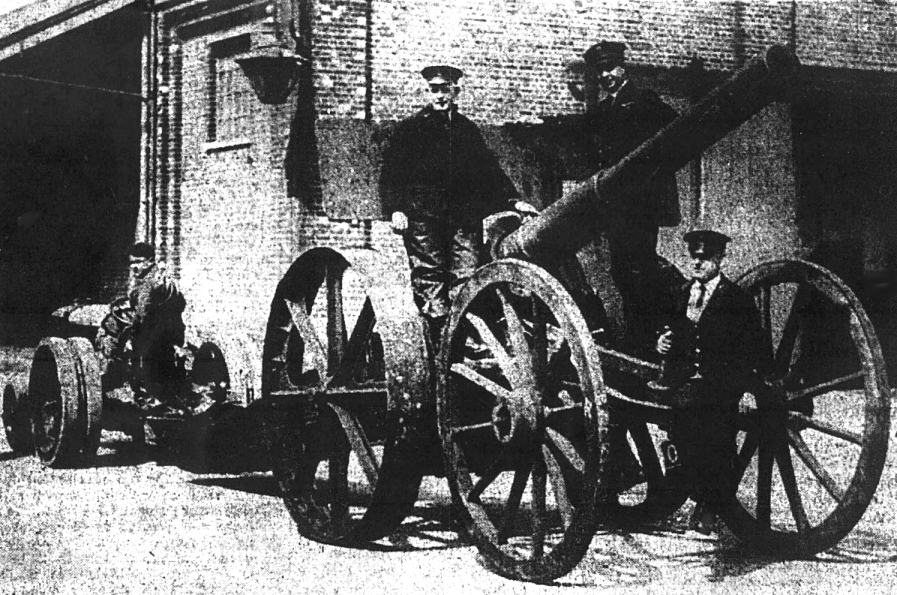
10.5cm SMS Königsberg Gun in London,
England
1924
Photo ©
Imperial War Museum
Now I had to sit up, we had a
few real mysteries on our hands. How many of the ten
guns had in fact survived the war? Certainly far
more than the two recorded in Pretoria and Mombasa. Was there really
one in England? What were the true wartime
histories of all ten individual guns? And
back to the start, could we find the real origins of the guns now on
display in
Mombasa and Pretoria?
Bob and I set to work
to solve these mysteries and very quickly noticed that we were not the only detectives on the trail. Two
German historians, Holger Kotthaus and Oliver Eicke
were also looking into the history of the ten
Königsberg guns. They
had done some incredible work trawling through German
archives to find every available eyewitness account
and reference to the guns in German, French and English, including many
unpublished diaries of veterans of the campaign in
East Africa. Through this they were largely able to
trace the wartime histories of the individual guns.
Bob and I were very impressed. Oliver and Holger were
equally curious to
know about the other existing guns and further information that
Bob and I had been able to find.
Together, we pooled our resources and along with a
worldwide team of online helpers (mainly via the
Axis History Forum) each providing
small clues along the way we set off to solve the
mysteries of the ten missing guns.
------------------
As we slowly
unravelled the
full story of the guns both in wartime and in the
later episodes of African history that they took an
incidental part in, the simple story of ten missing
guns proved to be far more
interesting and educational to me than I had ever
imagined. The story took us
back a century and across several continents from
the Baltic Sea to the Indian Ocean and from the
Great Lakes of East Africa (where the threat of a
Königsberg gun inspired the later novel and film
'African Queen') to the beachfront of a seaside
resort in England.
It showed us that recorded history in text books,
diaries, museums and war monuments is not always as factually accurate
as it might first appear. It also showed us that while
there is sometimes chivalry and even at times humour
between enemy armies, the horrific irony of
this episode of the First World War is that it is
that more African porters
probably died transporting these guns for the Germans
than
enemy combatant soldiers were put out of action by
their fire in battle.
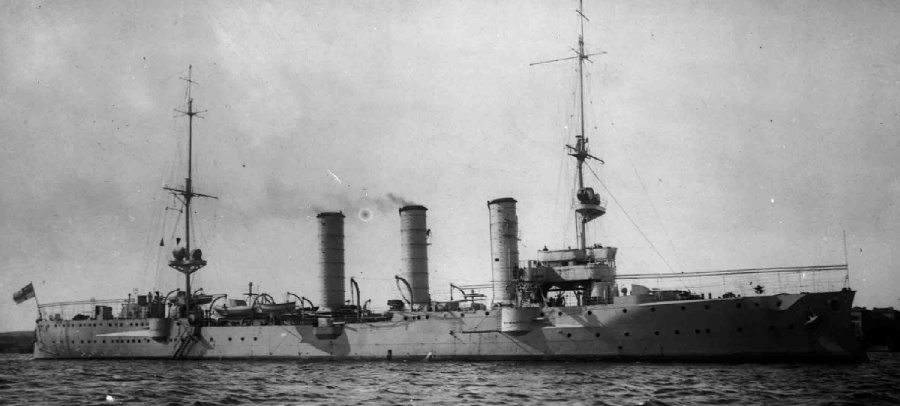
SMS Königsberg off German East Africa, 1914
Photo
by Walther Dobbertin
©
Frankfurt University Koloniales Bildarchiv
The story of the SMS
Königsberg and her guns all began
with the arms race leading up to the First World
War, the greedy scramble for Africa by the European powers and
their parallel struggle for maritime
supremacy. After the SMS Konigsbergg's short
radiding career and her successful attack on HMS
Pegasus at Zanazibar in 1914, she wa sunk by British
naval monitors in the Rufiji Delta and yet her guns
lived on.
The guns were
salvaged by the Germans and fought later on land on several
fronts of the East African campaign as part of the
German colonial army or Schutztruppe. As they fell
one by one, we saw a
chronological history of the East African campaign
unfold before us, from Jan Smut's first offensive
into German East Africa up until von
Lettow-Vorbeck's undefeated German forces finally
left their colony to invade Portuguese territory in
November 1917.
The
Railway Gun at Kahe was an
early victim to Smut's successful South African and
British invasion of German East Africa from the
north in March 1916. Big Bertha
was put of of action in May 1916 at the Battle of
Kondoa-Irangi as von Lettow-Vorbeck temporarily held
back van Deventer's South African advance on the
German Central Railway during the annual rainy
season.
The
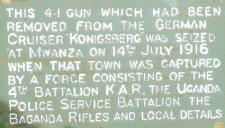
Gun at Mwanza was captured
in July 1916 when British and Belgian forces invaded
German East Africa from the north-west thus seizing
control of Lake Victoria. As the South African and
British offensive bore down on the Central Railway
from the North the Germans sent a
Gun to Bagamoyo,
suspecting that the British might attempt a landing
there, which they successfully did in August 1916.
Another gun had been deployed to the Schutztruppe's
retreating Northern Front and fought in several
delaying actions until the Gun
was destroyed near Mkyuni in August 1916 as it
was too heavy to make it across a wooden river
bridge.
Meanwhile on the
Western Front bordering the Belgian Congo one
Gun served aboard the SS
Goetzen a German steamer on Lake Tanganyika,
making her the most powerful ship on the lake and
another had been fitted in an emplacement on the
Elephant's Foot Peninsular at Kigoma overlooking
Lake Tanganyika. Between them, these guns gave the
Germans the upper hand in the Battle of the Lakes,
until they were both moved inland and fell fighting
in September 1916, against the Belgian overland
advance from the north-west.
Over towards the
coast Smut's offensive had captured the German
capital at Dar Es Salaam and taken the Central
Railway but not managed to defeat von Lettow-Vorbeck
decisively. Van Deventer took command of the South
African and British force and advanced towards the
Rufiji where he captured another
Gun Near Kibata. The
Germans were now forced into the south-eastern part
of their colony, one gun helped defeat a Portuguese
invasion at Newala and was then destroyed at the
Battle of Mahiwa against
the advancing British in October 1917. A day later
the Last Gun at Masasi was
destroyed, as von Lettow-Vorbeck slimmed down his
force into a more mobile unit to leave German
territory and invade the Portuguese colony of
Mozambique.
Along the way, the
story included a host of interesting characters most
notably the individual gun commanders. Some of these
had previously served as officers aboard
the SMS Königsberg. Others were merchant naval officers or local plantation
owners with varying degrees of previous naval artillery experience.
By the
end of the war in 1918, two of the remaining SMS Königsberg officers
were still fighting the war with von
Lettow-Vorbeck's Schutztruppe when news arrived
several days late of the armistice in Europe which
had taken place as of 11 November. They finally
laid down their arms on 25 November 1918.
After the war the
surviving gun commanders and Konigsberg crew
gradually returned to Germany, some remained in
naval service but most returned to civilian life.
One former Königsberg officer and gun commander
became a keen supporter of Adolf Hitler, another's
family became a victims of the Nazi regime.
Other characters and
events of interest we
met during the research of this website included the family and business scandals of
the guns' designers, the resourceful German
commanders in their isolated colony, the
conflicting and often eccentric British, South African, Belgian
and Portuguese
commanders within the allied camp and several of
the soldiers, sailors, mercenaries, explorers, pilots, bounty
hunters and authors that came into contact
with the guns during the war, each with their own
short story to tell. Eventually the search
led us into the late twentieth century and contact
with the dictators of
Uganda and the Congo, alongside modern day salvage
divers, scrap merchants, pirates, racing car drivers and
an Oscar winning Hollywood film
star.
It is a journey and a
story that we as a team, were certainly not expecting
from the start.
It should be stressed
that we were assisted in
our searches by many historians, professionals and enthusiasts from
all over the globe. This was a truly international
effort and our thanks go out to all those who helped
and are credited on the Thanks, Sources and Links
Page. Chris Dale 2016
---------------------------------------------------------------------------------------
Notes
Conflicting
Information
Inevitably through the research for this book we
have come across conflicting information from
various sources. Where this has happened we have
listed the differing sources and tried to determine
the most likely truths behind each event, where
possible trusting eyewitness or photographic
evidence over re-told histories. Logic and deduction
have been our greatest allies in dispelling several
myths about the histories of these guns.
Translation Notes
In translating German sources for this project, it
has at times been necessary to change the word order
and phrasing of sentences. Not all nouns and
adjectives are directly translatable from German and
very few idioms are. In these translations it has always
been our intention to keep the meaning of the
original writer the same as intended while at the
same time making the story readable in English.
German Naval Ranks
The basic officer ranks of the Imperial German navy
were: Leutnant zur See, Oberleutnant zur See, Kapitänleutnant, Korvettenkapitän, Fregattenkapitän
and Kapitän zur See. The title zur See,
or at sea is often abbreviated to the letters z.S.
Other letters will sometimes also been seen after
German naval officers ranks during this study. Former naval officers
that were now out of service, or außer Dienst
had the letters a.D. after their rank. For an
example, the officer that commanded the gun
destroyed at Mkuyuni was titled as
Leutnant z.S.a.D. von Eucken-Addenhausen. Former naval officers
that were now on the reserve lists had d.R. after
their rank for der Reserve, while officers from the
naval artillery (Matrosen Artillerie) had the
letters
d. Matr. Art. after their titles. A good example of
these mixed titles was held by the commander of the
Konigsberg gun at Bagamoyo
Leutnant d.R. d.Matr.Art. Dr. Paul Friedrich.
Also note that as Paul Friedrich has a civilian
doctorate (not exclusive to medical doctors) he
retains the Dr. in his military title. Naming the Guns
The guns had
serial numbers 360-369 when they were made in the
Krupp factory in Essen. They also would have had
titles relating to their position on board the SMS
Konigsberg, Port foredeck, Starboard midships, etc.
But there is no record in eyewitness accounts of the
guns having a numbered system to denote them from
each other in use by the Germans during the war. In
veterans' memoirs the different guns are simply
referred to by by
where they were based or abandoned, their
commander's name or sometimes nicknames. We have
kept these names in our annotation, mainly based
around where they were based or captured.
Chapter
1.
The
Railway Gun at Kahe
Rufiji River Delta - Dar Es Salaam - Tanga
(Putini position) - Korogwe (Usambara Mountains)
- Kahe
Chapter
2.
Big
Bertha at Kondoa-Irangi
Rufiji River Delta -
Dar Es Salaam
-
Dodoma
-
Kondoa-Irangi
Chapter
3.
Lake Victoria Gun at Mwanza
Rufiji River Delta -
Dar Es Salaam
-
Tabora
-
Mwanza
Chapter
4.
Bagamoyo Gun
Rufiji River Delta -
Dar Es Salaam
-
Bagamojo
Chapter
5.
Mkuyuni Gun
Rufiji River Delta -
Dar Es Salaam
- Lembeni - Korogwe - Handeni - Mlembule -
Kwedihombo - Morogoro - Mkuyuni
Chapter
6.
S.S. Goetzen to Korogwe Gun
Rufiji River Delta -
Dar Es Salaam
- Kigoma – S.S. Götzen´´ - Dodoma -
Kondoa-Irangi - Tabora - Korogwe (Kahama
District)
Chapter
7.
Kigoma Elephant's Foot to Tabora Gun
Rufiji River Delta -
Dar Es Salaam
-
Tabora
-
Kigoma (Elephant Foot)
-
Gottorp
-
Ussoke
-
Tabora - Itaga
Chapter
8.
Apel´s Kibata Gun
Rufiji River Delta -
Dar Es Salaam
-
Utete
-
Rufiji
-
Mohoro
-
Kibata
Chapter
9.
Wenig´s Mahiwa Gun
Rufiji River Delta -
Dar Es Salaam
-
Utete
-
Liwale
-
Lukuledi
-
Newala
-
Lindi
-
Mahiwa
Chapter
10.
Frankenberg´s Masasi Gun
Rufiji River Delta -
Dar Es Salaam
- Tanga (Nyamjani
position) - Pangani - Mlembule - Kwedihombo -
Kilossa - Kidodi - Ifakara - Saidi - Liwale -
Masasi
|