|
The
Lake Victoria Gun at Mwanza
"If possible bring the 10.5cm
gun on a steamer to Njantelessa. If not, blow
it up!"
Orders to
the Gun's Commander Oberleutnant Vogel
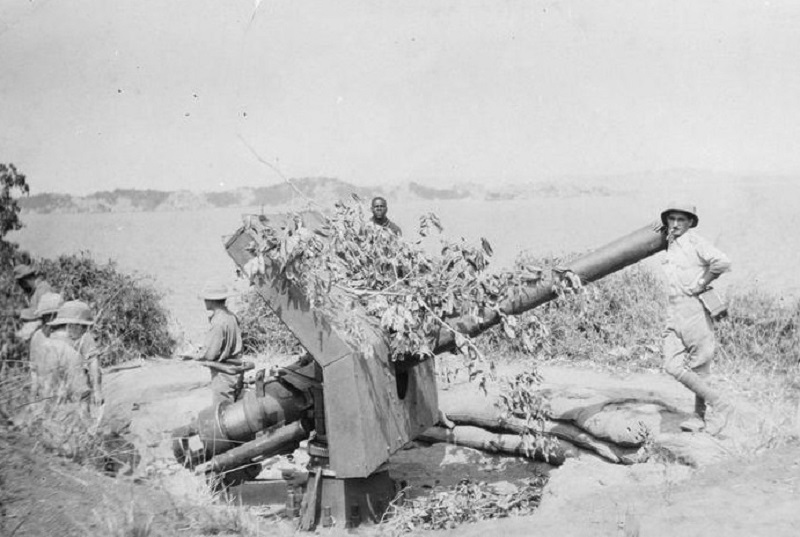
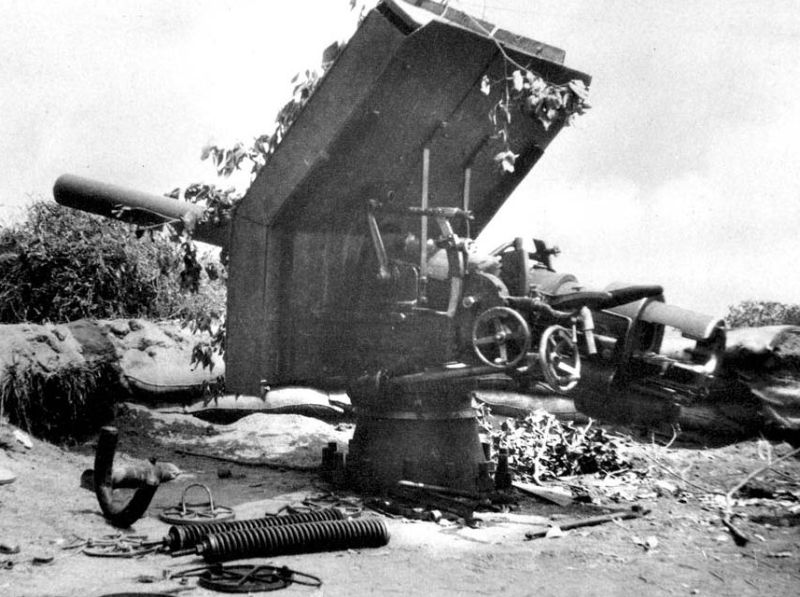
10.5cm
SMS Königsberg Gun
Captured at Mwanza, July 1916
Photo
©
Imperial War Museum
Deployment to
Mwanza
The Mwanza
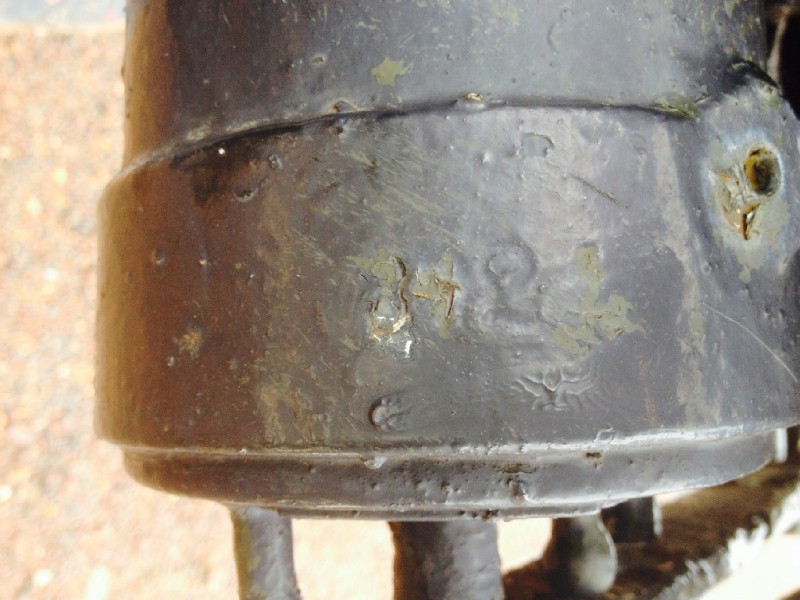
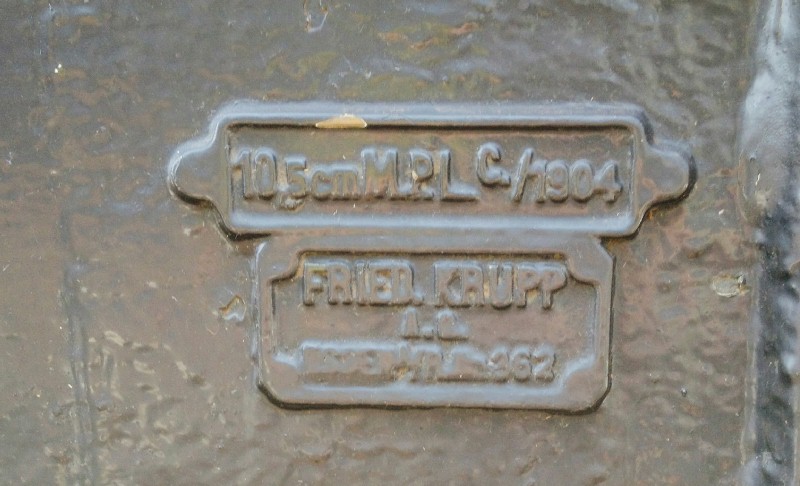
Gun (serial number 362) was originally one of the
side guns mounted in cupolas on the SMS Königsberg and
there fore had no
barrel flange. This is the only one of the ten
Königsberg
guns that we can be 100% certain of the combined
history and serial
number of.
After being salvaged and
repaired at Dar Es Salaam,
it was sent via the Central Railway to Tabora, then
dragged by 32 oxen (with another 16 in reserve)
overland over 200km to Mwanza (Muansa in
German) on the shore of Lake
Victoria, the source of the White Nile.
Lake
Victoria was a very useful strategic point in the
campaign as it bordered German and British territory. The British in
Uganda and British East Africa were on the northern side of the lake,
German East Africa was on the South with Mwanza as
it's biggest port on the lake. The British held the
upper hand on the lake with more ships and a landing
at Mwanza was expected by the Germans.
The
Schutztruppe commander, Oberstleutnant von
Lettow-Vorbeck described the position in his
memoirs-
"Warfare near Lake Victoria was very difficult for
us. There was always the danger that the enemy might
land at Mwanza or some other place on the south
coast, seize Usukuma and threaten Tabora. If however
our troops remained near Mwanza, the country around
Bukoba and therefore also Rwanda. would be in
danger."
(Quotation from
P88 'Reminiscences of East Africa' by Paul von
Lettow-Vorbeck, Naval &
Military Press Ltd 2004)
On 12 September
1915 the 10.5cm SMS Königsberg gun arrived at Mwanza
and was soon installed overlooking Lake Victoria in a fixed
position on its original naval pivot stand. The gun
was commanded by Oberleutnant d.R. Dr. Alfred Vogel.
This was an important defensive position and would
have deterred British attacks.
Photographs of the gun shortly after its capture
show that it was fitted with an improvised gun
shield, camouflaged by leafy branches.
The
peacetime Schutztruppe garrison at Mwanza consisted
of part of the 14. FK, in wartime the town became a
major recruitment centre for new askaris (five new
companies were recruited from the Wassukuma people
in 1915) and the area came under the German Western command of
Major General Kurt Wahle.
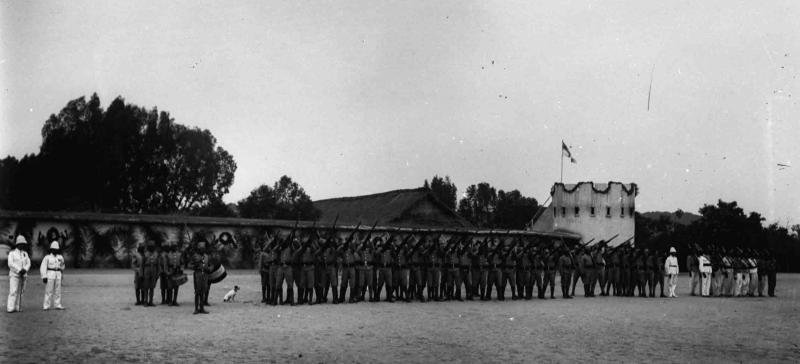
Schutztruppe
Feldkompagnie on Parade in Mwanza before the War
Photo by Kurt von
Schleinitz
©
Frankfurt University Koloniales Bildarchiv
The Battle of
Mwanza and the Loss of the Gun
In early
1916 the Allies were ready for simultaneous
offensives against German East Africa. In March
1916, South African and British forces drove the
Schutztruppe back from their North
Eastern border around Kilimanjaro and on to Kahe. In April 1916 the
Belgian Force Publique began an offensive from the
Belgian Congo
around the North of Lake Tanganyika into Ruanda
meeting up with the British Lakeforce under Sir Charles
Crewe advancing from Uganda.
This pushed Wahle's
outnumbered Western Schutztruppe
onto the retreat.
Mwanza was the main British aim to gain control of
Lake Victoria and from there it was a matter of time before Tabora and the Central Railway could
be taken.
On 13 July
1916 Belgian and British columns advanced towards
Mwanza and the Königsberg gun opened fire on the enemy at
night. Oberleutnant Vogel received orders to
try to withdraw with the gun- "If possible bring the 10.5cm
gun on a steamer to Njantelessa. If this is not
possible, blow
it up!"
(Quotation
from P284 "Kampf
im Rufiji-Delta, Das Ende des Kleinen Kreuzers
Königsberg" by RK Lochner, Wilhelm Heine Verlag, München 1987)
Due to a bad
telephone connection he misunderstood the order to
read that he should cover the retreat of other
German forces, namely Abteilung
Leutnant von Gynz-Rekowski, before
destroying the gun. Accordingly the gun remained in
action until the 14th when it was blown up before
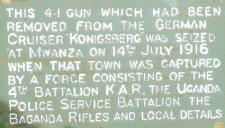
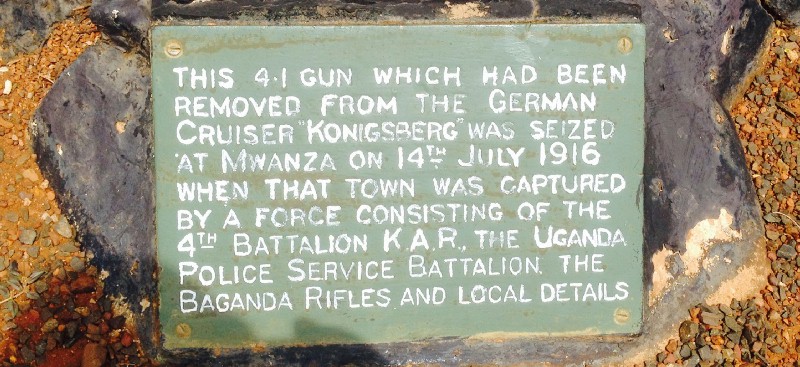
British troops (the 4th Kings African Rifles
Battalion with elements of the Uganda Police Service
Battalion, the Baganda Rifles
and local details)
seized the city. It therefore became the third of
the ten Konigsberg guns to be put out of action.
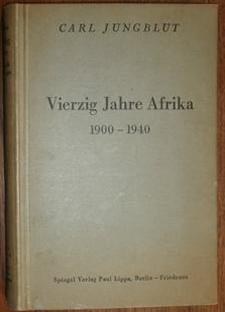
Local rice trader and veteran of
the East African campaign, Carl Jungblut described
the fall of Mwanza and the fate of the gun- "Plumes of smoke rose from
individual points of Mwanza town. The remaining rice
stocks in my mill had been ordered to be destroyed,
as had the radio tower and the 10.5cm gun as far as
possible with dynamite (which unfortunately failed)."
(Quotation from
P100 "Vierzig
Jahre Afrika 1900-40" by Carl Jungblut, Spiegel
Verlag Paul Lippa, Berlin-Friedennau 1941)
Unlike in
Kahe, the barrel did not split in a spectacular
fashion. A photograph of the gun immediately after
its capture shows the breech block missing and the
recoil springs removed but very little other visible
damage. According to a British officer's diary
(Major JJ Drought), four hundred shells were also
captured with the gun.
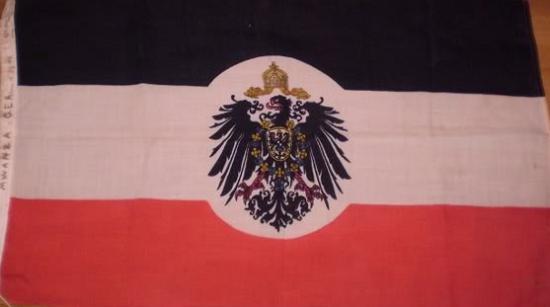
German Flag Captured at Mwanza,
July 1916
Collection of
Duncan
Bickerton originally shown on the
1914-1918
Invisionzone.com/Forum
Post-War Display
The British recovered the gun, its
recoil springs and breech block and
originally displayed it on its pivot stand in Kampala, British
Uganda, across Lake Victoria. In
the Summer of 1932 Carl Jungblut made a trip
to Kampala and mentioned that-
"Kampala has the appearance of a Northern
Italian town... In the middle of the city stands our
old naval gun from the cruiser
Königsberg.
It was formerly at the entrance of the port of
Mwanza but was carried off by the British as a
trophy during the war."
(Quotation from
P192 "Vierzig
Jahre Afrika 1900-40" by Carl Jungblut, Spiegel
Verlag Paul Lippa, Berlin-Friedennau 1941)
The gun was later removed from
Kampala to stand outside the 4th Kings African
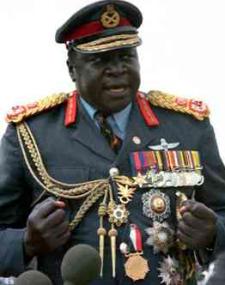
Rifles barracks in Jinja, Uganda (where the young
Lieutenant Idi Amin once trained).
The barracks
is now known as the
Qadaffi Barracks (since
Amin's alliance to the former Libyan Dictator)
and is the home
of the Uganda Junior Staff College. The barracks
were built in 1939 but not occupied until 1948, so
the gun was probably moved to Jinja around that
time. Albert Whitwell (formerly of the Black Watch
and 4th Kings African Rifles) remembered the gun
being there back in 1956.
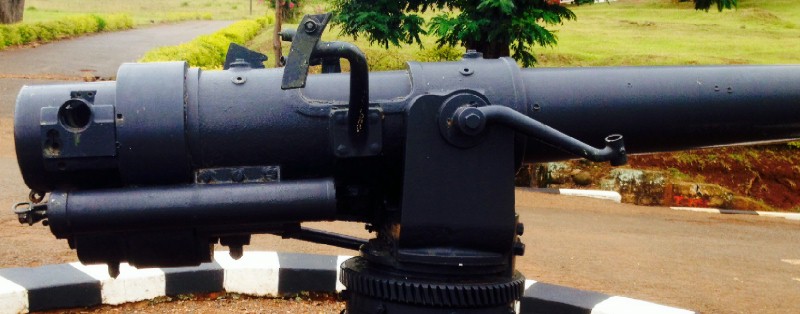
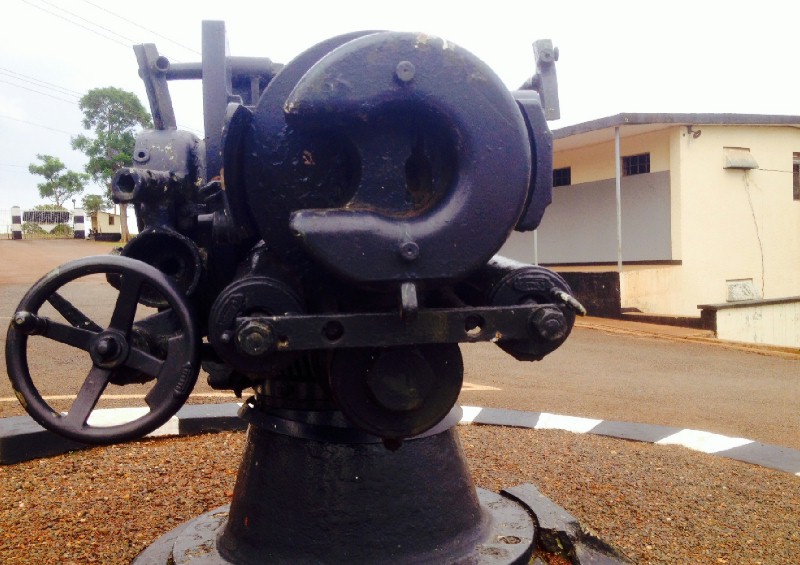
Its presence however had
been largely unnoticed by historians
until it was rediscovered
and photographed by Bob Wagner
in 1998 on a traffic roundabout at the barracks.
At the time Bob just got a very brief look at it-
"I was there for about two minutes when I visited
the Jinja Gun in the late 1990’s. I read the
plaque and walked around it one time. My host used
my camera to take my photograph. I took the photo of
the plaque. Then, back into the vehicle and go."
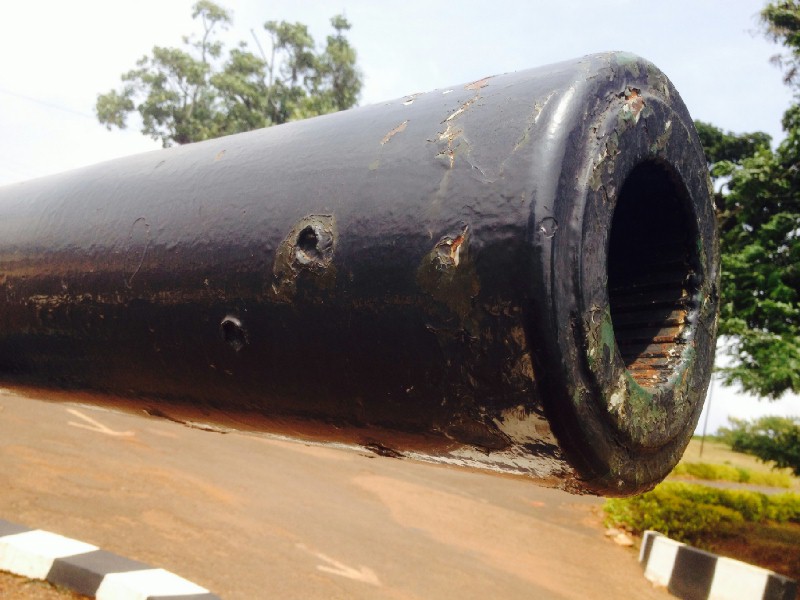
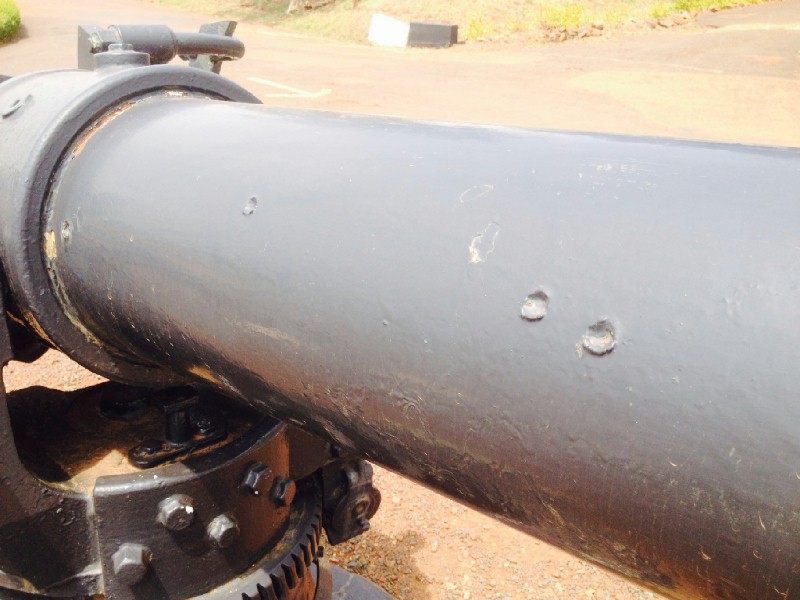
The gun remains on display at the Qadaffi Barracks
outside Jinja to this day (as of
March 2014) and along with the guns at Pretoria and
Mombasa is one of the three Königsberg guns known to
still exist.
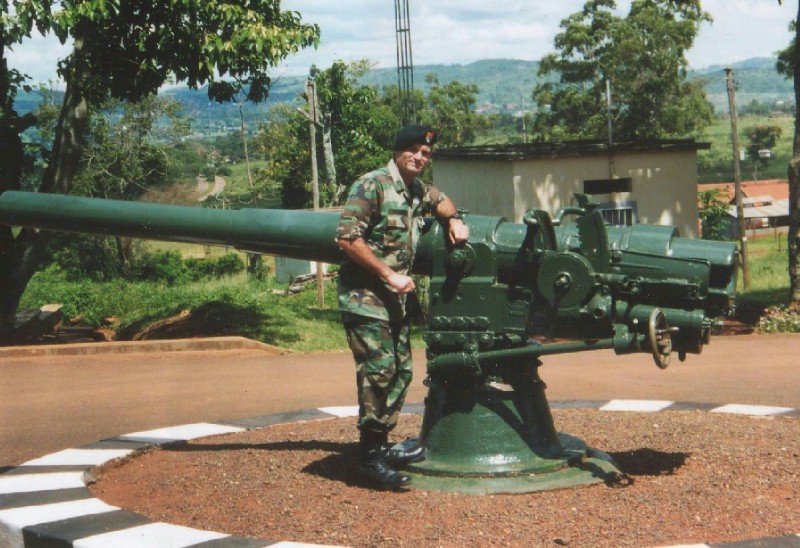
Bob Wagner with the Mwanza Gun at
Jinja 1998
Photo © Bob Wagner
Sources
"Kampf
im Rufiji-Delta, Das Ende des Kleinen Kreuzers
Königsberg" by RK Lochner,
Wilhelm Heine Verlag, München 1987
"Vierzig
Jahre Afrika 1900-40" by Carl Jungblut, Spiegel
Verlag Paul Lippa, Berlin-Friedennau 1941
"Reminiscences of East Africa" by Paul von
Lettow-Vorbeck, Naval &
Military Press Ltd 2004
"Das Offizierskorps der Schutztruppe für Deutsch-Ostafrika
im Weltkrieg 1914-1918" by
Wolfgang-Eisenhardt Maillard and Jürgen Schröder,
Walsrode 2003
Capture of Mwanza at
KaisersCross.com
Charles Crewe Biography at
ThePeerage.com
Jugblut Biography- "Ein Kolonial Skandal: Settler
Carl Jungblut's Campaign for a Lake Victoria Rice
Milling Monopoly, 1906-16"
by Laird Jones at
ResearchGate.net
Idi Amin Biography at
News.BBC.co.uk
Mwanza Flag first shown at the
1914-1918.InvisionZone.com/Forums
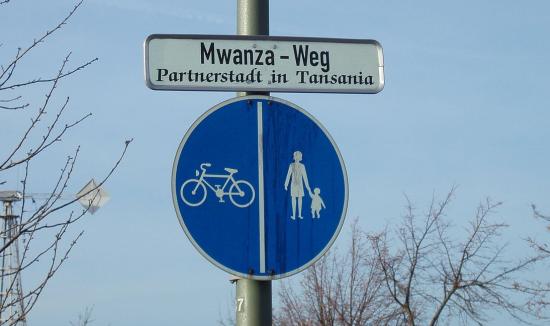
Mwanza-Weg street
sign in Würzburg, Germany 2008
As the sign says the two cities of Mwanza in
Tanzania and Würzburg in Bavaria are now twinned.
Photo from
Wikipedia.org
|