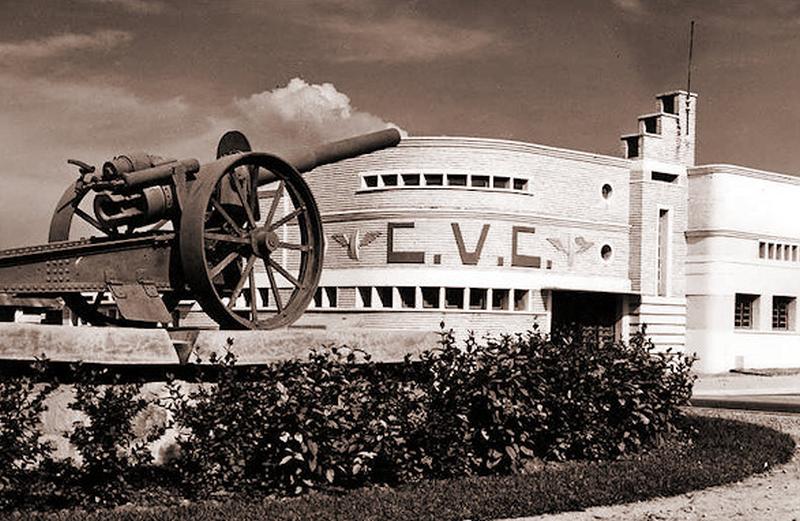
|
The SS Goetzen Gun
"She's the
boss of the lake 'cos she's got the biggest gun in
Central Africa!"
Humphrey Bogart in the 1951 film 'The African Queen'
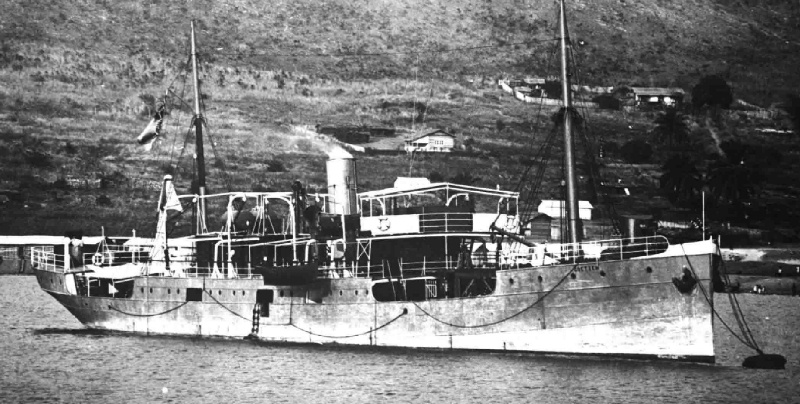
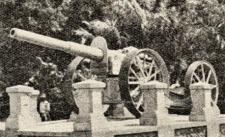
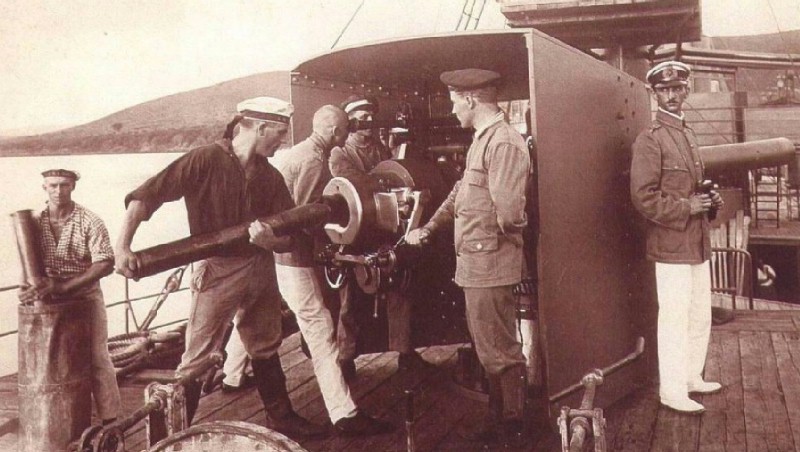
SS Graf von Goetzen fitted with a
SMS Königsberg Gun
on Lake Tanganyika
Photo by Kapitän Zimmer
©
Frankfurt University Koloniales Bildarchiv
Deployment on the SS Goetzen
and the Battle of the Lakes
This gun was originally one of the turret mounted
guns on the SMS Königsberg and as such had a barrel
flange the small shield of which was never removed.
It is the only gun from the Königsberg always seen
with its barrel shield in position and is thus
easily identifiable in photographs.
After its refitted in
Dar Es Salaam, it was
one of two guns (along with the gun positioned on
the Elephant's Foot in Kigoma) sent to defend Lake Tanganyika against
the British and Belgians who held the opposite
coast. The defence of the lake was trusted to
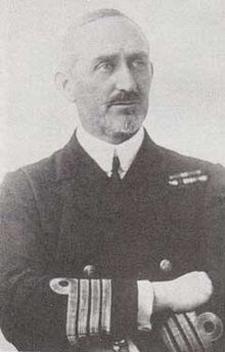
Korvetten-Kapitän
Gustav Zimmer (formerly
of the SMS Möwe) and came under the overall command
of Generalmajor Kurt Wahle's Western Schutztruppe.
"After July 1915,
when the SMS Königsberg was sunk by the English, two
of the 10.5cm guns were sent to Kigoma. From there,
one was used on Lake Tanganyika and the other was
emplaced on a mountain overlooking Kigoma."
(Original
Quotation from P15 "Die Möwe-Abteilung
auf dem Tanganjikasee in DOA 1914 – 1916" by Gustaf
Zimmer, Marine Archiv, Berlin 1931)
Both guns were transported from Dar Es Salaam
to Kigoma on the Central Railway via Dodoma and Tabora. One gun
was fitted into an emplacement at Kigoma, the other
was mounted in its original turret on the foredeck
of the German steamer SS Graf von Goetzen in August
1915. Also added to the Goetzen was one of the 8.8cm
Königsberg guns and two 3.7cm Revolver Guns from the
survey ship SMS Möwe. This made the SS Goetzen by
far the most powerful ship on the lake, easily
outgunning their Belgian opponents.
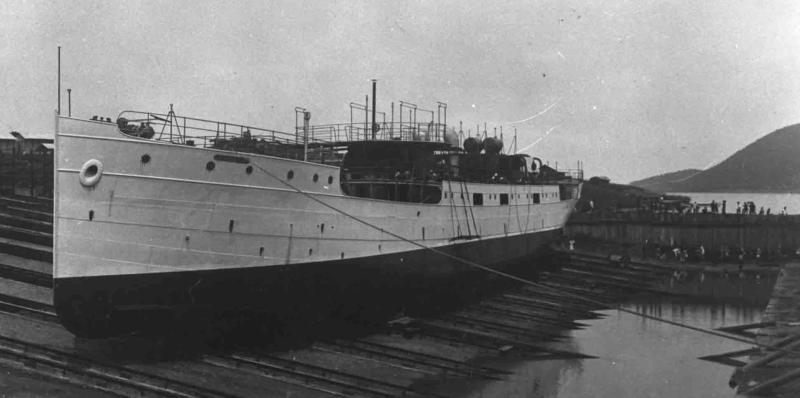
The
Goetzen was a steamer ship originally intended for
civilian passengers and cargo on Lake Tanganyika.
She was built in early 1914 in Germany then
dismantled and sent in 5,000 separate parts by ship to
Dar-Es-Salaam then via the Central Railway to Kigoma
where she was unboxed, reassembled and finally launched on
5 February 1915, by which time the First World War
had broken out and the Goetzen was pressed into
military service and captained by Oberleutnant d.R.
Theodor Siebel.
The
other two German ships on the lake were the Kingani
and the Hedwig von Wissmann (the sister ship of the
Hermann von Wissmann on Lake Nyassa). German
dominance of the lake caused the British to sent two
motor gunboats from England. Much like the Goetzen
they were carried overland in parts and assembled on
the lakeside.
Their eccentric Commander Geoffrey
Spicer-Simpson initially requested their names be
HMS Cat and HMS Dog but when this was rejected by
the British Admiralty he changed their names to HMS Mimi
and HMS Toutou (French childish names for the sounds
made by cats and dogs). These gunboats captured the Kingani (which
was then renamed HMS Fifi by Spicer-Simpson)and sank
the Hedwig von Wissmann, thus
altering the balance of power on the lake in favour
of the allies.
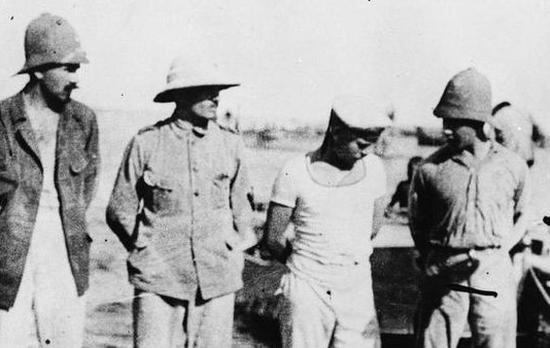
The Crew of the
Hedwig von Wissman in Belgian Captivity
Photo ©
Imperial War Museum
Despite
now being the only German ship on the lake and
confined to port, the Goetzen still maintained a
stalemate on the lake as her 10.5cm gun still out-ranged anything the British or Belgians could put on
the lake. Eventually the British and Belgian advance
by land from the North threatened to cut off Kigoma
and on 18 May 1916 the Goetzen's guns were removed to
prevent their capture and to be more useful on other
fronts. Replica fake guns were installed on the ship
and the Goetzen was left with only a single real
3.7cm gun to defend herself from Belgian air
attacks. Before the allies took Kigoma the Goetzen
was very carefully scuttled in Katabe Bay on 26 July
1916 by her assembly crew, no doubt expecting to
recover her when the war won.
For more on the Battle
of Lake Tanganyika, see
Tanganjikasee - A Gunboat War in Deutsch-Ostafrika
1914 - 1916 by Dennis L Bishop and Holger Dobold.
Deployment on Land and the Battle of
Kondoa-Irangi
Meanwhile in May 1916 gun was urgently needed by von
Lettow-Vorbeck on other fronts. At the Battle of
Kondoa-Irangi a Königsberg gun
had a misfiring and was put out of action. The
Goetzen gun was taken back down the Central Railway
from Kigoma to Dodoma, then overland to
Kondoa-Irangi where the Schutztruppe had temporarily
halted Van Deventer's southward advance.
At Kondoa-Irangi the gun
was put under the command of the former Königsberg
officer, Oberleutnant z.S. Reinhardt Kohtz, who had
commanded the previous Königsberg gun at
Kondoa-Irangi until its misfiring.
Private Eric Thompson of
the 7th South African Infantry Regiment (one of the
regiments Smut sent to reinforce Van Deventer's
position) at
Kondoa-Irangi recorded in his diary for
27 May 1916,
"Woke up at daylight and lit the fire and cut the
steaks for breakfast. The Germans must have brought
up one of their big guns during the night as they
began bombarding the town as soon as it was light
enough. They were
shooting at a very long range and fired a good many
shots."
(Quotation from "A
Machine Gunner’s Odyssey Trough German East Africa:
January 1916- February 1917" by ES Thompson
published by the
South African Military Society)
For use on land the gun
was mounted
on one of the gun carriages made in Dar Es Salaam
for use on land. A
photograph of the gun taken in this period show it
with logs tied around its wheels presumably to stop
it sinking into soft or wet ground in the rainy
season.

However as the rainy
season abated in July, Van Deventer prepared to
break out of Kondoa-Irangi and von Lettow-Vorbeck's Schutztruppe were
once again forced to retreat south towards the Central
Railway. From Dodoma, Kohtz and the
gun were taken back down the Central Railway to
Tabora to support Wahle's Western Front.
Back to the Western Front and
the Gun's Destruction
In the west,
the Schutztruppe under Generalmajor Kurt Wahle was
gradually retreating from the Belgian Force Publique
under Tombeur who had launched an offensive from the
Belgian Congo into German East Africa to the north
of Lake Tanganyika in June 1916.
From Tabora on the
Central Railway the gun was sent northwards overland
to Ngogwa as part of Abteilung Hauptmann Wintgens. The gun
saw action against the Belgian advance until a lack
of transport forced it to make a last stand near
Korogwe in the Kahama district in early September
1916. Bruno Koppe a Schutztruppe veteran of the
Western Front recalled-
"The 10.5 cm gun was already
written off by us as a loss because it was no longer
transportable due to a lack of draft animals. As a
kind of abandoned scarecrow it could only serve as a
bulwark to hold down the Belgians for as long as
possible. Its ammunition was fired and it was blown
up with its own last round, falling to the enemy as
a sensational trophy."
(Quotation from "Hptm. Wintgens Rueckzug von Ruanda nach Tabora und
die Kaempfe um Tabora" by Bruno Koppe, Koloniale Rundschau, Leipzig 1919)
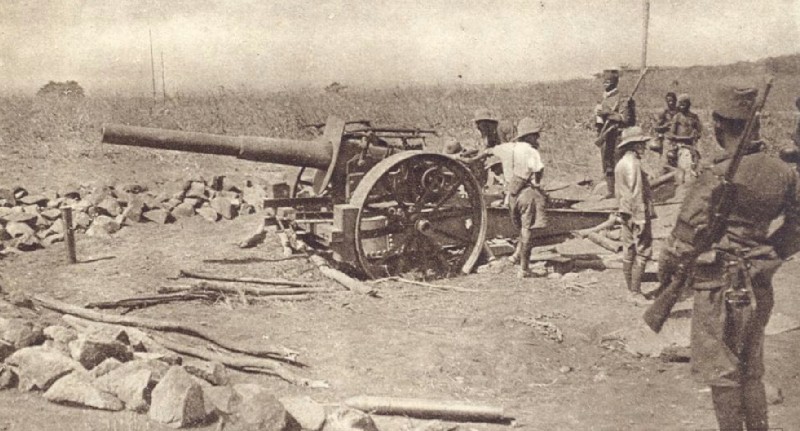
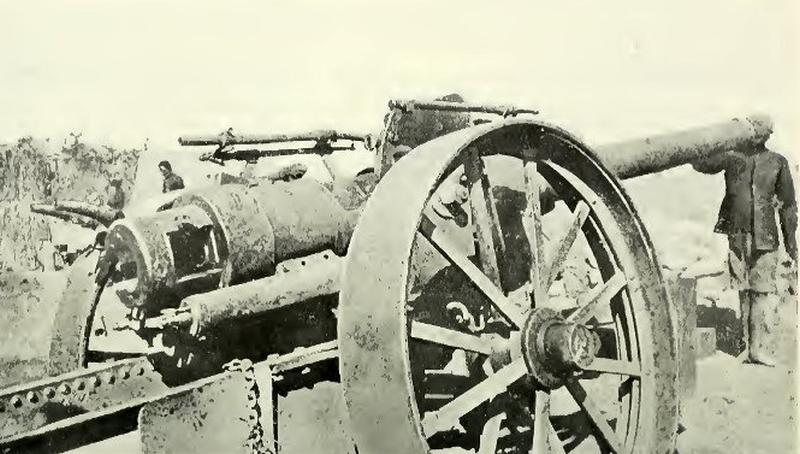
Former Goetzen Gun Captured by Belgian Troops, Korogwe 1916
Photo © Ministere
des Colonies de Belgique
Capture and
Post-War Display
Soldiers of the Belgian
Force Publique
came across the gun abandoned near Korogwe in on 2
September 1916, making it the sixth of the ten
Königsberg guns to be put out of action. The town of
Korogwe is now simply known as Kahama on modern
maps.
The
Belgians took the gun back to the Congo to display.
At some point in transportation, they
dismantled the gun but when it was put back together
it was done so with the barrel the wrong way up.
Photographs of the newly captured gun show the
shield shaped flange attachment with its flat upper
edge and barrel the correct way up
while later photos in the Belgian Congo show it inverted with the recoil
pistons now above instead of below the barrel and
the rounded lower edge of the barrel shield
uppermost.
It was
initially shown with its limber on the parade ground
in front of the barracks at Boma. the then capital
of the Belgian Congo. Photographs show it was there
in 1923.
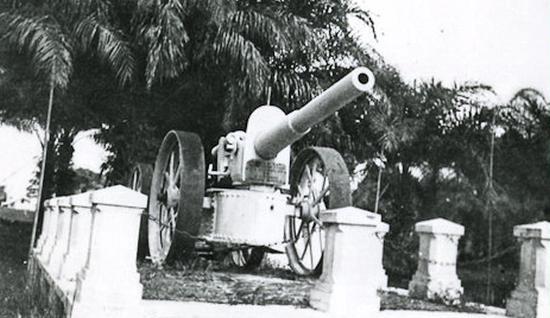
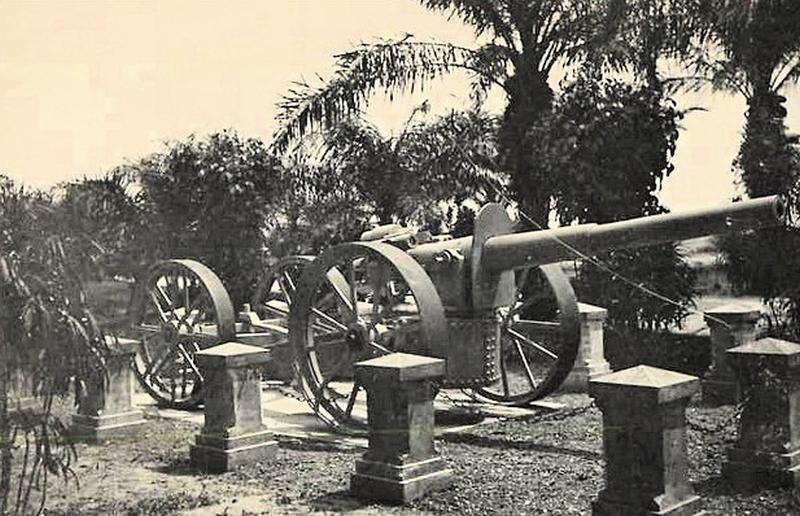
Former Goetzen
Gun at
Leopoldville or Stanleyville, Belgian Congo
Photo by Jean-Pierre
Sonck ©
Stanleyville.be
At some point it was
probably removed 200 miles
upstream to Leopoldville (modern Kinshasa and the
capital of the Congo from 1926). Photographs from
1936 to the early 1950s are captioned as it being at
Leopoldville and show it on display there on
a plinth with its original gun limber. From the
backgrounds to these photos it would appear that was
near an army barracks too.
In the
early 1950s the gun was then moved further upstream
on the Congo River to Stanleyville (modern
Kisangani). It was displayed there on a plinth at a
traffic junction appropriately named the Place du Canon
without its limber from around 1953. Some
historians, Bob Wagner among them debate as to
whether the gun ever went to Leopoldville and
suggest that it went directly from Boma to
Stanleyville in the 1920-30s.
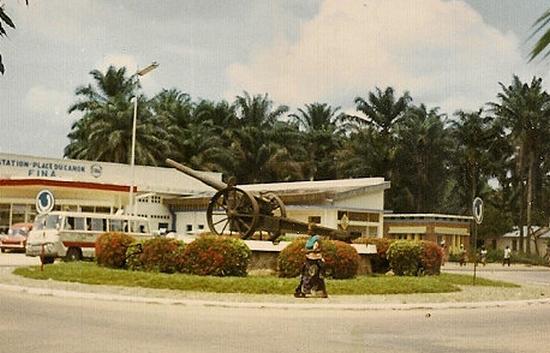
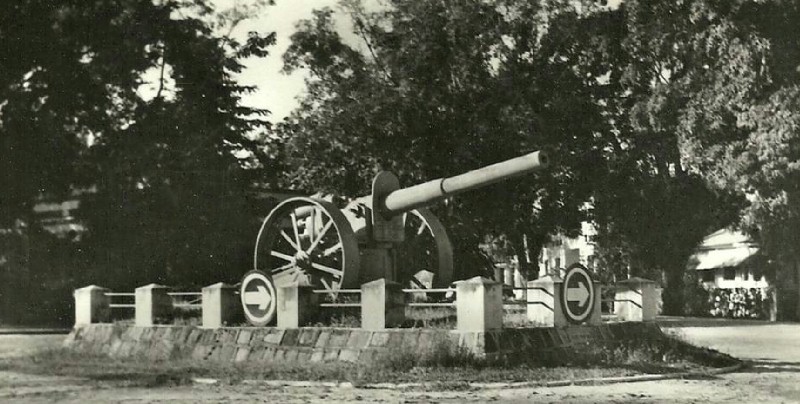
The Last Known
Photograph of the Former Goetzen Gun, Stanleyville
1973
Photo by Jacques Dassy ©
Stanleyville.be
In
1960 the colony gained independence from Belgium as
Zaire (more recently re-titled as the Democratic
Republic of the Congo). In the early 1970s President
Joseph
Mobutu (Mobutu Sese Seko)
declared a policy of Zaireinisation, part of
which meant disassociating themselves from their
colonial past. To this end many Belgian place names
were changed (eg. Leopoldville was renamed
Kinshasa and
Stanleyville became Kisangani).
Colonial relics and memorials were also disposed of
as part of this process.
The gun was almost
certainly a victim of these political changes. It
was last photographed in 1973 and after that was
removed from display and probably scrapped or
possibly simply dumped out of sight. While
the Place du Canon is still named after the
Königsberg gun that once stood there,
photographs since 1982 show that the plinth is now
empty and more recently an advertising stall now
stands where the gun once was.
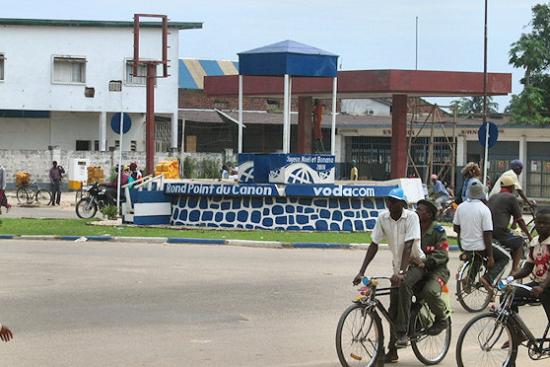
Empty Plinth
at Place du Canon, Kisangani 2008
Photo by
Mamayo ©
Stanleyville.be
SS Goetzen's Legacy and The
African Queen
Back in Lake Tanganyika,
after the war the SS Goetzen was re-floated by
British Royal Navy engineers in 1924. It was found
that the ship was in remarkably good condition her
engines having been carefully greased and her cargo
holds filled with sand by the scuttling crew. In
1927 she was put back into service on Lake
Tanganyika and still operates to this day (as of
2015) as a ferry on the lake under the name MV Liemba. She is the last ship of the Imperial German
Navy still in operation, though it
is reported that she is currently in desperate need
of repairs.
The
story of the SS Goetzen on Lake Tanganyika inspired
the 1935 novel 'The African Queen' by CS Forester, which
itself inspired the 1951 film of the same name
starring Humphrey Bogart and Audrey Hepburn (for
which the former won his one and only Oscar). The
book and film tell the fictional tale of a
mismatched couple who fall in love while on a
mission to destroy the Goetzen (re-titled the Queen
Louisa in the film). It has also been suggested that
a part of the plotline around improvised torpedoes
in the prow of a boat was inspired by photographs of
a similar captured vessel in Bagamoyo taken along with
another captured Königsberg gun.
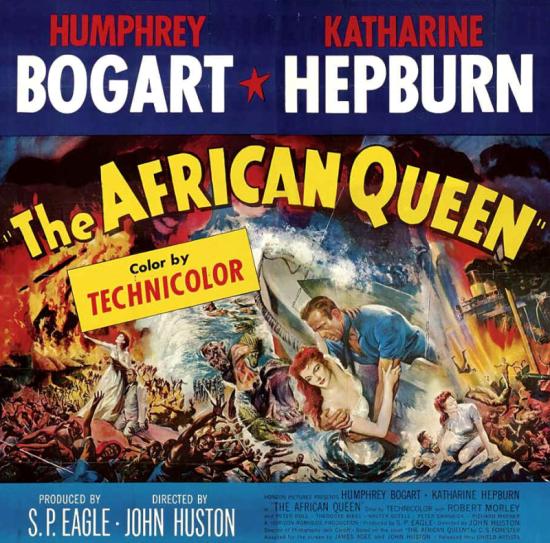
Poster for The African
Queen, 1951
Picture from
SwapSale.com
Sources
Tanganjikasee - A Gunboat War in Deutsch-Ostafrika
1914 - 1916 by Dennis L Bishop and Holger Dobold
"Die Operationen in Ostafrika im
Weltkrieg 1914-1918" by Ludwig Boell, Verlag Walter
Dachert, Hamburg 1951
"Königsberg- A German East African
Raider" by Kevin Patience, Zanzibar Publications,
Bahrain 1997
"Das Offizierskorps der Schutztruppe für Deutsch-Ostafrika
im Weltkrieg 1914-1918" by
Wolfgang-Eisenhardt Maillard and Jürgen Schröder,
Walsrode 2003
"Meine Erinnerungen aus Ostafrika" by Paul von
Lettow-Vorbeck, KF Koehler Verlag, Leipzig 1920
"Erinnerungen an meine
Kriegsjahre in Deutsch-Ostafrika 1914- 1918 by Kurt
Wahle, O. Ortsang. 1920
"Die Möwe-Abteilung auf dem Tanganjikasee in DOA 1914 – 1916" by Gustaf
Zimmer, Marine Archiv, Berlin 1931
"Hauptmann Wintgens Rueckzug von Ruanda nach Tabora und
die Kaempfe um Tabora" by Bruno Koppe, Koloniale Rundschau, Leipzig 1919
"Mimi and Toutou go Forth" by Giles Foden, Penguin
History Book , London 2005
"A
Machine Gunner’s Odyssey Trough German East Africa:
January 1916 – February 1917" by ES Thompson
published by the
South African Military Society
"Kampf im Rufiji-Delta, Das Ende des Kleinen
Kreuzers Königsberg" by RK Lochner, Wilhelm Heine
Verlag, München 1987
"La
campagne anglo-belge de l'Afrique Orientale
Allemande" by Charles Stiénon, Paris 1918 shown at
Archiv.Org
"The First
World War in Africa" by Hew Strachan, Oxford
University Press 2004
Revue du Touring Club de Belgique #19, 1 October
1936
Axis History Forum Discussion on the Hedwig von
Wissmann
Axis History Forum Discussion on Kurt Wahle
1914-18.InvisionZone Discussion of Vizesteuermann Edel
Stanleyville.be with lots of photos of the gun
on display in the Belgian Congo
Axis History Forum Discussion on the SMS Königsberg
Guns in English
Panzer Archiv Forum Discussion on the SMS Königsberg
Guns in German
Thanks on this page to Jean-Luc
Ernst of
Stanleyville.be and Per Finsted for their
additional help.
|