|
The
Gun at the Elephant's Foot in Kigoma
"For
four days before the fall of Tabora those who were
in the town heard heavy gun-fire resulting from an engagement which was taking place to the
north."
(New Zealand Sun newspaper,
16 March 1917)
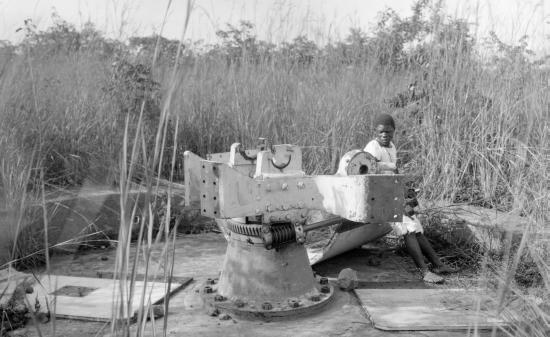
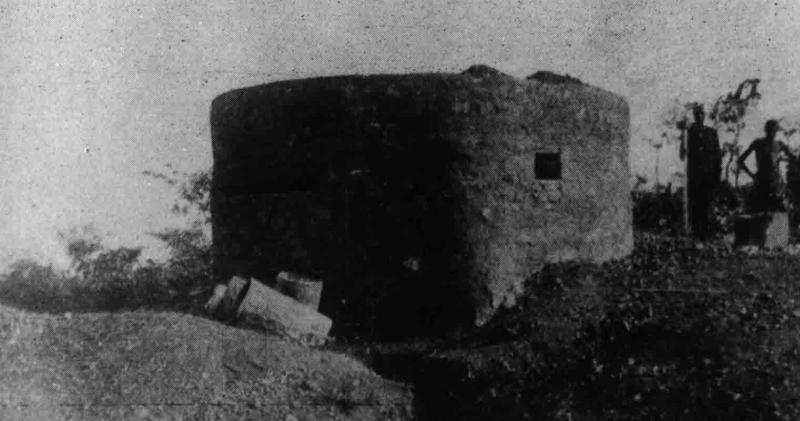
Remains of the Gun Emplacement at Kigoma
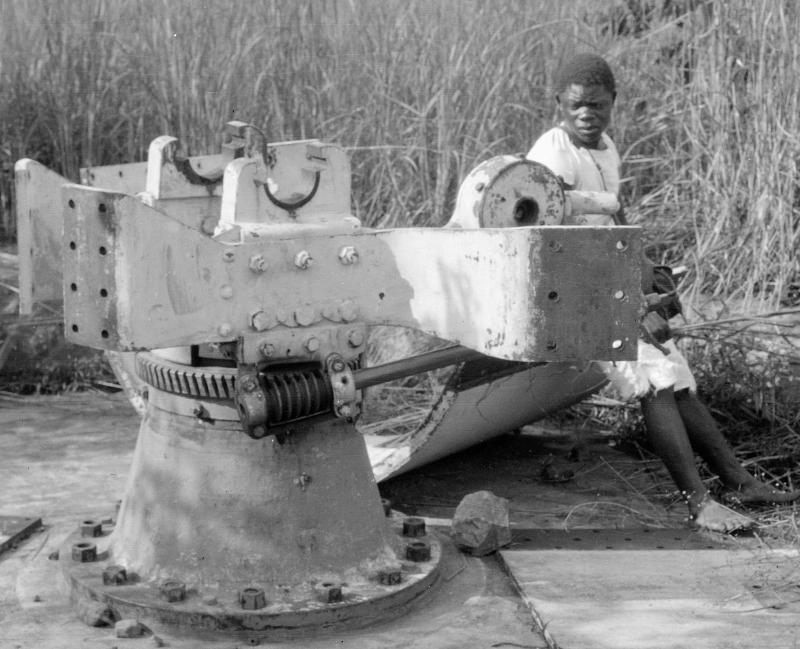
This gun was originally one of
the turreted guns on the SMS Königsberg. It
therefore had a flange on the barrel to hold a small
shield which would fit inside the turret. It was one of two
guns sent west to Kigoma on the shore of Lake Tanganyika.
The other was the
Gun Mounted on the SS Goetzen.
Deployment at Kigoma
After being refitted in Dar Es Salaam, two of the
SMS Königsberg guns were
transported from Dar Es
Salaam to Kigoma on the Central Railway via Dodoma
and Tabora.
The German
defence of Lake Tanganyika was under the command
of the resourceful Korvetten-Kapitän Gustav Zimmer
(former captain of the SMS Möwe) and came under the
overall command of Generalmajor Kurt Wahle's Western
Schutztruppe.
"After July 1915,
when the SMS Königsberg was sunk by the English, two
of the 10.5cm guns were sent to Kigoma. From there,
one was used on Lake Tanganyika and the other was
emplaced on a mountain overlooking Kigoma."
(Original
Quotation from P15 "Die Möwe-Abteilung
auf dem Tanganjikasee in DOA 1914 – 1916" by Gustav
Zimmer, Marine Archiv, Berlin 1931)
While one of
the two guns was installed on
the SS Goetzen, the other gun was put into a fixed
emplacement on the Elephant's Foot ("Elefantenfuß")
peninsular between Kabando and Kigoma in August 1915.
The gun was mounted on its original naval fixed
pivot stand with its turret. Around the gun
emplacement a series of trenches and blockhouses
were constructed.
Here it
overlooked the lake and due to the fact that it
outranged the guns on any allied ships in the area
it was able to protect Kigoma from a potential
seaborne assault. The threat eventually came from
Belgian forces coming on land from the north.
Deployment towards Tabora and Counter Offensive
Actions
By September 1916 the Central Railway
at Dar Es Salaam was in British and South African hands and
Belgians were advancing on the Central Railway at
Kigoma from the North.
Korvettenkapitän Zimmer
heard reports of Belgian askaris at Ussoke and
immediately ordered the gun to be removed from the
emplacement at the Elephant's foot and sent along
the Central Railway to towards Tabora. A
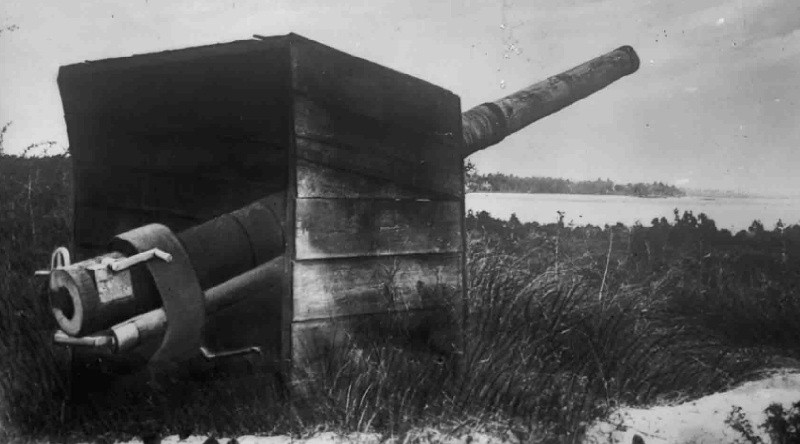
fake gun and turret was put on the lakeside to deter
allied ships in the absence of the real gun.
Unfortunately, we have not seen any photographs of
the real Elephants Foot gun after it was removed
from Kigoma as the Schutztruppe retreated.
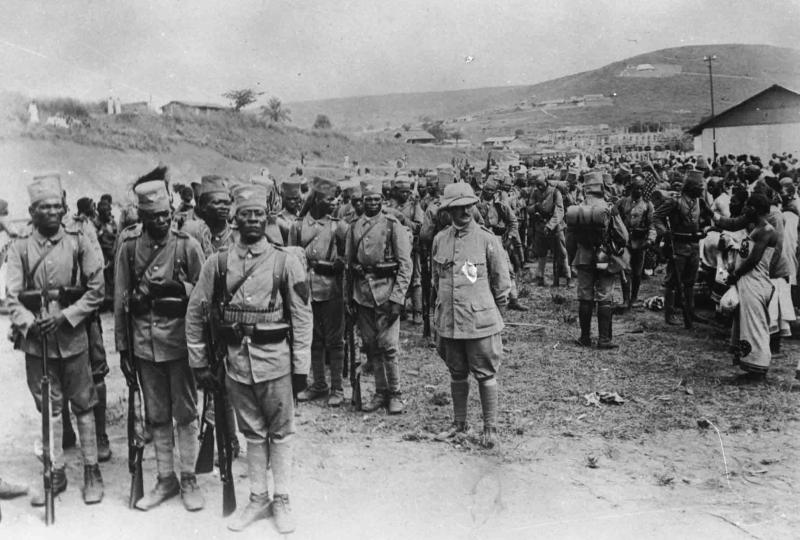
Schutztruppe Askari Company,
Kigoma 1916
Photo by Gustav
Zimmer
©
Frankfurt University Koloniales Bildarchiv
According to
the diary of Hans Apel (of the the Königsberg gun
officers), one of the Krupp gun carriages that
arrived on the SS Marie was sent to Kigoma. The gun
from the SS Goetzen that was later displayed in the
Belgian Congo had a Dar Es Salaam carriage, so the
Krupp carriage that he mentions must have been for
the Elephants Foot gun.
The problem
here is that the SS Marie only carried four Krupp
gun carriages for the Königsberg's guns. One was
given to the Gun at
Kondoa-Irangi, one to the
Gun at Bagamoyo, one to
Wenig's Gun later captured at Mahiwa and one to
the Tanga Gun that was
destroyed at Masasi.
The gun at
Kondoa-Irangi suffered a mis-firing in May 1916 that
had damaged both the barrel and the carriage and it
was sent back to Dar Es Salaam for repairs. The
engineers at Dar Es Salaam could not repair the
barrel and buried it. We have not found a record of
what happened to the gun carriage. Maybe it was
repaired with improvised parts or perhaps just the
wheels were usable and a new carriage was made for
the gun at Kigoma.
What we do
know is that as the gun was
withdrawn east down the Central Railway it took part in a series of counter
attacks organised by Wahle's Schutztruppe to delay the Belgian advance. About twenty
miles west of Tabora, the gun was first put into
action on land at Mabama
on 1 September 1916 under
Kapitänleutnant Fritz Schreiber as artillery
commander.
On the
night of 2/3 September it was involved in the German
counter offensive south of Ussoke. It remained at Ussoke and again saw
action on 7 September.
The biggest counter offensive
of the Schutztruppe in the west was at the Battle of Lulanguru
fifteen miles west of Tabora on the Central Railway.
Alongside one of the 10.5cm howitzers from the SS
Marie and two 3.7cm guns from the SMS Möwe, the
Königsberg 10.5cm gun from Kigoma, now commanded by Leutnant z.S.
Reinhold Kohtz, supported Hauptmann Wintgens'
Abteilung in their battle
from 10-12 September against the Belgian advance.
After three
days fighting the gun was retreated to Tabora.
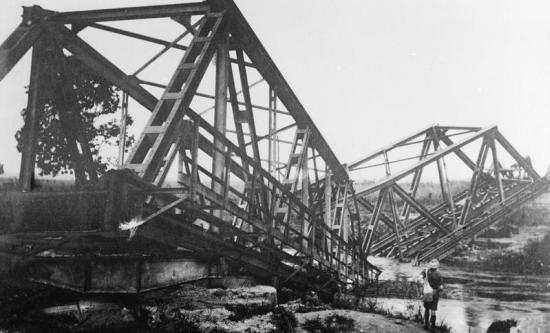
Railway Bridge on the
Central Railway near Tabora, 1916
The Germans destroyed much of the Central Railway
and anything that the allies might find useful, as
they retreated East and South.
Photo from the
Lt-Col Mann Collection ©
Imperial War Museum
Battle of Itaga and the Destruction of the Gun
From Tabora it was sent north
overland to Itaga where Wahle had set up his
headquarters.
It was
deployed again alongside
the 10.5cm howitzer and saw
action against
the Force Publique from 13-14 September. It was
at Itaga that on the afternoon of 18 September
1916 the gun fired its last 30 rounds at Belgian camps at
Misha
and Matende
and was abandoned. It thus become the seventh of
the ten Königsberg guns to be put out of action.
"For
four days before the fall of Tabora those who were
in the town heard heavy gun-fire resulting from a
day's engagement which was taking place to the
north."
(Quotation from
New Zealand Sun newspaper, Volume IV, Issue 966,
16 March 1917, Page 11)
We have not been able to
find any later references to the gun, its capture or
its whereabouts since. This gun is
therefore unaccounted for.
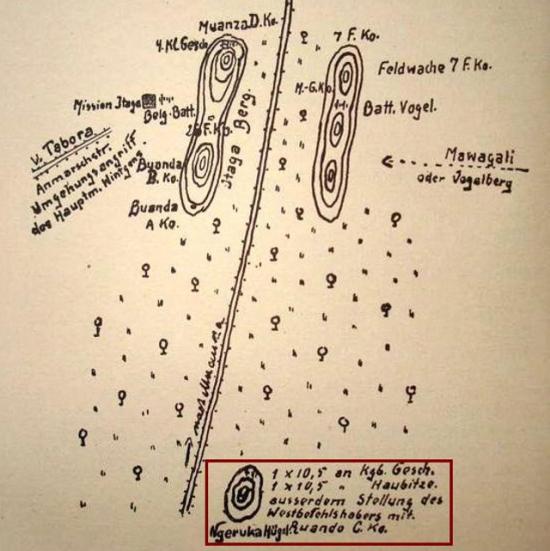
Sketch Map of the
Battle of Itaga, September 1916
In the upper left corner, the Belgians hold Mount
Itaga, opposed by the Schutztruppe 7. Feldkompagnie
and Batterie Vogel (under Oberleutnant d.R. Dr.
Alfred Vogel, former commander of the Königsberg
Gun
at Mwanza). The position of the Königsberg gun and
10.5cm Howitzer to the bottom of the map is marked
in red.
Belgian
Occupation of Tabora
The
following day on the 19 September, the Belgian
Force Publique under Tombeur entered Tabora without a
fight. The Schutztruppe had already moved south and
the British under
Brigadier-General Crewe halted their advance after
the fall of Mwanza.
For this action the commander was later awarded the
title Baron Tombeur of Tabora.
After
occupying Tabora
the Belgians
"demanded an unspecified quid pro quo in
consideration of rendering any further military
assistance",
which offer the British declined. And so the Belgian
advance went no further than Tabora.
(Quotation from the British War Office "Précis
of correspondence relating to Belgian occupation of
Tabora District, German East Africa, and further
Belgian co-operation in the East African campaign
1916" WO 106/257 at
National Archives, Kew London)
In
the hospital at Tabora the Belgians captured several German
patients including Reinhold Kohtz. Kohtz had
commanded three of the Königsberg guns, the mis-fired
Gun at Kondoa-Irangi, its
replacement in the Former SS
Goetzen Gun and lastly the gun recently captured at Itaga.
The Belgians
eventually withdrew from Tabora which came under
British rule as part of the new colony of Tanganyika
after the First World War. At the Treaty of
Versailles, the Belgians gained the former German
territories of Ruanda and Burundi for their part in
the campaign.
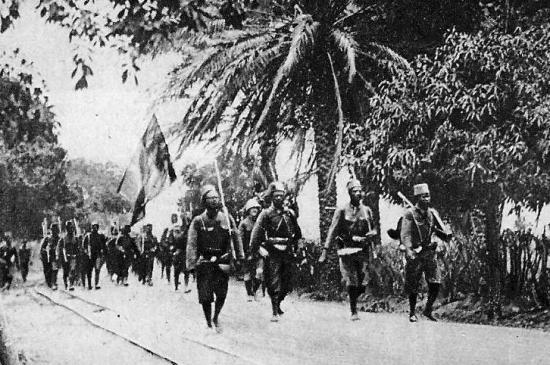
Belgian Askaris
entering Tabora, 19 September 1916
Originally
published in 'Les
Campagnes Belges d'Afrique 1914 - 1917' by the
Belgian Ministere des Colonies, 1918 on
Wikimedia
Remains of the Gun Emplacement
at Kigoma
The pivot
stand, turret parts and emplacement itself at the
Elephants foot remained in place for some time after
the war. It is not known how much of them still
remain but a recent tourist website reported:
"On a hill halfway
to Katonga are the remainders of some First World
War German fortifications. The place intended for
the 105mm naval gun that was taken from the MV
Liemba is the most interesting one of the remains.
When the Germans left Kigoma, the gun was carried
away to be never found again. There are several
bunkers, old ammunition stores and interconnecting
channels. It is said that one of these channels runs
from the regional commissioner’s office to the train
station, though nobody knows all the precise details
of this."
(Quotation from
KigomaDioceseTourism)
They have mixed the gun
up with that on the SS Goetzen but they certainly
describe the gun emplacement as still being visible.
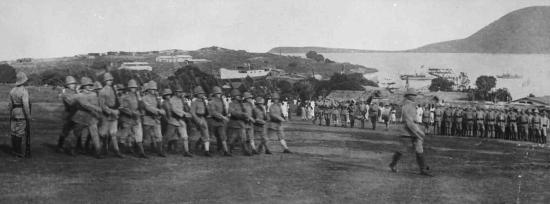
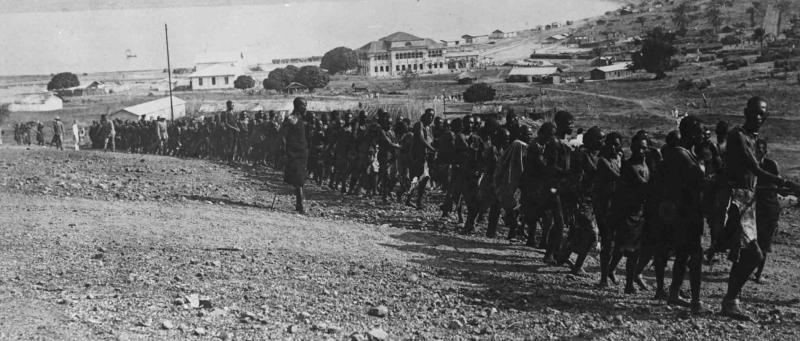
Schutztruppe on
Parade in Kigoma to Celebrate the Kaiser's Birthday,
27 January 1915
Lake Tanganyika, the
port of Kigoma and the SS Goetzen under construction
in dry docks can all be seen in the background.
Photo
©
Frankfurt University Koloniales Bildarchiv
Sources
"Meine
Erinnerungen aus Ostafrika" by Paul von
Lettow-Vorbeck, KF Koehler Verlag, Leipzig 1920
"Die Möwe-Abteilung auf dem Tanganjikasee in DOA 1914-1916" by Gustaf
Zimmer, Marine Archiv, Berlin 1931
"Tätigkeit S.M.Vermessungsschiff Möwe und
seiner Besatzung bei Kriegsausbruch in
Deutsch-Ostafrika 1914" by Gustav Zimmer, Sidi-Bishr
1918
at
Traditionsverband
"Lebensbericht
5. Die Schiffsgeschütze als Artillerie der
Kaiserlichen Schutztruppe" by Hans Apel, unpublished
personal memoirs
"Die Operationen in Ostafrika im
Weltkrieg 1914-1918" by Ludwig Boell,
Verlag Walter Dachert,
Hamburg 1951
"Das Offizierskorps der Schutztruppe für Deutsch-Ostafrika
im Weltkrieg 1914-1918" by
Wolfgang-Eisenhardt Maillard and Jürgen Schröder,
Walsrode 2003
"Les
Campagnes Belges d'Afrique 1914-17" published by the
Belgian Colonial Ministry
"The First
World War in Africa" by Hew Strachan, Oxford
University Press 2004
"Königsberg- A German East African
Raider" by Kevin Patience, Zanzibar Publications,
Bahrain 1997
"The First
World War in Africa" by Hew Strachan, Oxford
University Press 2004
New Zealand Sun newspaper, Volume IV, Issue 966,
16 March 1917, Page 11
Original Map from 'A
Short History of the Great War'
by AF Pollard,
Methuen & Co, London
KigomaDioceseTourism
WorldWar1Gallery.com
Axis History Forum Discussion on the SMS Königsberg
Guns in English
Panzer Archiv Forum Discussion on the SMS Königsberg
Guns in German
|