|
The
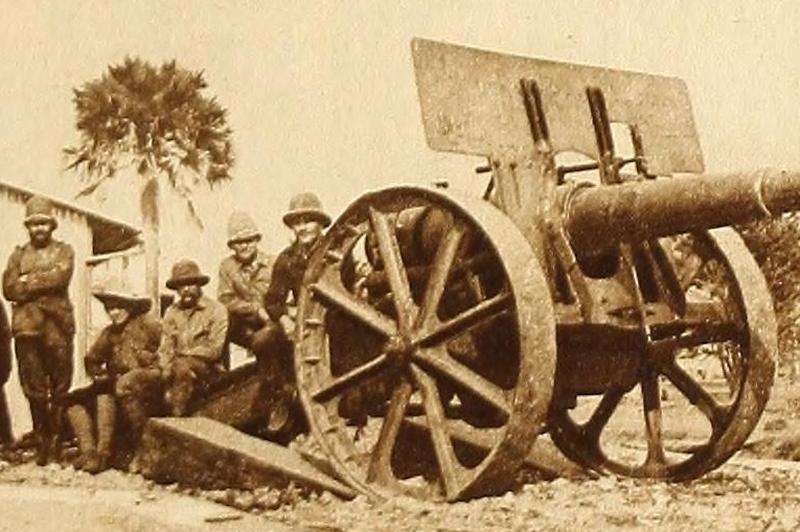
Kondoa-Irangi 'Big Bertha'
"In a
clearing by a hilltop we
rested and found Big Bertha, as the 10.5cm was
nicknamed"
August Hauer, Schutztruppe Doctor
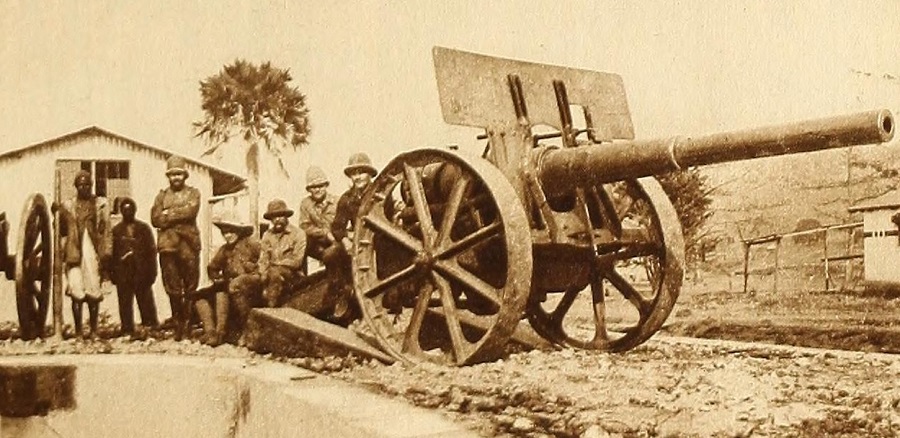
Gun at Dodoma, 1916
Originally
published in "Les
Campagnes Belges d'Afrique 1914-17"
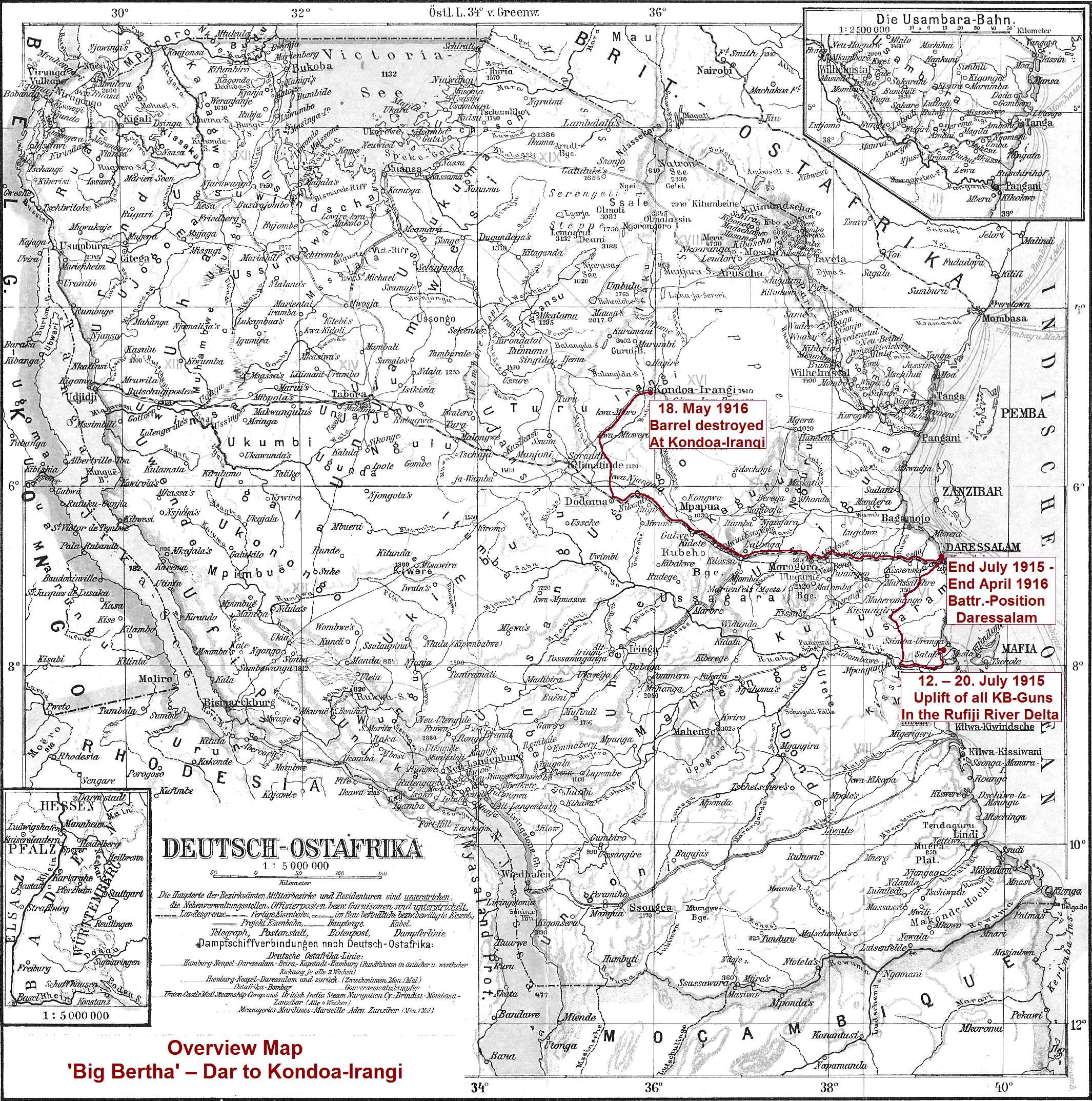
Deployment to Dar
Es Salaam
Big Bertha
('dicke Bertha' in German), was
commanded by one of the original SMS
Königsberg officers, Leutnant z.S. Reinhold Kohtz and
was one of the five guns initially deployed for the
defence of Dar Es Salaam from July 1915 until April
1916.
The Battle of
Kondoa-Irangi
As General Smuts opened his South African offensive
into the north of German East Africa in March 1916
taking Moshi and Kahe, the South African
2nd Division under General van Deventer invaded the
Germans took the
town of Kondoa-Irangi as a risky part
of the general southward offensive begun by General
Smuts the previous month via Kahe and towards the
crucial German Central
Railway (Mittellandbahn).
Although the
South Africans captured Kondoa-Irangi with few
casualties, they became stranded there with over
stretched supply lines as the rainy
season began. Many of the horses of the supply line had
been killed by the Tsetse fly that plagued German
East Africa and the South African soldiers
themselves were plagued by malaria
and ended up having to scavenge for food to support
their limited rations.
Von
Lettow-Vorbeck saw the weakness of the South
Africans and diverted his troops and artillery there
to try to take Kondoa-Irangi back in a major-counter
attack.
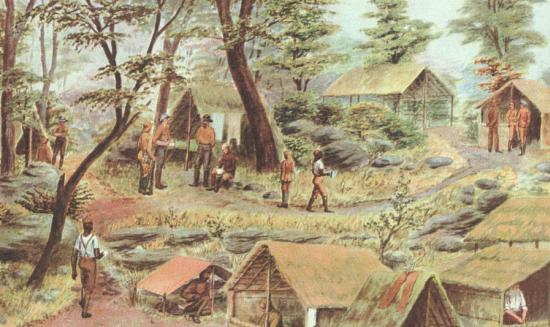
German Command Post
at Kondoa-Irangi, 1916
Eyewitness
Illustration by Walther Rehfeldt from published in "Bilder
vom Kriege in Deutsch-Ostafrika" published by
Charles Fuchs, 1920. Now shown on
ReichsKolonialamt.de
In April
1916 Kohtz's gun was mounted on one
of the Krupp gun carriages which had arrived on the
SS Marie the previous month and
was sent to Dodoma
down the Central Railway. From Dodoma
it was loaded onto a Boer wagon and sent to Kondoa-Irangi to
shell the South African positions.
For the journey
from Dodoma to Kondoa-Irangi the barrel
was separated from the carriage. The Krupp carriages
were heavy and even with the widened wheels the
additional weight of the barrel may have caused it
to sink in the mud during what was the rainy season
at the time. August Hauer, a doctor who served in the Schutztruppe
noted- "There was no time to be lost. The
enemy was advancing on Kondoa. Now there, we had an
eight-day forced march to Dodoma where in the market
place we saw a Boer wagon loaded with the long
barrel of one of the Königsberg guns."
(Quotation from P144-146 "Kumbuke,
Kriegserlebnisse eines Arztes" by August Hauer,
Deutsch-Literarisches Institut J Schneider, Berlin-Tempelhof
1935)
He also saw
the gun a few days later- "In
a
clearing
by a fine hilltop we rested and found 'Big Bertha',
as the 10.5cm was nicknamed. Not less than 32 oxen
were attached to the Boer wagon on which she lay
sprawled black and stiff."
(Quotation from P144-146 "Kumbuke,
Kriegserlebnisse eines Arztes" by August Hauer,
Deutsch-Literarisches Institut J Schneider, Berlin-Tempelhof
1935)
At
Kondoa-Irangi the gun was re-assembled and along
with one of the smaller 8.8cm Königsberg guns (under
Oberleutnant z.S. Wunderlich, formerly of the SMS
Möwe) put
into action against the allied forces. The commander of
the Schutztruppe, Paul von Lettow-Vorbeck described
the position as- "We
had two
naval guns, one 8.8 cm and 10.5 cm, carried on
wheeled carriages and immediately placed them in
position. These shot at the enemy camp south of
Kondoa from our overlooking positions with
apparently good results."
(Quotation from P116 "Meine
Erinnerungen aus Ostafrika" by Paul von
Lettow-Vorbeck, KF Koehler Verlag, Leipzig 1920)
Joining the two Konigsberg guns were the two 10.5cm
Howitzers that had arrived on the SS Marie. This
gave the Germans artillery superiority for the first
time (and last) time in the East African Campaign.
Schutztruppe officer Karl Ernst Göring, described
the German artillery in his memoirs-
"The artillery uniformly commanded by my friend Franz Köhl,
had a 10.5cm and an 8.8 cm naval gun as well as
the two 10.5cm field howitzers which had arrived with the
auxiliary ship (SS Marie). These came into effective action in the
battlefields before Kondoa for the first time."
(Quotation from P52
"Meine
Kriegserlebnisse
in Deutsch-Ostafrika 1914-1920" by Karl Ernst Göring)
The British
and South Africans returned fire with their
artillery but for the first and only time in the
campaign, the Germans had artillery supremacy on the
battlefield. The British artillery included one of
the salvaged guns from HMS Pegasus-
"We learned later that the
enemy 12.5cm (sic) cannons came from the English cruiser
Pegasus, which our powerful Königsberg had
sunk before Zanzibar in 1914.
Thus, the defeated guns of friend and foe exchanged
their bronze greetings in the African bush."(Quotation
from P52
"Meine
Kriegserlebnisse
in Deutsch-Ostafrika 1914-1920" by Karl Ernst Göring)
The 10.5cm Königsberg gun did not
last long in action however.
Rudolf
Viehweg, one of the SMS Königsberg sailors in East
Africa simply noted- "A
gun
had been sent from Dar Es Salaam to Kondoa, but soon
had to be replaced due to a broken barrel."
(Quotation from P105 "Erlebnisse eines
Matrosen auf dem Kreuzer ,"Königsberg"´ sowie im
Feldzug 1914-18 in DOA" by Rudolf Viehweg, Buchhandel Krüger & Co, Leipzig 1933)
Dr. Ludwig
Deppe, who also served in the East African
Schutztruppe in the First World War described the
gun's action as- "The
second
Dar
Es Salaam gun under Oberleutnant Kohtz went to
Dodoma end of April and then to Kondoa. After firing
a few shots it had a barrel burst and was brought back
to Dar es Salaam, where it was buried."
(Quotation from
P477
"Mit Lettow-Vorbeck durch Afrika" by Dr.
Ludwig Deppe, August Scherl Verlag, Berlin 1919)
So it seems that the gun fired
its first and
last shots at the Battle of Kondoa-Irangi before
damaging its own barrel with an accidental misfiring
on 18 May 1916 making it the second of the Königsberg's
heavy guns to be put out of action.
The German word that Deppe uses to describe the
gun's accident is "Rohrkrepierer". This is
roughly translated into English as a barrel burst,
but is often known in a military terminology as a
squib load. A squid load occurs when a round fails
to leave the barrel and sometimes detonates there.
It is purely a matter of speculation to wonder if the misfiring
was due to a gunner's error, an over heated barrel, an
existing fault in the gun
itself or down to faulty ammunition that had been
recovered from the River Rufiji and cleaned and
dried out to the best of the abilities present.
The official German War Diary 'Kriegstagebuch'
notes that the gun's Krupp carriage was also damaged
in the explosion.
The gun was
taken back to Dar Es Salaam for repairs but was
deemed to be damaged beyond repair and according to Deppe,
was
buried (probably somewhere near the railway works).
Although
repeated German assaults on Kondoa-Irangi failed to
recapture it, the Schutztruppe artillery continued
to pound the enemy defences.
Finally in
mid-July 1916 as the rainy season abated, van Deventer was able to continue his
advance and the Germans were forced to withdraw from
Kondoa-Irangi to avoid encirclement by Smut's other
South African column advancing from the West. This
left the way open for van Deventer to take the
Central Railway at Dodoma.
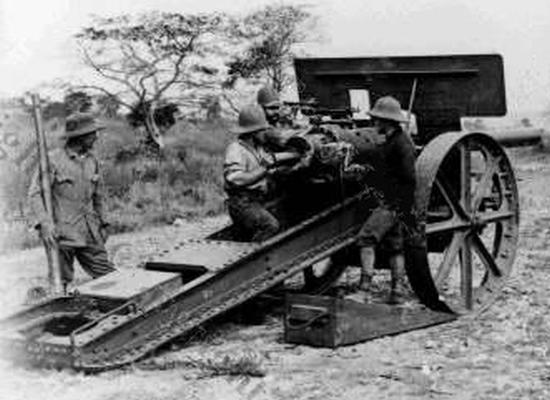
10.5cm SMS Königsberg Gun, Dodoma 1916
Sources
"Kumbuke,
Kriegserlebnisse eines Arztes" by August Hauer,
Deutsch-Literarisches Institut J Schneider, Berlin-Tempelhof
1935
"Meine
Erinnerungen aus Ostafrika" by Paul von
Lettow-Vorbeck, KF Koehler Verlag, Leipzig 1920
"Erlebnisse eines
Matrosen auf dem Kreuzer ,"Königsberg"´ sowie im
Feldzug 1914-18 in DOA" by Rudolf Viehweg, Buchhandel Krüger & Co, Leipzig 1933
"Mit Lettow-Vorbeck durch Afrika" by Dr.
Ludwig Deppe, August Scherl Verlag, Berlin 1919
"Kommando der
Schutztruppe für Deutsch-Ostafrika.- Kriegstagebuch
1916", Bundesarchiv
"Meine
Kriegserlebnisse
in Deutsch-Ostafrika 1914-1920" by Karl Ernst Göring
"Das Offizierskorps der Schutztruppe für Deutsch-Ostafrika
im Weltkrieg 1914-1918" by
Wolfgang-Eisenhardt Maillard and Jürgen Schröder,
Walsrode 2003
"Les
Campagnes Belges d'Afrique 1914-17" published by the
Belgian Colonial Ministry
"The First
World War in Africa" by Hew Strachan, Oxford
University Press 2004
"Königsberg- A German East African
Raider" by Kevin Patience, Zanzibar Publications,
Bahrain 1997
"The First
World War in Africa" by Hew Strachan, Oxford
University Press 2004
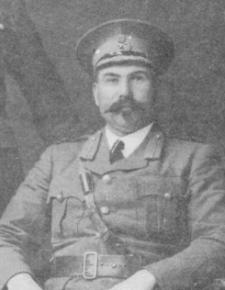
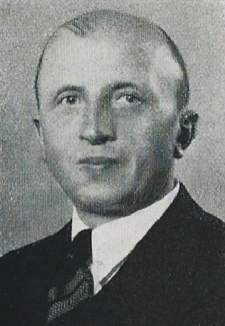
Reinhold Kohtz's testimony against former
Spruchkammer
NS-Kreisleiter Hans Hausböck
in an
article on
Garmisch-Partenkirchen
und seine jüdischen Bürger 1933-45
"C
Smuts
and JL van Deventer: South African
Commanders-in-Chief of a British Expeditionary
Force' by Ross
Anderson, South African Journal of Military Studies
2003
"Army Diary
1899–1926" by Richard Meinertzhagen,
Oliver & Boyd,
Edinburgh 1960
Original Map from 'A
Short History of the Great War'
by AF Pollard,
Methuen & Co, London
1920
WorldWar1Gallery.com
Axis History Forum Discussion on the SMS Königsberg
Guns in English
Panzer Archiv Forum Discussion on the SMS Königsberg
Guns in German
|