|
The End of the SMS
Königsberg
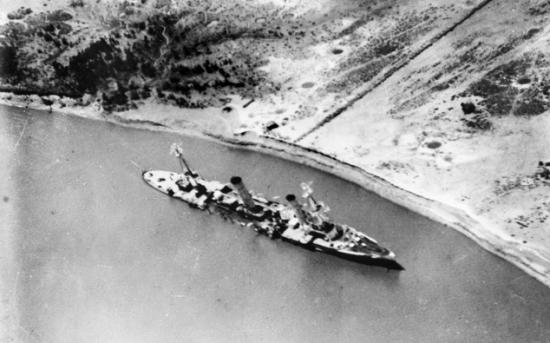
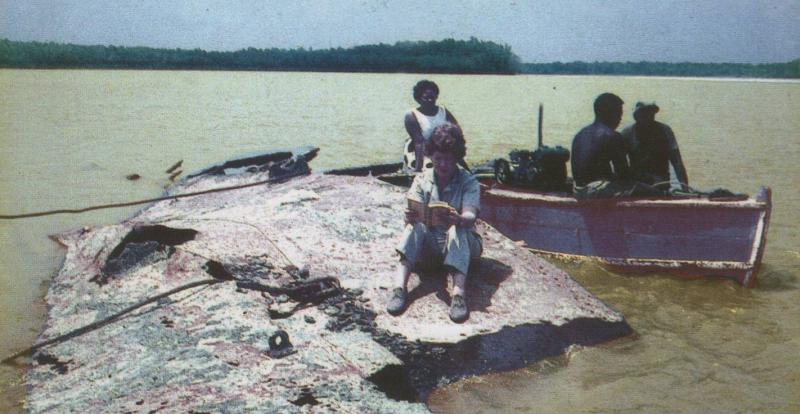
Last Known
Photograph of the SMS Königsberg above water in 1965
"Stories
circulated for years of other guns seen in remote
areas of the bush."
Kevin Patience, "Königsberg- A German East African
Raider"
End of the Ship
After the guns, radios,
medical supplies and any other equipment useful to the
Schutztruppe were
salvaged from the wreck of SMS Königsberg it was
left to rust and gather weeds. During the war, Nis
Kock a stoker from the SS Kronberg noted that
already "Farther
downstream the Königsberg lay shattered and burnt,
her deck overgrown with creeping plants and her side
plastered with the slimy river weeds"
(Quotation from P168 "Blockade and Jungle" by
Nis Kock, edited by Christen P Christensen, Battery
Press 2003)
Sailors from the Royal
Navy and other trophy hunters
later salvaged more small parts over the following
years which have ended up in private or museum
collections. Ironically as a salvage dealer in East
Africa in 1923 John Ingles, the former
captain of the HMS Pegasus bought the rights to
the SMS Königsberg for £200 along with the wrecks of
the Hedwig, Rovuma and Tomondo. That must have given
him some form of personal satisfaction in that he now owned
the ship that had so infamously sunk his own back in
1914.
But it was not a
profitable venture for Ingles and finding himself
unable to salvage the wreck from
its watery grave he later resold its scrap rights. Nobody
ever fully salvaged the vessel and the SMS Königsberg
gradually keeled over onto her starboard side and slowly sank deeper into the mud of the river Rufiji over
the decades. It was last seen above water in the
mid 1960s.
Remaining Relics of the SMS Königsberg
Not all traces of the ship have completely
disappeared beneath the waves. As we have
already seen on this website, three of the guns are
still on display in Pretoria, Mombasa and Jinja.
Another three were on display after the First
World War, those in Dar Es Salaam and England were
removed in the 1930s and the other in the former
Belgian Congo was removed in the 1970s.
The former SS Goetzen
Gun that was on display in Stanleyville in the
Belgian Congo is now now probably scrapped or
dumped somewhere in modern Kisangani in the
Democratic Republic of Congo. The
gun captured at Bagamoyo is now either scrapped or
buried under a car park in Hove, England. The car
park is due for redevelopment later this year but as
yet appeals to the local council to conduct a search
for the gun before building begins have proven
unsuccessful.
The other
four
are most probably rusting away near where they were last
seen in the former German East Africa. The
Kondoa-Irangi Gun is most likely still buried near
the old railways workshop in Dar Es Salaam. The Mkuyuni River Crossing Gun was also probably scrapped
or dumped in Dar Es Salaam as was the remains of the
Kahe Railway Gun after its display at the Governors
residence. Apel's gun was seemingly never recovered
from where it was captured near Mount Kibata. It is
probably corroding there to this day.
The
Imperial War Museum, London
has several parts of the Königsberg in their
collection: the ship's steam whistle, a ships
navigational device, a shell case and a torpedo aiming device. The
National Maritime Museum in Greenwich, London
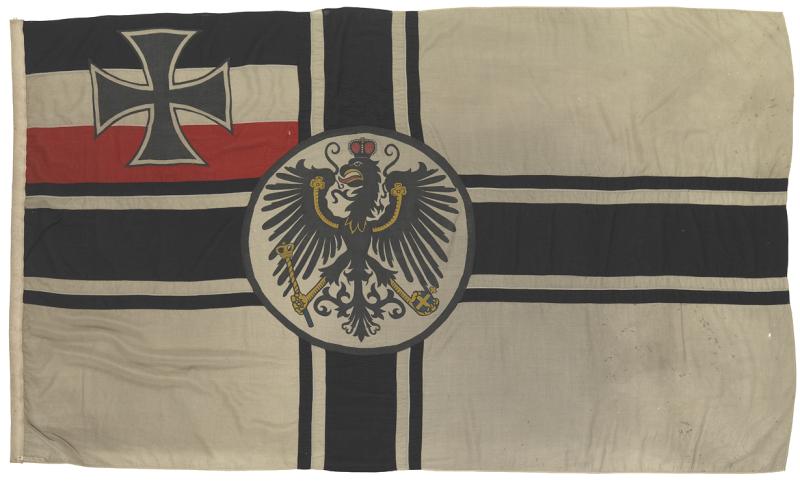
has several items including an ensign flag which is
claimed to be from the SMS Königsberg. The
officers' table furniture from the ship is now at the
Kenya Railway Museum (having been taken off the
ship in 1914 as she set sail on her brief raiding
career). Many other small parts salvaged from the
ship are in collections around the world.
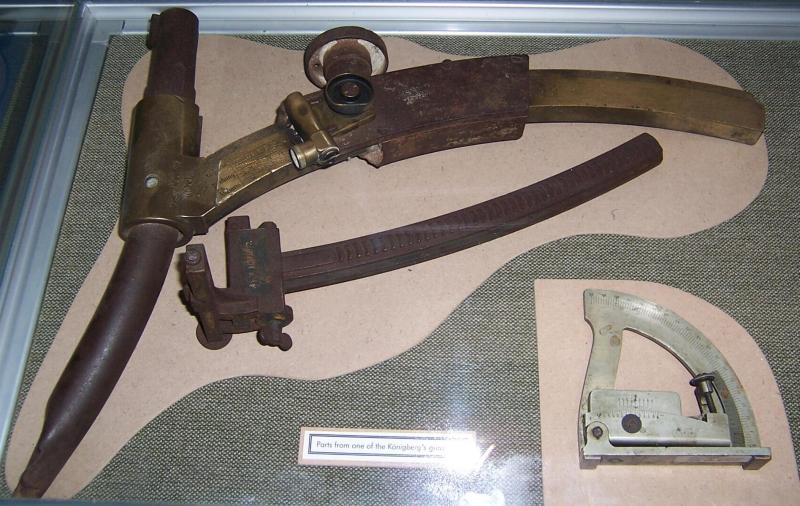
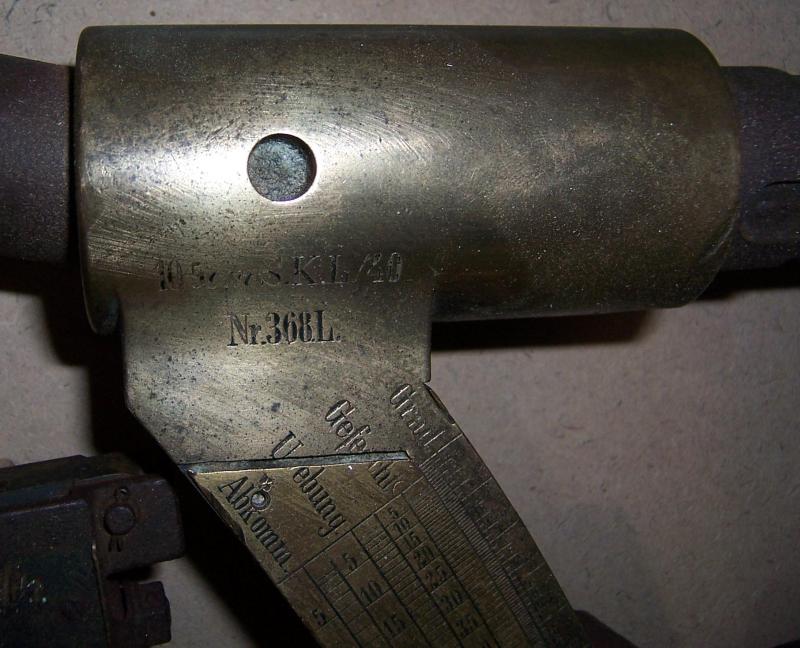
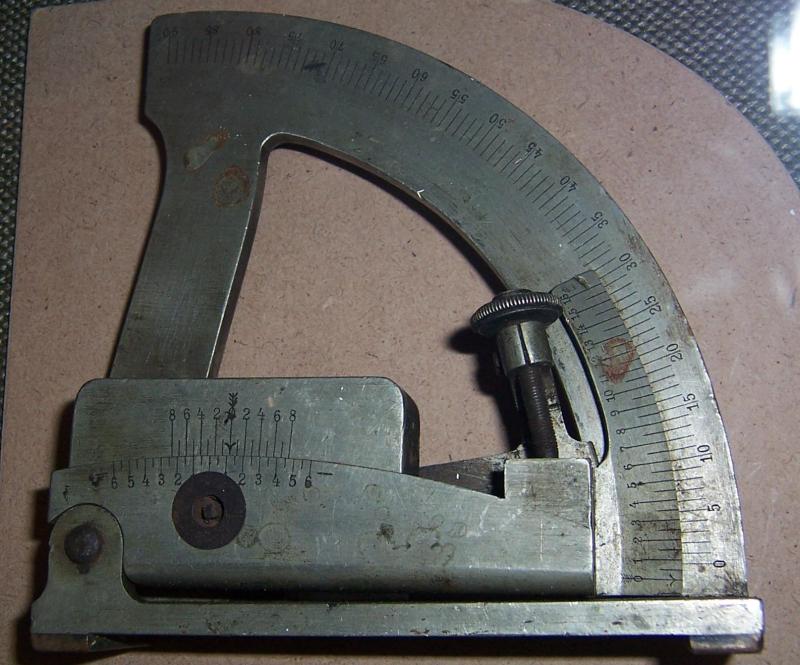
There is a twisted sight
arm and aiming quadrant from one of the 10.5cm
Königsberg guns with the serial number 368 on display at the
South African National Museum of Military History in
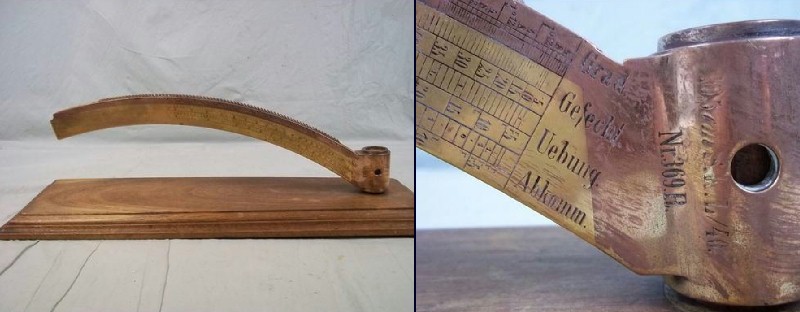
Johannesburg and a sight arc from one of the guns
with the serial number 369) recently turned up at
the
Antiques Storehouse in Portsmouth, England.
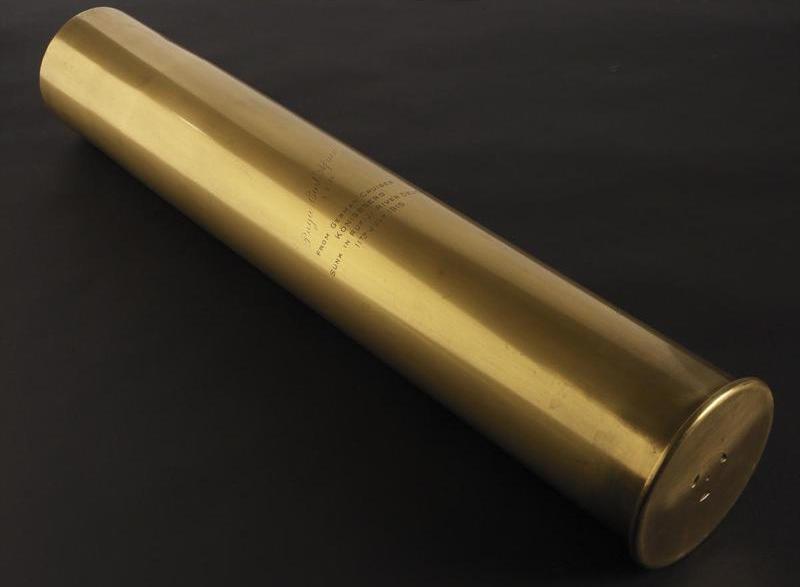
I have seen a couple of
shell casings from the Königsberg guns in private
collections in South Africa and there are probably
many more out there somewhere. There
is a Königsberg 10.5cm Shell captured at Bagamoyo in
August 1916 at
the
Simons Town Museum
in
South Africa and there is a
cordite shell container from the Königsberg in the
Zanzibar Museum, Tanzania.
There was also a story
that the Germans put the used brass Königsberg shell
cases to further use in East Africa by punching them
out as small discs and stamping them into Ersatz
coins for wartime currency, though I have yet to
find proof of this.
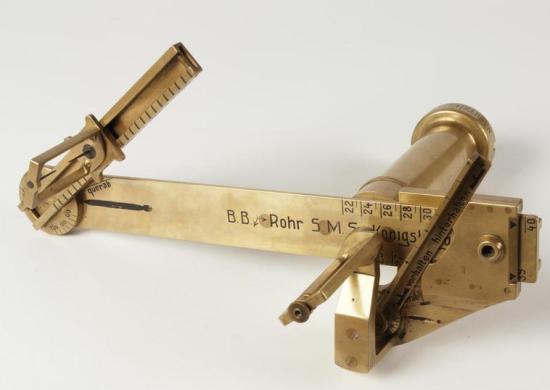
Torpedo Aiming Device
from the SMS Königsberg
Photo
©
Imperial War Museum
Veterans of the SMS Königsberg
During the Königsberg's
final battle in the Rufiji in 1915, thirty three of
the crew were killed and many more severely wounded.
The surviving
crew served on land as part of the
Schutztruppe for the duration of the war. Some served
with the now land based Königsberg guns deployed around East Africa,
fifty served on Lake Tanganyika in the West
while most formed a new Schutztruppe unit as the Abteilung
Königsberg under the ships former commander Max
Looff. As such they protected the Rufiji Delta and
successfully defeated an attempted
Portuguese invasion in October-November 1916.
The Abteilung Königsberg remained based in the
malarial swamps of the Rufiji for two years and
suffered the obvious consequences in
high casualty rates from sickness until the British and South
Africans advanced into the area in 1917 and the
Schutztruppe prepared to invade Portuguese East
Africa.
Some
histories say that only fifteen of the original crew
of 322 survived the war to make it back to
Germany. Even by the standards of the First World
War a 95% casualty rate in a land based unit is
severely high and the figure needed further
clarification.
In fact fourteen crew of the SMS Königsberg
remained in active service with the Schutztruppe up
until their final surrender along with von
Lettow-Vorbeck at Abercrombe in British Rhodesia on
25 November 1918, exactly two weeks after the European Armistice.
Among them were two of the gun commanders, Hans Apel
and Richard Wenig.
A full list of the last 155 Germans to surrender and
identification of these officers can be found at
Traditionsverband.de.
When Looff was
re-joined with the last fourteen survivors for their
return to Germany, they became known as the last
fifteen.
But
they were not the only crew of the Königsberg to
have survived the war. Some had been captured by the
British earlier in campaign, the largest number
along with Max Looff had surrendered to the British
when the Schutztruppe slimmed down its force and
invaded Portuguese East Africa. At that
point the
wounded, those stricken by malaria or considered unfit for
the final campaign simply remained in camp in the south of
the colony near Lindi and awaited
British capture. Those prisoners of war that
lived through their sickness and injuries were
usually transferred to camps in Egypt (Sidi-Bishr
near Alexandria for officers and Toura near Cairo
for other ranks) before being
gradually returned to Germany in early 1919.
In 'In Monsun
und Pori Safari', Richard Wenig gives the figure
of thirty-two Königsberg veterans returning home. If
this figure is accurate it is still a very grim
statistic with the crew suffering an overall 90% casualty rate
over the course of the war.
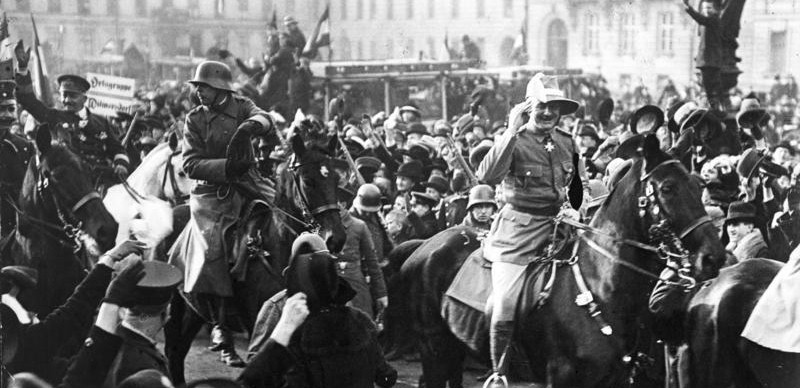
East African
Veterans' Parade,
Pariser Platz,
Berlin 1919
Von Lettow-Vorbeck is mounted in the right side
foreground. Max Looff is waving, mounted on a white
horse in the left background.
Photo from
Bundesarchiv /
Wikimedia
On 2 March
1919, von Lettow-Vorbeck, Governor Schnee and Max
Looff along with other German survivors of the
East African campaign
made a triumphant march through the Brandenburg Gate
in Berlin as the only undefeated German army of the
First World War.
The remaining Königsberg
veterans then mostly retired into private life,
several wrote their memoirs, (which have been used
extensively in this website) but few remained in
active naval up to the Second World War
Kevin Patience, an
East African resident at the time, reported that in
the 1960s "There was a story of an elderly
German gentleman who visited the site (of the
Königsberg's wreck) every two years and apparently
always bought a one way ticket to Dar Es Salaam. He
had been a crew member of the ship and his last wish
was that he could be buried in the area. Whether he
achieved his ambition is not known"
(Quotation from P184
"Königsberg- A German East African
Raider" by Kevin Patience, Zanzibar Publications,
Bahrain 1997)
Effects of the East African
Campaign of the First World War
From a purely
military perspective the Schutztruppe under von
Lettow-Vorbeck kept up an incredible tactical defence of
their colony for over four years against an almost
complete blockade and over whelming allied military
superiority.
It is estimated that the total number of British,
South African, Belgian and Portuguese forces in East
Africa during course the war numbered as many as
250,000 while
the German force including their African askaris
never totalled more than 18,000 and was usually much
less.
Although von Lettow-Vorbeck remained undefeated and
did tie down a small part of the allied war effort
with his
campaign, the amount was never great enough to have
any decisive effect on the war in Europe and Germany
was ultimately defeated in 1918 with or without the
efforts of the
Schutztruppe of East Africa.
Casualties
in East Africa were however
massive, especially among the African population who
made up the bulk of the fighting strength of both
the German and allied armies and of course suffered by
far the most civilian losses. The Schutztruppe are
estimated to have lost around 2,000 men and the allies
over 10,000. Many more died from their wounds, malaria or the following influenza epidemic shortly
after the war.
At least 100,000 African
porters died working on the allied side in the First
World War. German
figures do not record their numbers. The total number of African men,
women and children who lost their lives as a
result of the campaign and its following famines and
epidemics will never be accurately
known but easily numbered into the hundreds of thousands.
The First World War
marked the beginning of the end for European
colonial power in Africa. The suffering of the local
population in what was seen as a white man's war
encouraged increasing senses of African nationalism.
The African people had also now seen that their soldiers could
be victorious over Europeans on the
battlefield and that even the iron clad warships of
their colonial masters were not indestructible.
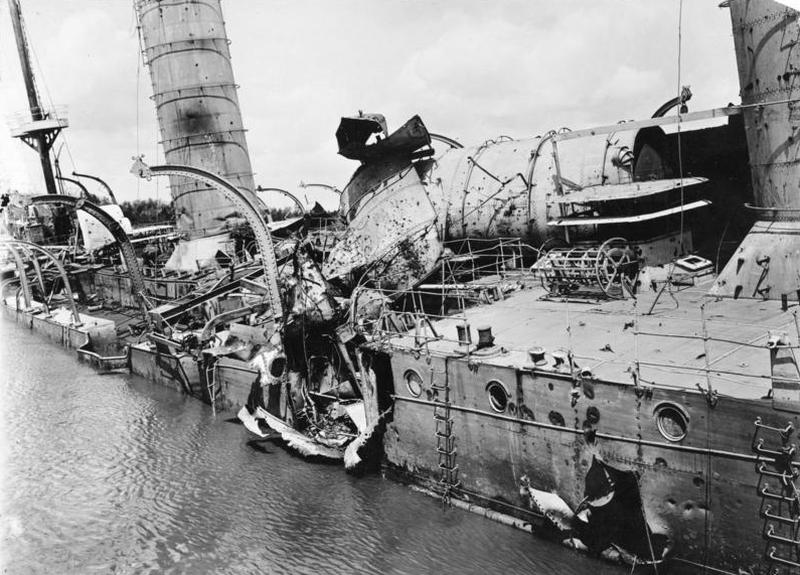
SMS
Königsberg, Scuttled and Wrecked in 1915
Photo
by Walter Dobbertin © Bundesarchiv from
WikiCommons
|