|
The
Ruvu River Gun
"We fired around 300
shells and our
stocks decreased
noticeably. It was
simply
war!"
Hermann Müller
(Königsberg Gun Crew)
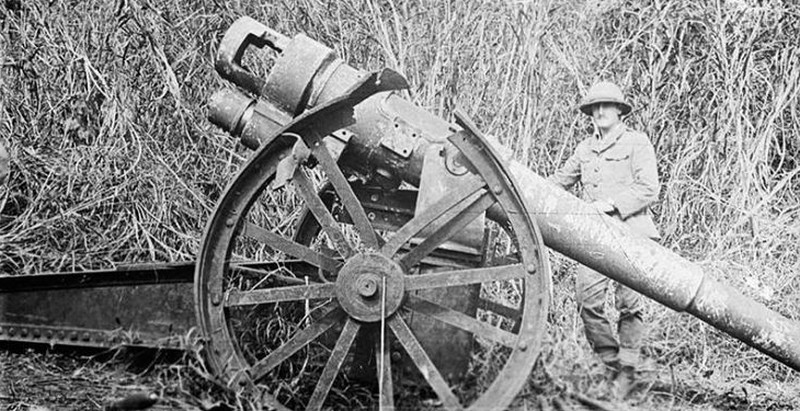
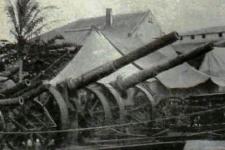
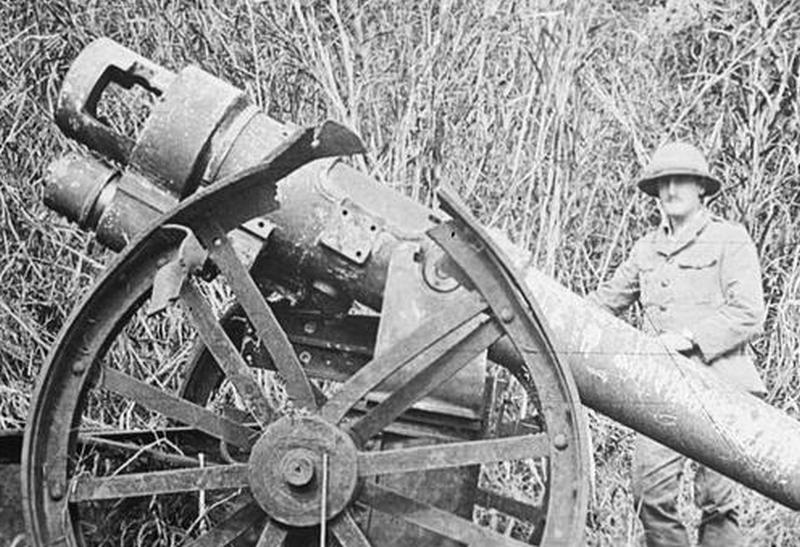
Gun Captured
near Mkuyuni, 1916
Photo
© Lt C Dale
Collection,
Imperial War
Museum
Deployment to Dar Es Salaam
This gun was
originally one of the side mounted guns in
unarmoured cupolas on the SMS Königsberg and
therefore did not have a barrel flange to hold a
turret shield. After being re-fitted at Dar Es
Salaam, it was one of the five guns that were
deployed for the defence of the port on their fixed
pivot mounts from July 1915. It was
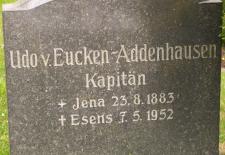
commanded by
Leutnant z.S.a.D. Udo von Eucken-Addenhausen.
Deployment to the
Northern Front
In March
1916 with the South African offensive in the north
of the colony looking more threatening than a
seaborne landing at Dar Es Salaam or Tanga, the
Germans moved two of the 10.5cm Königsberg guns and
one of her 8.8cm guns to the Northern Front.
Ludwig Boell
who served as an officer
in the East African
Schutztruppe during the war
described the situation- "To
remedy
the
especially painful perceived lack of long-range guns
(on the Northern front), the command decided on 10th
March to weaken the coastal defence. An 8.8cm
and a 10.5 cm gun
were transported from Dar Es Salaam to the Northern
railway and a 10.5cm gun from Tanga (the Kahe
Railway Gun) made its way to Kahe. The first two
guns were on carriages made in the colony".
(Quotation from P167 and footnote
"Die Operationen in
Ostafrika im Weltkrieg 1914-1918" by Ludwig Boell,
Verlag Walter Dachert, Hamburg 1951)
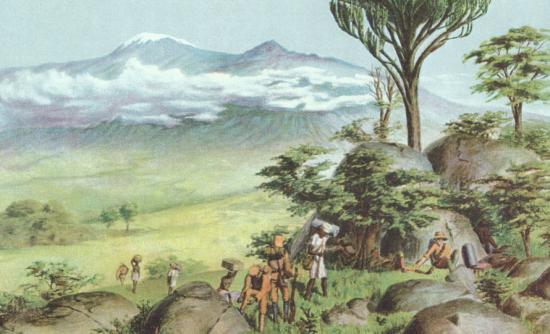
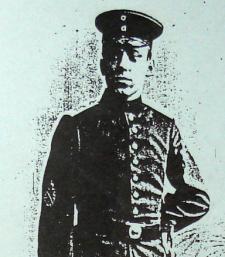
Schutztruppe Patrol
and Porters near Mount Kilimanjaro on the Northern
Front
Eyewitness
Illustration by Walther Rehfeldt from published in "Bilder
vom Kriege in Deutsch-Ostafrika" published by
Charles Fuchs, 1920. Now shown on
ReichsKolonialamt.de
As Boell
said, the 10.5cm gun from Dar Es Salaam,
was fitted with one of the gun
carriages made in Dar Es Salaam. The gun
carriage was similar in design to that used on the
gun from the SS Goetzen captured at Kahama-Korogwe but
differed in that period photographs show that it did
not have a central riveted seam at the front of the
carriage nor a double riveted central joint halfway
down the tails of the gun carriage.
In Boell's
text, he mentions the guns from Dar Es Salaam before
the gun from Tanga that went to Kahe. In fact the
Tanga gun was transported to the Northern Front at
Kahe where it was deployed and destroyed before the
guns from Dar Es Salaam arrived on the Northern
Railway.
The story of this Second Gun 10.5cm on the Northern Front is told
in the memoirs of Hermann J
Müller who served with the gun's crew from
it's arrival on the Northern Front in March 1916
until its destruction five months later. Throughout
this time the gun was constantly on the move as von
Lettow-Vorbeck's army retreated south from Smut's
offensive. The gun fired on the advancing allies for
a few days, then moved on again. The most notable
feature throughout the narrative is the difficulty in transporting gun,
which was ultimately to be its downfall as in August
1916 it became the fifth of the SMS Königsberg's
10.5cm Guns to be put out of action.
Prior to working with this gun,
Hermann Müller had
served onboard the SMS Königsberg and
with the railway gun that had been destroyed at Kahe
around 20 March 1916. A week after the destruction,
Müller was sent to collect
a new gun which had been sent up from Dar Es Salaam
to reinforce the Northern Front.
The
following quotations are all from
Müller's memoirs ("Kriegserinnerungen aus
DOA 1914-1917", Vol. I, P28-37, Privately
Published).
"On
27 March I received an
order to bring the
10.5cm gun which had newly arrived from Dar Es Salaam
by rail to the Müller
plantation,
to
Mkulumuzi. The transportation
to
Mkulumuzi was quite
difficult at night,
especially since there
was a lack of
reliable
guides which would have made our
journey shorter. We had about three hundred Amboni
porters
under the leadership of Mr.
Stutz that
came to assist."
From
Mkulumuzi the gun was transported on the Northern
Railway to Lembeni.
"Loading
onto the
Northern Railway
took place in the afternoon
and
it then departed
immediately for
Lembeni. In
Lembeni busy life
again
prevailed,
as it can
only be at the front. A lively
coming and going especially
when under command, lasted
the whole
time.
Lembeni
lies in the Pare Mountains,
about 2300 meters high. To the south
of
Kiyenge near Lembeni,
the ground
falls particularly steeply and it was
a very difficult
job to
set up the observer
status there.
The
gun was
soon in
position and within
about 20 minutes
the telephone
began to call, "Nikeska",
"Keiliberg" etc."
But as always, the South
African and British forces continued their advance
and the gun was soon on the move again.
"From
Mkumbara we
went to
Korogwe, here
the advance
began to
Central Railway and
the
Northern
Railway was abandoned.
Our
transport was pulled by eight heavy
horses
provided by
Wilkens &
Wiese, the
sawmill
in the Schume
Forest in
the
Usambara Mountains,
but these
poor animals were
down to three by the departure from Handeni."
"On 6 June at Handeni
we had a brief
skirmish
with the English who were
advancing on
Dezema. We
were forced
to move away
during the night.
Unfortunately, we did not have
more than eighty four porters for the heavy
artillery and we needed to continue to Killimamzinga. Because
of this lack of manpower it was a
sad journey,
having to
drag the heavy artillery
through the sand
and
over
hill and dale."
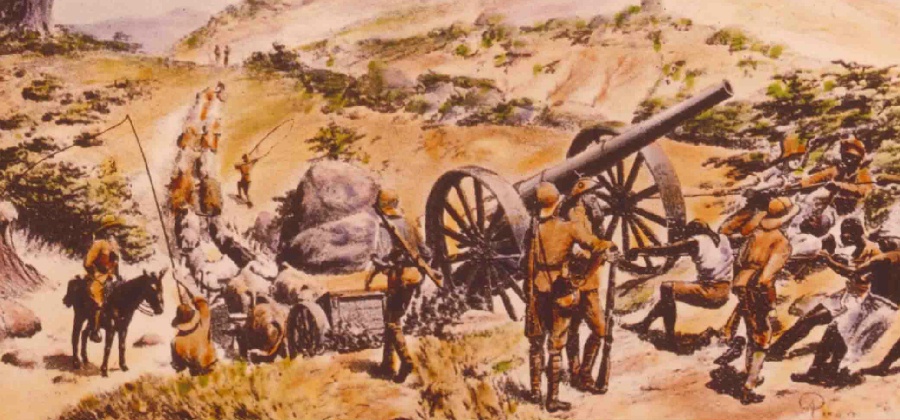
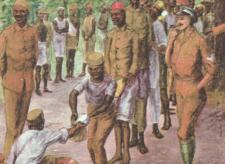
One of the 10.5cm Guns from the
SMS Koenigsberg on the Move
Eyewitness
Illustration by Walther Rehfeldt from published in "Bilder
vom Kriege in Deutsch-Ostafrika" published by
Charles Fuchs, 1920. Now shown on
ReichsKolonialamt.de
About
fifteen to twenty miles south of Handeni, the gun
was again put into position for firing at the
advancing South Africans.
"Our
artillery activity
was quite
satisfactory. Due to our
very
excellent observation
at
Mlembule, which was about 2,000 meters high,
we could
exceptionally watch the
entire storage
life of
the enemy well
and watch
our shots
accordingly. The gun
emplacement was
then
about 800 meters back
due to violent
and
almost daily
air raids
and here
in conjunction with the
newly arrived
second
10.5cm gun under
Fähnrich von Nippelt,
formerly
a plantation owner at Loge
Loge, we
again have some shells to fire
at the enemy
day and night. It was
simply
war!
We fired around 300
shells we
fired in
that time and our
stocks decreased
noticeably."
Soon after however, the
gun was on the road south again.
"On 25
August
we had to
march south through
Morogoro, which
we were ordered to leave immediately
and march
south
on the Kiroka Pass. From
Kingolvira to the
Kiroka
Pass the road was good but went
slowly
but steadily uphill. It was
an efficient
piece of work
to get the gun through
but more than once
we thought
the wheels
would slide back down
the slope."
"Hauptmann
Stemmermann was quite surprised
when he received the report, "Gun in position" the
following morning.
I think, he hoped to have seen
that the gun had been blown up in the pass, then all
the many people required for transporting it could
be released. In his heart the Abteilung leader wanted
the artillery unit to be disbanded."
Destruction of the Gun
Near Mkuyuni it was
considered that the gun was too heavy to cross the
improvised bridge over the Ruvu River
and the decision
was made to destroy the gun. Several dynamite
charges were used to break the gun
and its wheels. Thus it became the fifth of the ten
Königsberg heavy guns to be put out of action. Müller
recalled-
"On 30th
August (1916) the enemy attacked early. We were
ordered to intervene and destroy the gun after
firing off the ammunition. A sad command! But what
was it? In Eucken we did not have a leader equal to
Schönfeld who was able to confront the department
commander, so we were only told 'Execute the order'.
By
six o'clock in the evening we had fired our
ammunition and the gun was blown to pieces around
seven o'clock. But the blast was not as good as in
Kahe, perhaps because of the rain?
Parts
were blown out of the barrel and the breech cracked.
I laid two more explosions at the wheels to make the
gun unable to drive. The brass shell casings (111 of
them each weighing 5kg) were hidden in one of the
caves... and then we moved out into the night."
After the
destruction of the gun the crew moved onto towards
the Ruvu whereupon they found that the river
crossings were quite strong and that maybe they
could have transported the gun over them.
Müller
recalled-
"After two hours march through the jungle we
reached Chimbosa. It was a rare sight to see the
transportation of the howitzer battery with its many
parts on the Ruvuvu Bridge by torchlight. It had
been said that it would have been impossible for our
10.5cm gun to cross the bridge but seeing the bridge
now it seems it would have been possible in
daylight. But what use is talk now? What's done is
done!"
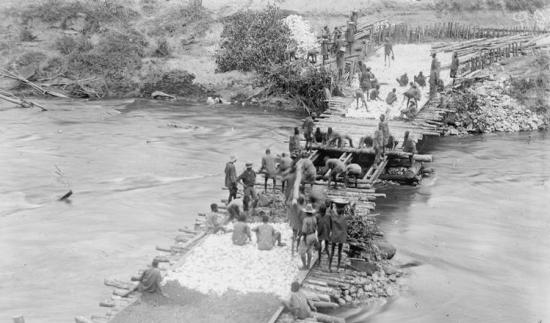
British 2nd Road
Corps building a new Bridge over the Ruvu River,
June 1917
Photo Lt LAW
Powell collection ©
Imperial War Museum
Meanwhile British forces (most
likely elements of the Loyal North
Lancashires and Kings African Rifles) came across
the remains of the gun with its broken right wheel
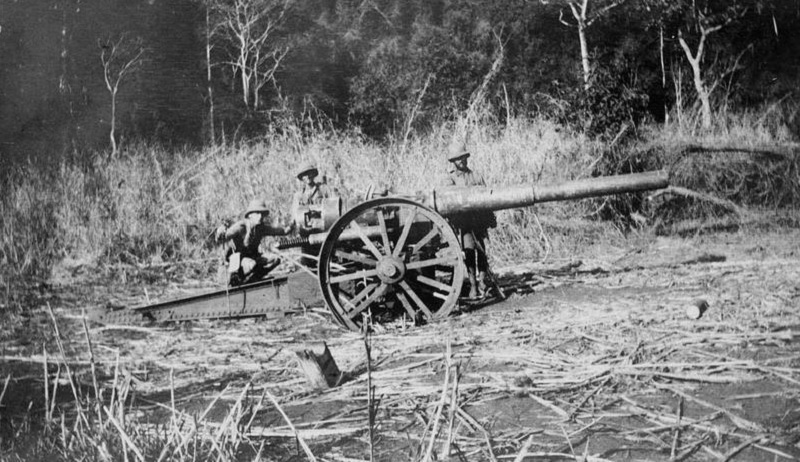
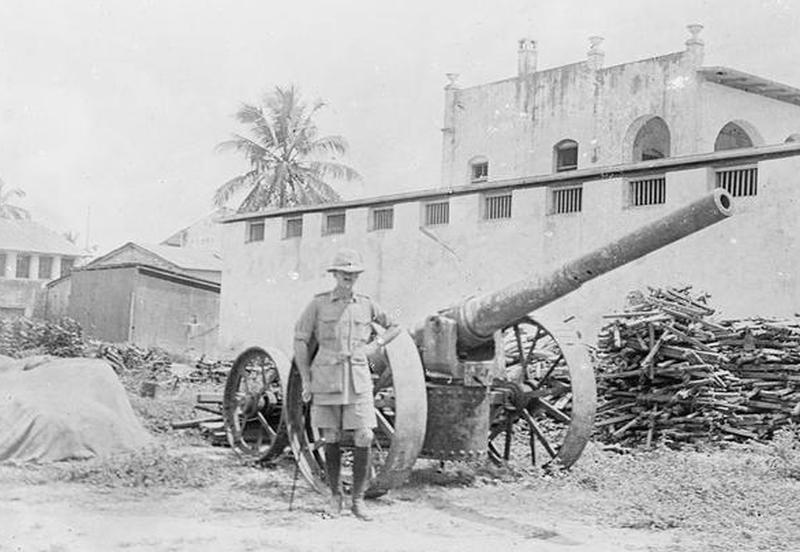
on 30 August 1916. The gun
still had its limber and notably had very
distinctive scratches on the right side of its
barrel. From these scratches the gun can be
identified in later photographs showing that the gun
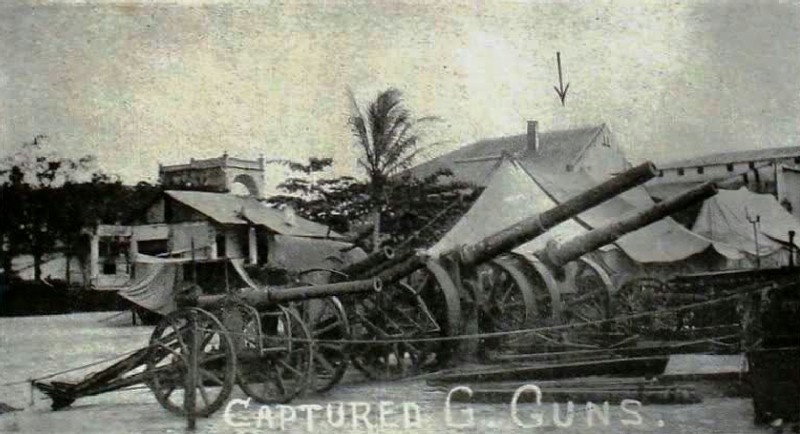
was to some extent repaired by its captors. The gun was last seen in a photograph
of a collection of captured German guns taken in Dar
Es Salaam in December 1918. Its whereabouts since then
are unknown.
Close examination of the
existing photos of the gun after its capture show that there are possible crack marks on the top of the
gun cradle. These splits, the damaged gun
bucket, broken wheels and the inherent instability of
the Dar Es Salaam made gun carriage
are probably all factors to the reason why this gun was
never put on permanent display after the war. No trace
of it has been seen since these last photos taken in
December 1918. It may well have been
scrapped
in Dar Es Salaam shortly after the end of the First
World War.
Sources
"Kriegserinnerungen aus DOA
1914-1917" by Hermann J Müller, Privately Published
"Die Operationen in
Ostafrika im Weltkrieg 1914-1918" by Ludwig Boell,
Verlag Walter Dachert, Hamburg 1951
"Königsberg- A German East African
Raider" by Kevin Patience, Zanzibar Publications,
Bahrain 1997
"Meine
Erinnerungen aus Ostafrika" by Paul von
Lettow-Vorbeck, KF Koehler Verlag, Leipzig 1920
Field Artillery Magazine, US Field Artillery
Association, Fort Sill Oklahoma, July-Aug 2001
"In Monsun und Pori
Safari" by Richard Wenig, Verlag, Berlin 1922
"Bilder
vom Kriege in Deutsch-Ostafrika" byWalther Rehfeldt, published by
Charles Fuchs, 1920. Now shown on
ReichsKolonialamt.de
"Das Offizierskorps der Schutztruppe für Deutsch-Ostafrika
im Weltkrieg 1914-1918" by
Wolfgang-Eisenhardt Maillard and Jürgen Schröder,
Walsrode 2003
"The First
World War in Africa" by Hew Strachan, Oxford
University Press 2004
Axis History Forum Discussion on the SMS Königsberg
Guns in English
Panzer Archiv Forum Discussion on the SMS Königsberg
Guns in German
Von Eucken-Addenhausen's Grave at Aurich in Lower
Saxony at
Grabsteine-OstFriesland.de
|