|
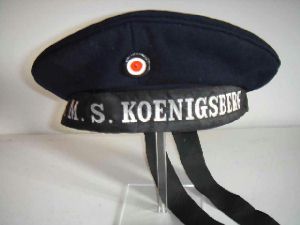
The History of the SMS Königsberg
and the First World War in
East Africa
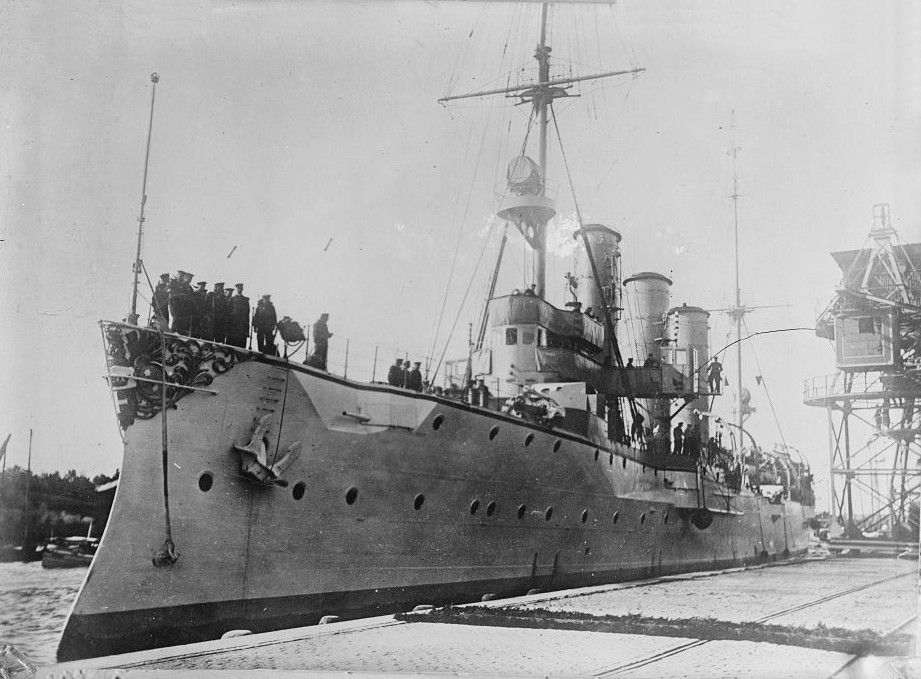
Photo from the
American Library of Congress on
Wikimedia
At the beginning of the
twentieth
century the Imperial German navy went through a period of
rapid expansion as part of an arms race with the British
Royal Navy. One of many new ships built in time was
the SMS Königsberg, launched at Kiel on 12 December 1905 and named
after the East Prussian capital, now known as
Kaliningrad in Russia. She was the first of four
Königsberg class light cruisers, her sister ships
being the
Stettin,
Stuttgart,
and
Nürnberg.
The crew consisted of 14 officers and 308 other
ranks. She had an impressive maximum speed of 24
knots, displacing over 3,500 tons and was armed with
ten deadly 10.5cm quick firing guns and two 45cm
torpedo-tubes with five torpedoes. The
Königsberg also had two 5.2cm quick firing guns
mounted in the stern but these were removed before
the First World War. Two 8.8cm guns were later added
intended to arm an auxiliary cruiser in the event of
war. Her speed and
firepower made her the ultimate naval hunter of the
day.
The SMS
Königsberg was originally part of the Imperial
German home fleet renamed the High Seas Fleet in
1907. On several occasions she served as an escort
to Kaiser Wilhelm II in his yacht, Hohenzollern.
This included two voyages to England in 1907 and
again in 1910. The following year she accompanied
Wilhelm on a tour of the Mediterranean.
In early 1914 it
was decided to send the SMS Königsberg to German East
Africa to replace the ancient steam and sail ship
SMS Geier, which was currently Germany's only naval
presence on the East African coast. This was planned
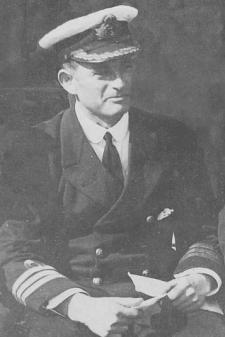
to be a two year mission. A new ship's captain was
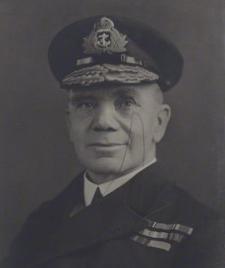
appointed for the task, Fregattenkapitän
Max Looff.
Although Looff was an experienced naval officer it
was his first ship's command.
As fate would have it, it also proved to be his last command.
The
Königsberg set sail from Kiel on 25 April 1914 and
travelled through the Mediterranean into the Suez
canal and down the East African coast, arriving in
Dar Es Salaam on 6 June to a rapturous welcome.
The first task of the newly arrived ship was to
cruise the colony's coastline as show of strength to
the locals, to familiarise herself with the waters and to be greeted by local German
dignitaries in each port they visited. The
peace of those first few weeks in East African
waters for the Königsberg crew was soon shattered by
the outbreak of the First World War.
German East Africa
before the First World War
The
colony of German East Africa was established in by
the raising of a flag in 1884
and confirmed on a map by the European powers at the Treaty
of Berlin the following year. It consisted of most
of modern Tanzania (minus the eastern offshore islands
of Zanzibar and Pemba which were British) and
Rwanda. As such was the largest of the four German
African colonies, the others being Togo, Cameroon
and German South West Africa (modern Namibia).
German
rule had gradually spread inland since the first
trading posts on the coastline, often accompanied by
violent resistance from the existing population
which was harshly suppressed by the German
authorities. The most
recent and most widespread revolt was the Maji-Maji Rebellion of
1905-07 in the aftermath of which it is estimated
that tens of thousands of Africans were either killed or died
of starvation caused by the war.
After
the Maji-Maji Rebellion (and the almost
simultaneous Herero and Nama Rebellions in German
South West Africa which were crushed with even more severity) German colonial rule became more
moderate and power was entrusted to civilian
governors rather than military officers. Agreements were reached with local
tribal
leaders, although usually heavily weighted to the colonial powers benefit.
Infrastructure received investment, railways and
schools were built. An effort was made to inoculate
and educate the African population. This was not an
entirely philanthropic enterprise however as it was
realised that a healthy and literate workforce
could earn more profits for German traders.
Early
in the colonies establishment an armed force had
been formed to
fight against the rebellions and prevent further
ones, the
Schutztruppe. The peacetime
strength of the Schutztruppe in 1914 consisted of
around 300 German officers, NCOs and staff with
2,700 African other ranks or Askari. These were
divided into 14.field companies spread over the
colony to prevent outbreaks of rebellion. The artillery of the Schutztruppe
consisted of outdated recoilless guns, C73 8.8cm and
7.85cm field guns (which were mostly formed as a
single artillery Abteilung in Dar Es Salaam) and
some smaller 6cm and 3.7cm guns (assigned to the individual
field companies). There was
also an armed police force (the Polizeitruppe)
with another 2,000 askaris spread across the colony.
The Schutztruppe was adequate to deal with local
minor rebellions but was not prepared to fight a
European enemy or another colonial power.
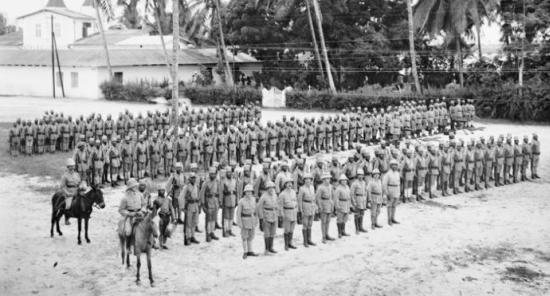
Schutztruppe
Feldkompagnie, 1914
Photograph by Walther Dobbertin from Bundesarchiv /
WikiCommons
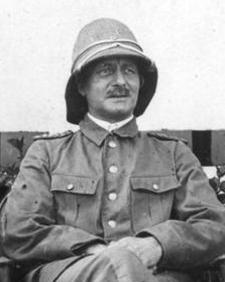
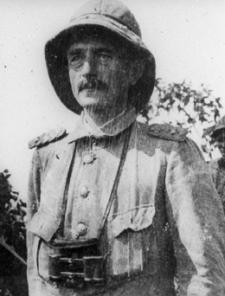
Paul von
Lettow-Vorbeck and the Outbreak of the First World War
Aside from the SMS Königsberg, another recent
arrival in German East Africa in 1914, was the new
commander of the Schutztruppe,
Oberstleutnant
Paul von Lettow-Vorbeck. He was a forty-four year
old Prussian army officer with experience of
colonial and guerrilla warfare, having served
previously in the Boxer Rebellion in China and the
Herero Rebellion in South West Africa. Initially he
was put forward to command the Cameroon Schutztruppe
but his destination and destiny was changed to German East
Africa in April 1914.
Upon
arrival in East Africa, von Lettow-Vorbeck immediately set
to work re-thinking the future role of the
Schutztruppe. He toured the colony seeing for
himself the railway system, ports and defensive
points. He was able to
to asses the
strengths and weaknesses of the colony and get to
know the local Schutztruppe officers. He also
encouraged the formation of local shooting clubs
where German civilians, farmers and traders did
paramilitary firearms training. Von Lettow-Vorbeck foresaw a European war which in his
opinion, could potentially spill over into the
colonies.
As the
new commander was making his notes war was indeed
brewing in Europe. On 28 June 1914, Archduke Franz
Ferdinand, the heir to the Austro-Hungarian throne
was assassinated in Sarajevo by Serbian nationalists.
Austria-Hungary demanded justice from Serbia and
with Russia backing Serbia and Germany backing
Austria-Hungary the world stood on the brink of war
for surely France and Britain would not stand by. And
what of the Turkish Ottoman Empire? Or the
Portuguese to the south in Mozambique?
For a few weeks
confused and conflicting reports reached East Africa until
finally it was confirmed that
Germany was at war with Great Britain. After
delivering notice of their intentions, the British
Royal Navy began to bombard Dar Es Salaam on 8
August 1914.
The colony's
governor Heinrich von Schnee desperately hoped that peace would
prevail throughout the colonies despite the European
war. German East Africa was surrounded by enemy
colonies. To the north
were the British Colonies of British East Africa
(modern Kenya) and Uganda. To the west were the
great lakes with the Belgian Congo bordering the
opposing shore and further south British Rhodesia
and Nyasaland. South of German East Africa was Portuguese
Mozambique. Portugal did not
start the war on the allied side but a
misunderstanding caused the Germans to raid their
territory early in the war and Portugal eventually
joined the war on the allied side in March 1916.
To complete the isolation of the colony, the British Royal Navy's
Cape of Good Hope Squadron blockaded the coast.
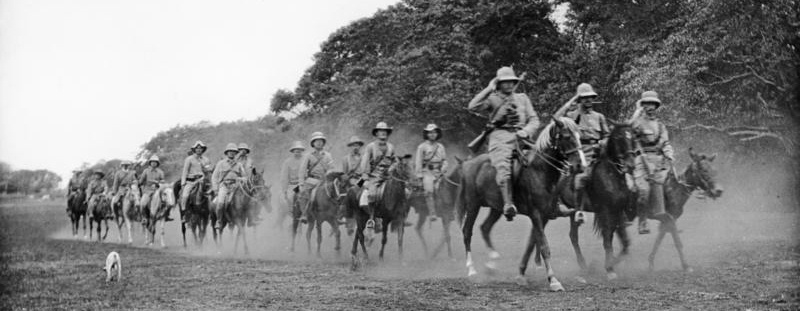
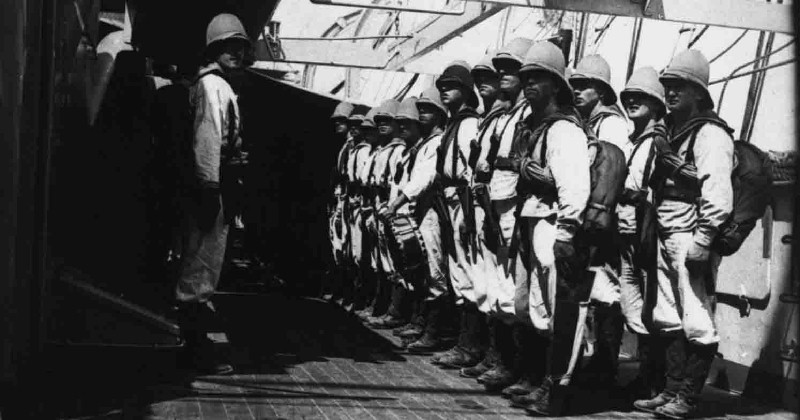
German Reservists on
the Kilimanjaro Front shortly after the outbreak of
war in 1914
Photo by
Walther Dobbertin at the Bundesarchiv /
WikiCommons
When the war in Europe
did break out von Lettow-Vorbeck had already made
contingency plans and German East Africa was put on
a total war footing. Retired askaris were recalled
to their units, the colonial police force was
incorporated into the Schutztruppe and the civilian
shooting clubs became armed shooting companies ('Schützenkompanie').
Germans and Austro-Hungarians living in the colony
were called up as reservists and all civilian material useful to the war effort was
commandeered. This included any motor vehicles,
coastal boats, steamships on the lakes bordering
enemy colonies, an aeroplane that was visiting for
an air show at the time and even steam powered farm
machinery. A naval survey ship, the SMS Möwe was
scuttled to block Dar Es Salaam harbour and her
3.7cm revolver canons and crew thenceforth served on
land, the latter as the Abteilung Möwe. All of the above was useful to the war
effort.
Von
Lettow-Vorbeck intended not only to prevent the
allies capturing the colony but also to tie up large
numbers of enemy soldiers and war effort, thereby creating a diversion from
their efforts from the all important Western Front.
A decisive German victory on the Western Front
followed by a peace settlement in Germany's favour
would naturally end the war in the colonies, whereas
a victory or defeat in the colonies would not effect
the outcome of the general war in Europe.
The
allies had early successes in conquering all the
other German colonies. Togo, New Guinea, Samoa and
German port of Tsingtao in China all fell in 1914. German South West Africa
surrendered the following year and the last German garrison in
Cameroon laid down its arms in February 1916. But in
German East Africa the allies had only experienced
failure in the opening stages of the war. The
Schutztruppe repelled British invasion attempts at
the Battles of Tanga and Longido and also
raided heavily into British territory and fired at
Belgian shipping on Lake Tanganyika.
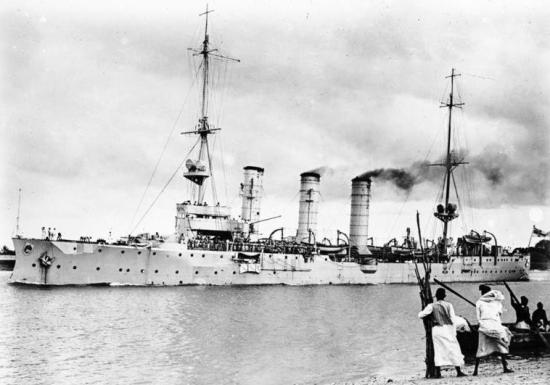
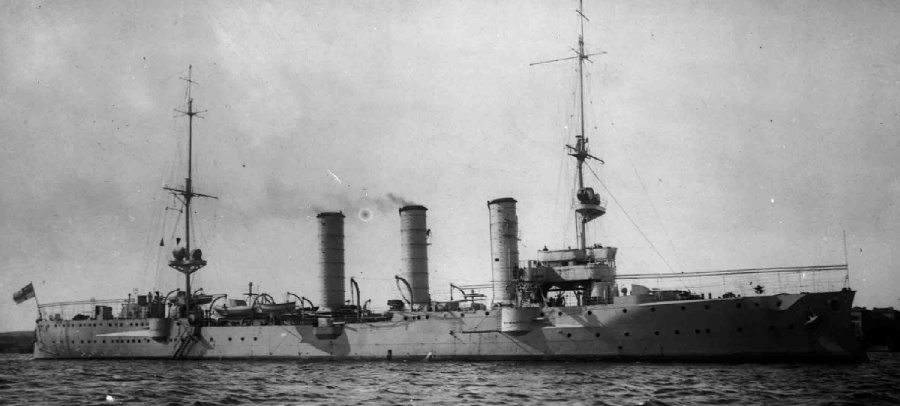
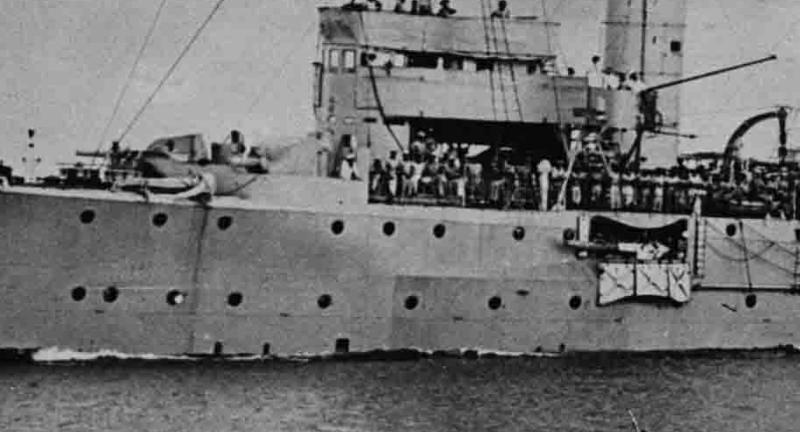
SMS Königsberg off
the coast of German East Africa 1914
Photo
by Walther Dobbertin from the Bundesarchiv on
Wikimedia
The SMS Königsberg on the Outbreak of War
As the
situation in Europe became more tense during the
Summer of 1914 and the threat of war loomed after
the Sarajevo assassination, the ship's crew began additional
gunnery training while Looff and von Lettow-Vorbeck
consulted as to their best options if war with
Britain did break out.
Looff feared that the Königsberg
could be trapped in the harbour at Dar Es Salaam by
the superior firepower of the British Royal Navy and
so the ship was prepared for war at sea. All excess
woodwork was stripped away and every available space
filed with coal. War had not been declared when she
took to the Indian Ocean on 31 July 1914. A supply
ship, the Somali under
Korvettenkapitän
Zimmer also set sail on 3 August to resupply the
Königsberg with coal when needed.
Shortly
after leaving port the SMS Königsberg ran into the
British Cape Squadron under Vice Admiral King-Hall
consisting of three cruisers, HMS Pegasus, HMS
Hyacinth and HMS Astraea. Although war had not yet
been declared between Britain and Germany the
situation was tense as the announcement was
imminently expected by both sides and the Cape
Squadron had been specifically sent from their base
in
Simpsontown, South
Africa up the East African coastline to search for
the SMS Königsberg and had now found her by
accident.
Looff
initially kept the Königsberg at a slow cruising
speed of 16 knots while the British ships kept pace
either side of him. When night was falling and with
rain to hide his intentions, Looff suddenly put the
Konigsberg into full speed and doubled backed on
himself to evade his unwanted escort first turning
back to port then again back out to sea when he had
lost the British cruisers. When war was declared
on 4 August 1914 the British had already lost
their best chance of capturing the Königsberg.
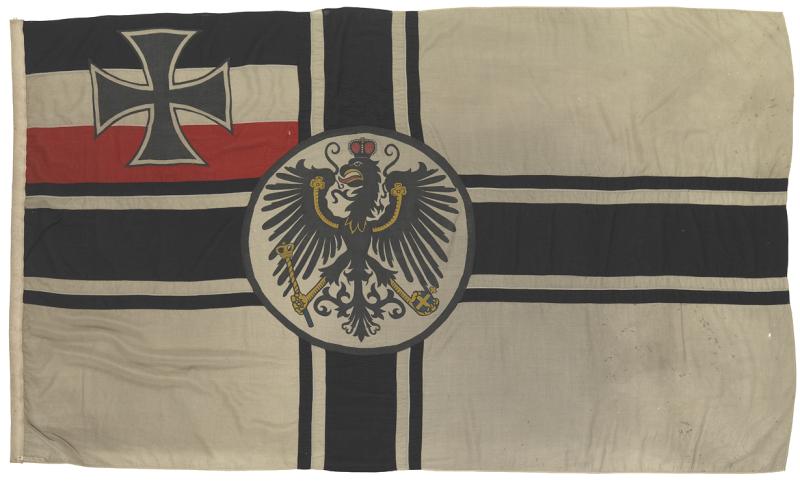
Ensign Flag from the
SMS Königsberg
Donated by Richard
Meinertzhagen to the
National Maritime Museum, Greenwich, England
SMS
Königsberg's Raiding Career
The Königsberg sailed up to the Horn of Africa,
searching for allied shipping to capture. Her first
and only catch was off the coast of Oman in the form
of the British City of Winchester. The cargo of the
City of Winchester was a large stock of tea and was
valuable to the English being the first harvest of
the season! But unfortunately for the Königsberg the
City of Winchester
was found to carry
very little coal.
By now the Königsberg had
been recognised by a neutral Japanese freighter who
reported her presence to allied warships. The SMS
Königsberg, once the ultimate hunter, was now a hunted
ship herself and running dangerously low on coal.
She met up with the Somali for a coaling
rendezvous off the coast of Somaliland and set out
hunting at sea again. This time towards French
Madagascar, where again she found no allied shipping.
The Königsberg was now
was cut off from radio signals from Dar Es
Salaam, having trouble with her engines and worst of
all having very little luck finding allied merchant
ships to attack. Coal was also again running low. After a
failed attempt to refuel from the Somali at Aldabra
Island due to bad weather, Looff decided to head for
the shelter of the Rufiji Delta in German East
Africa for repairs.
The
Rufiji is a major river at roughly 370 miles long.
It enters the Indian Ocean South of Dar Es Salaam in
the form of a wide Delta with densely forested
banks. Earlier that year it had been
studied by the German survey ship SMS Möwe and found
to be largely navigable by a ship of the size of the
Königsberg. Looff had been given the charts of the
delta and knew that it was the ideal place to hide a
battleship. It was also ideal conditions for malarial
mosquitoes to breed.
On 3
September 1914 the SMS Königsberg entered the mouth
of the Rufiji much to the surprise of the local
German authorities there who had no idea she was on
her way. Supplies of food and coal were soon
provided and maintenance work began.
Sinking of HMS Pegasus
On 19 September 1914 while in the Rufiji Delta, Looff
heard news that a single cruiser of the British Cape
Squadron had entered Zanzibar harbour. While the SMS
Konigsberg alone was not a match for all three
cruisers of the Cape Squadron, she was a danger for
any ship caught alone.
Meanwhile the British were unaware of the position
of the SMS Königsberg assuming her to be still at
large in the Indian Ocean. With this in mind they
considered Zanzibar to be a safe harbour for the HMS
Pegasus to receive repairs and attention to her
boilers.

HMS Pegasus
Photo from
Wikipedia
The SMS
Königsberg set sail for Zanzibar that same afternoon. It
was daybreak on 20 September 1914 when she spotted the
HMS Pegasus, ran up her battle flags and opened fire
with her five 10.5cm port guns at a range of five
miles.
Within
45 minutes the HMS Pegasus was sinking with
casualties. The captain of the Pegasus, Commander
John Ingles ran up the white flag but the burning
ship's smoke initially prevented Looff from seeing
the surrender signal. He continued shelling the
sinking ship. Finally after firing 276 rounds
into the Pegasus, Looff ordered the Königsberg to
ceasefire and retreat back to the safe waters of the
Rufiji. HMS
Pegasus sank in Zanzibar harbour on the afternoon of
20 September 1914 having lost 24 dead and 55
wounded. The Königsberg was unharmed, though
suffered an engine failure on her way back to the
safety of the Rufiji.
The commander of the
British Cape Squadron, Vice Admiral King-Hall
telegrammed the British Admiralty in London later
that day to break
the news and to express his displeasure at Commander
Ingles' failure to prevent the loss-
"HMS Pegasus sunk
in harbour 2pm. HMS Pegasus appears to have been
surprised by Konigsberg in an unprepared state and
unable to move which I think in the absence of
further particulars is inexplicable in view of my
orders to Captain. I have directed Commander Ingles
report fully by telegram to me and Admiralty."
(Telegram from
Commander-in-Chief, Cape to Admiralty 20th September
1914,
National Records Office, Kew Ref:- ADM 137/10/10
Folio 336)
Ingles replied to the
Admiralty with a report, describing the action as-
"Konigsberg
ascertained our correct position during night,
approached Effbe lighthouse full speed 5am, disabled
patrol launch with 3 shots then opened fire on HMS
Pegasus; had range correct with second salvo before
we could open fire. Her shooting very accurate; she
opened at 9 and closed at 7, all our engagement
broadside guns disabled after 15 minutes and fire
ceased from us. Nearly all our casualties occurred
round the guns and on the upper deck. Ship badly
holed on the water line, she eventually sank.
Removed 2 3-pdrs and 2 maxims. All survivors camped
inland; very few rifles obtained; defences generally
poor through lack of guns. Impossible to save
4guns."
(Telegram from
Captain, HMS Pegasus Zanzibar to Admiralty 20th
September 1914,
National Records Office, Kew Ref:- ADM 137/10/10
Folio 336)
The
Pegasus had also been armed with 4 inch guns (which
is presumably what Ingles was referring to as
"4guns" in his telegram) but could
not match the range of the
of the Königsberg guns and as Ingles stated, were soon put out
of action by the German fire.
These 4 inch guns from the
Pegasus were later salvaged from the wreck and like the
Königsberg guns were given carriages for use on
land. They again duelled with the guns of the SMS
Königsberg at
the Battle of Kondoa-Irangi in 1916 as they had done
at sea at Zanzibar in 1914. Today one of
the Pegasus guns stands side by side with a
Königsberg gun at Fort Jesus, Mombasa, Kenya.
Battle of the Rufiji and the
Sinking of the SMS Königsberg
The
Königsberg sailed back to the refuge of the Rufiji
Delta for more repairs. The German land defences
along the Rufiji consisted of the Abteilung Delta:
about 150 sailors and askaris armed with rifles and
machine guns under Korvetten-Kapitän a.D. Werner
Schönfeld, who would later command the Königsberg
railway gun at Tanga and Kahe. Improvised mines were
laid across the river mouth to deter
British ships from entering the river. Instead the British
blockaded the delta to prevent the Königsberg's
escape while they planned their next move.
On New Year’s Day 1915 the
British Admiral King-Hall sent Looff a message in
German wishing the SMS Königsberg a happy new year and hope that
they see each other soon. Looff replied in English, “Thanks,
same to you, if you want to see me, I am always at
home.”
(Quotation
from "Der
Kreuzerkrieg in den ausländischen Gewässern" by
Admiral Erich Raeder at
Archive.org)
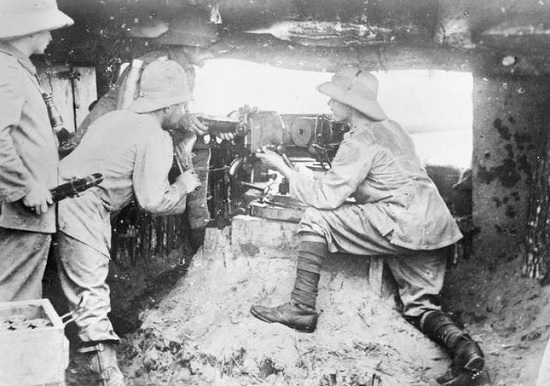
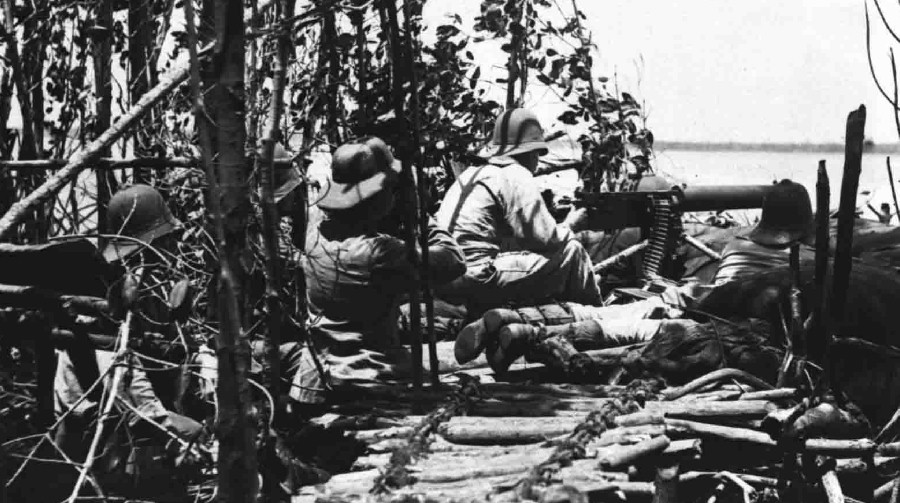
German Defences on the Banks of the Rufiji
This photograph is sometimes mistakenly captioned as
showing one of the Königsberg Guns. In fact it shows
a Hotchkiss 4.7cm gun that the Germans had captured from
a British vessel, 'Adjutant' on 6 February 1915.
Photo ©
Imperial War Museum
To hunt
the Königsberg further upstream two shallow draught
monitors, the Mersey and the Severn were towed from
England to East Africa. They had been built in
Britain for the Brazilian navy but on the outbreak
of war were diverted to the British war effort and
were first used bombarding German positions at the
1914 Battle of the Yser in Flanders. They were each
armed with two 6 inch guns as their main armament.
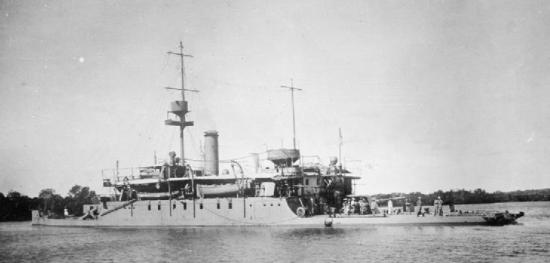
British Naval Monitor, HMS Severn
Photo from the Imperial War Museum Collection on
Wikimedia
To
assist the monitors in their search, two
seaplanes were requisitioned from a private owner in
South Africa and taken to the Rufiji Delta. Admiral
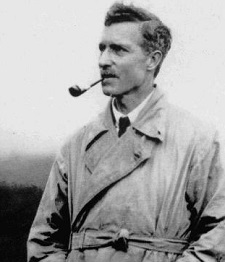
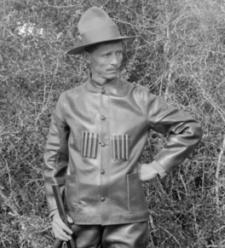
King-Hall also hired a Boer elephant hunter, named
PJ Pretorius to use his knowledge of the area to
scout and gather intelligence on the Königsberg and
its whereabouts.
On 6 July 1915 The two
monitors HMS Severn and HMS Mersey began their first
assault on the Königsberg accompanied up the Rufiji
by the spotter planes which also dropped bombs.
Despite scoring a few hits on the Königsberg, they
were forced to retire by her counter-fire which had
disabled one of the two guns on HMS Mersey.
The second attempt by
the monitors began on the 11 July 1915. The battle
raged for two hours hours in which time the
Königsberg was hit again and again by accurate fire
from the monitors directed by the spotter planes. A
magazine on the Konigsberg was hit and caught fire
and a blast hit the bridge injuring Captain Looff.
Eventually Looff wounded ordered the
scuttling of the
ship. The breech blocks of the guns were thrown
overboard, the remaining crew abandoned ship
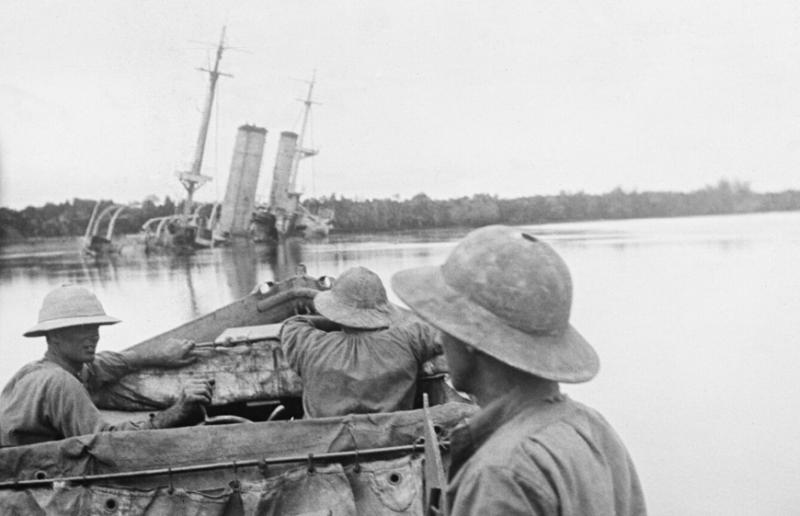
and the SMS Königsberg was sunk by officer Koch
using one of her own
torpedo heads to blast a hole in the hull. The
Königsberg heeled to port and began to sink into the
Rufiji mud at around 1400 on 11 July 1915. Thirty
three of the Königsberg's crew had been killed in
the bombardment. Looff signalled to Berlin: “Königsberg
is destroyed but not conquered.”
(Quotation from
"Königsberg- A German East African Raider" by Kevin
Patience, Zanzibar Publications, Bahrain 1997)
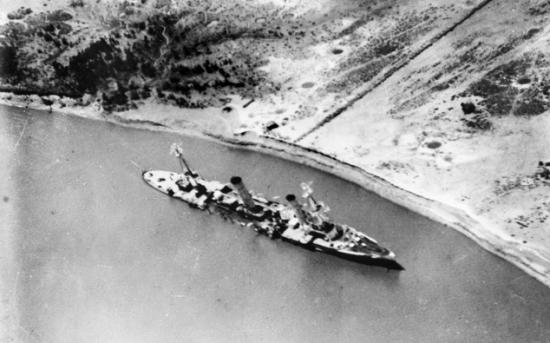
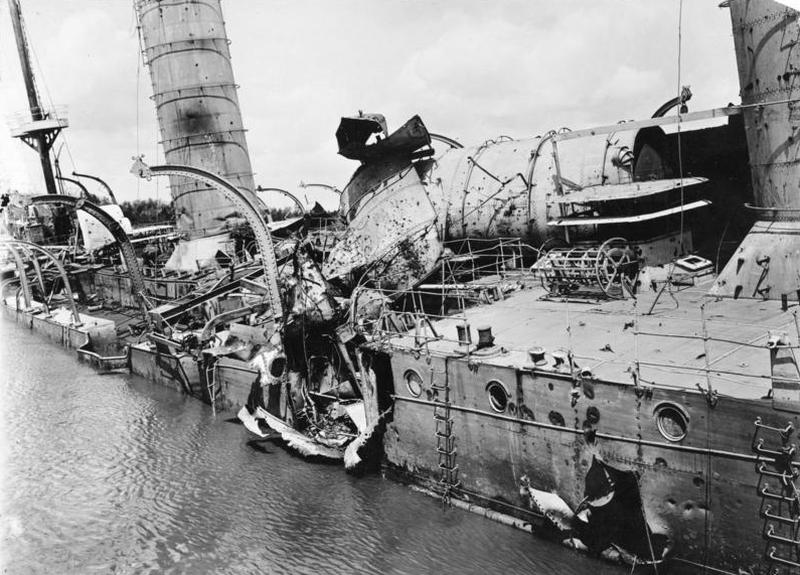
SMS Königsberg,
scuttled in the Rufiji, 1915
Photo from the Australian
War Memorial and
Wikipedia
Interestingly, although
the East African Campaign of the First World War
itself is largely forgotten and the ship herself has
now sunk into the depths of the Rufiji, the story of
the SMS Königsberg has made its way into general
twentieth century culture in several ways.
This was partially by
inspiriting Hollywood films such as 'The
African Queen' starring Humphrey Bogart and Audrey
Hepburn and 'Shout at the Devil' starring Lee Marvin
and Roger Moore and but also by inspiring countless
novels, comics and war-game scenarios. The guns may
not have altered the course of the war but they did
in their own small way alter course of public
consciousness about the war in Africa.
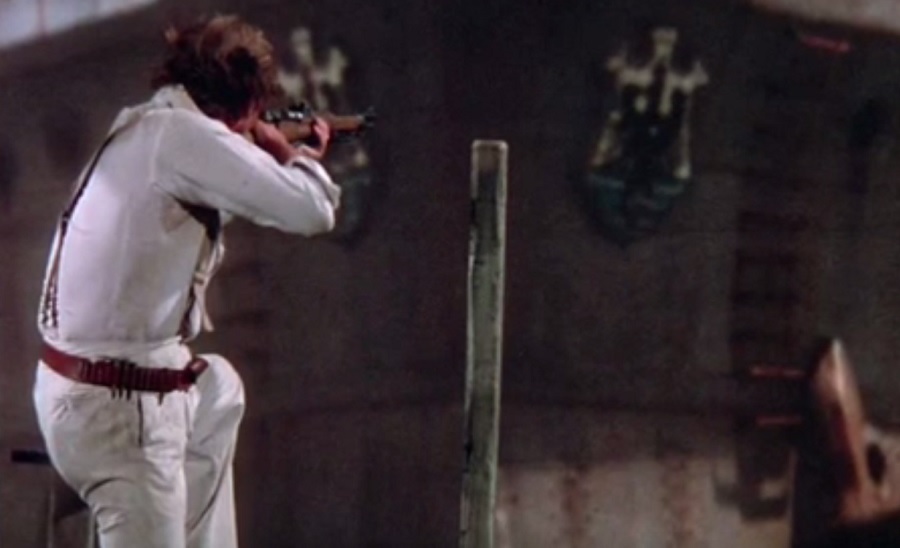
Roger Moore takes on
the SMS Königsberg (AKA the
Blücher)
armed only with a rifle!
Photo from
'Shout at The Devil'
©
Tonav Productions
SOURCES
"Königsberg- A German East African
Raider" by Kevin Patience, Zanzibar Publications,
Bahrain 1997
"The Germans Who Never Lost" by Edwin P. Hoyt, Leslie
Frewin, London, 1969
"The First
World War in Africa" by Hew Strachan, Oxford
University Press 2004
"Meine
Erinnerungen aus Ostafrika" by Paul von
Lettow-Vorbeck, KF Koehler Verlag, Leipzig 1920
"Kampf im Rufiji-Delta, Das Ende des Kleinen
Kreuzers Königsberg" by RK Lochner, Wilhelm Heine
Verlag, München 1987
"Der Kreuzerkrieg in den ausländischen Gewässern" by
Admiral Erich Raeder, EG Mittler and Son, Berlin
1923 at
Archive.org
"Das Offizierskorps der Schutztruppe für Deutsch-Ostafrika
im Weltkrieg 1914-1918" by
Wolfgang-Eisenhardt Maillard and Jürgen Schröder,
Walsrode 2003
"The
Meinertzhagen Mystery: The Life and Legend of a
Colossal Fraud" by Brian Garfield,
Potomac Books, Washington DC 2007
"Jungle Man" by PJ Pretorius,
Resnick's Library of African Adventure,
2001
HMS Mersey and Severn vs. SMS Königsberg
Edited by Gordon
Smith
Essay on the
Königsberg on the South African
Military History Website by Pierre du Toit
2013
Traditionsverband Article on the SMS Königsberg and
her Guns by Bernhard Buchholz
Article on the Königsberg Incident at Richthofen.com
Axis History Forum Discussion on the SMS Königsberg
Guns
Panzer Archiv Forum Discussion on the SMS Königsberg
Guns in German
|