|
Apel's
Kibata Gun
(Dar Es
Salaam-Rufiji-Kibata)
"On the
second day an English steamer anchored and we
immediately opened fire."
Oberleutnant z.S. Hans
Apel, Commander of the Kibata Gun
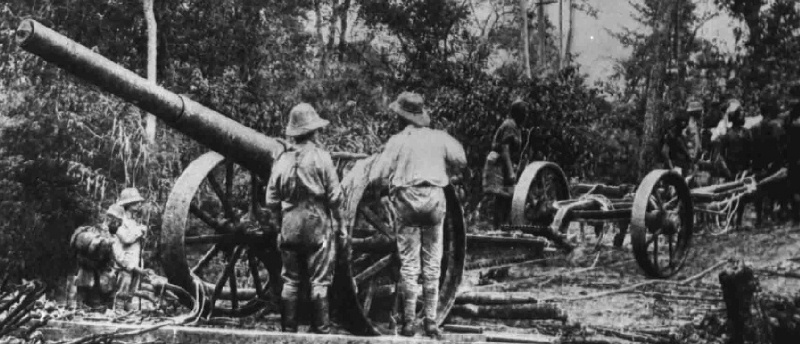
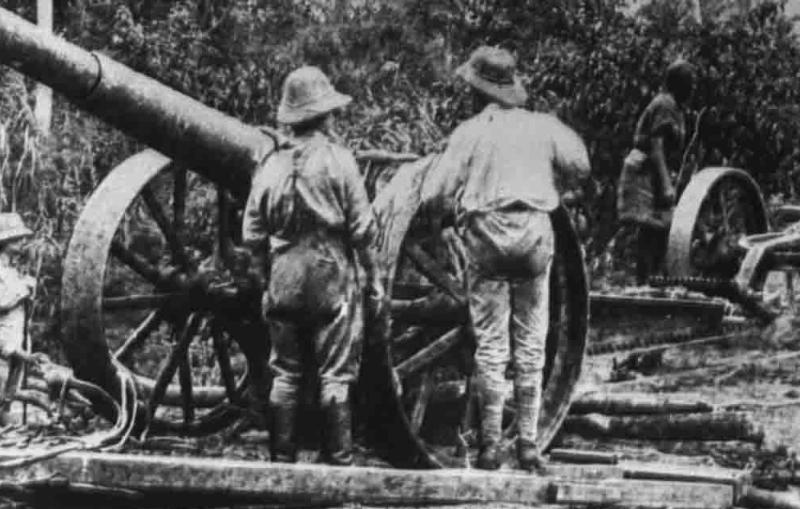
10.5cm
SMS Königsberg Gun
on the Move, c1916
Photo by Walther
Dobbertin
©
Frankfurt University Koloniales Bildarchiv
Deployment to Dar Es Salaam
This gun was originally one of the cupola guns on
the SMS Königsberg and therefore had no barrel
flange. After being salvaged and cleaned up it was deployed along
with four other guns for the defence of
Dar Es Salaam from July 1915. The gun was commanded
by one of the original Königsberg gunnery officers,
Oberleutnant z.S. Hans Apel.
Retreat to the
Rufiji
In March
1916 a successful British and South African
offensive was opened in the North of the colony
forces broke the Schutztruppe lines. Two of the Dar
Es Salaam guns eventually sent North to fight the
advancing allies at Kilimanjaro and Kondoa-Irangi
with a third being sent to Bagamoyo in August. This
left only Apel and Wenig's guns to defend Dar Es
Salaam.
Apel
described the guns actions in his memoirs-
"It
was not until the end of July that enemy cruisers
began to fire on Dar Es Salaam. The bombardments
were primarily aimed at our battery positions and
the railway lines. No notable successes were
achieved. No doubt it was the enemy's intention to
turn our artillery. After we had sent yet another
gun to the front (the Bagamoyo gun), only two mobile
guns remained. With them were able to stop two English
landing attempts North of Dar Es Salaam. When in
mid-August 1916, the enemy had taken over the
central railway from Dar Es Salaam to Kigoma it
became clear to us that the time was imminent to
leave Dar Es Salaam itself. At the end of August, I
left with the two remaining guns in the direction of
the Rufiji."
(Original quotation from
P41-44 "Lebensbericht
5. Die Schiffsgeschütze als Artillerie der
Kaiserlichen Schutztruppe" by Hans Apel, unpublished
personal memoirs)
Apel's gun
was fitted with one of the gun carriages made in Dar
Es Salaam from farm machinery and traction engine
parts and preparations were made for its withdrawal.
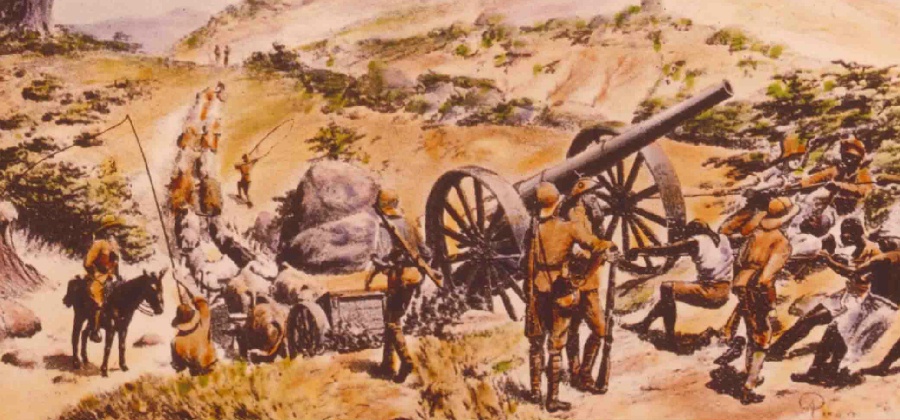
"For
the transportation of two guns we needed 400 blacks
(African porters) plus another 100 to carry 100
rounds of ammunition. At this time we also
recognized the limitation of our guns. Accordingly,
the
idea of allocating a gun to a fast moving formation had
to be abandoned. The gun's deployment could only
be to areas where our troops were in a fixed
position for a long period of time and would change
only slowly. After the evacuation of Dar Es Salaam, the
company moved into a first position about 10km south
of the city and was followed two days later by
the guns."
(Original quotation from
P41-44 "Lebensbericht
5. Die Schiffsgeschütze als Artillerie der
Kaiserlichen Schutztruppe" by Hans Apel, unpublished
personal memoirs)
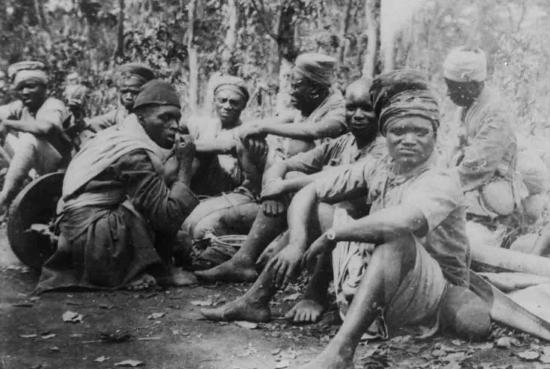
African Porters
in German Service at Rest
Photo ©
Frankfurt University Koloniales Bildarchiv
From Dar Es Salaam
the two guns went South to the Delta of the River
Rufiji, where the SMS Königsberg had been
scuttled a year before.
"An
imminent landing of English troops and a subsequent attack was expected
at Utete, south of the Rufiji, so we
brought the two guns into positions there from which all
advancing routes could be covered with by their
fire. As it happened, the enemy landed in Kilwa and
forged towards the Kibata Mountains, probably with
the intention of cutting off the Southbound trekking
routes. Since the expected attack failed to
materialize, one of the two guns was withdrawn to
the south to Lindi (the gun later captured at Mahiwa)."
(Original quotation from
P41-44 "Lebensbericht
5. Die Schiffsgeschütze als Artillerie der
Kaiserlichen Schutztruppe" by Hans Apel, unpublished
personal memoirs)
Apel's gun
however remained in the Rufiji Delta with the
intention of harassing British shipping.
"For
the remaining gun I was ordered to explore a
position at the Rufiji Delta from where it might be
possible to fire on English steamer traffic in the
Mafia Channel. The gun was then loaded and placed in
position with some difficulty on an island in the
mouth of the River Kiomboni."
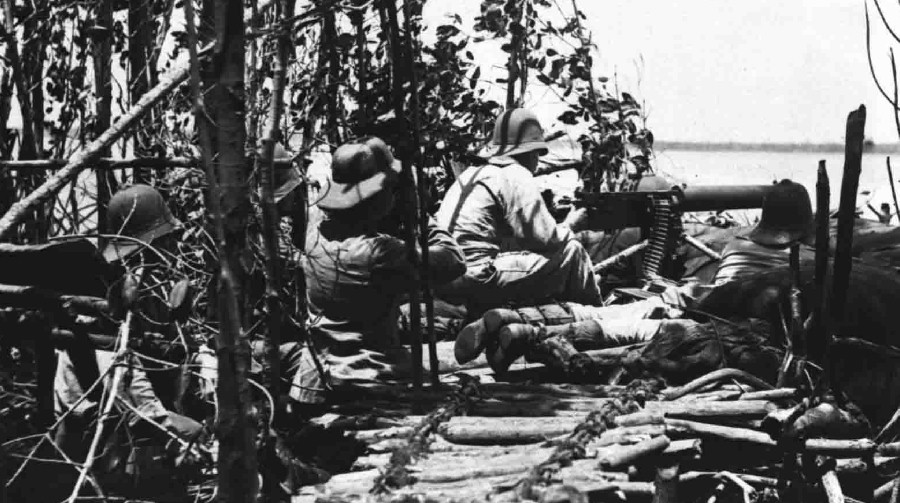
"On the
second day an English steamer anchored and we
immediately opened fire. We scored several hits but
the steamer quickly withdrew from the range of our
gun. We expected little enemy traffic for the next
few days. I consequently loaded the gun up again and
took it upstream to Mohoro."
"From there it was
ordered to the Kibata Mountains to join Abteilung
Otto. As the terrain was very hilly and had to be
accomplished with any technical aids we had to
recruit another 100 blacks (African porters) in
addition to our existing 200 strong crew."
(Original quotation from
P41-44 "Lebensbericht
5. Die Schiffsgeschütze als Artillerie der
Kaiserlichen Schutztruppe" by Hans Apel, unpublished
personal memoirs)
Apel then
describes the adjustments to the gun needed for use
in a land campaign. Up until this point, although it
had been deployed on land for a year, it had only
ever been used for firing at targets at sea.
"Now it was time to adapt to
new shooting ratios for use on land. Our guns lacked
some technical tools that were installed on land
guns from the outset. For the lateral adjustment of
the gun we fired alongside our 7.5cm guns
(presumably the
7.5cm Gebirgskanone M08 that had been brought from
Germany on the SS Marie
in 1916). After determining
this direction we could then detect further targets
by lateral improvements to our gun."
(Original quotation from
P41-44 "Lebensbericht
5. Die Schiffsgeschütze als Artillerie der
Kaiserlichen Schutztruppe" by Hans Apel, unpublished
personal memoirs)
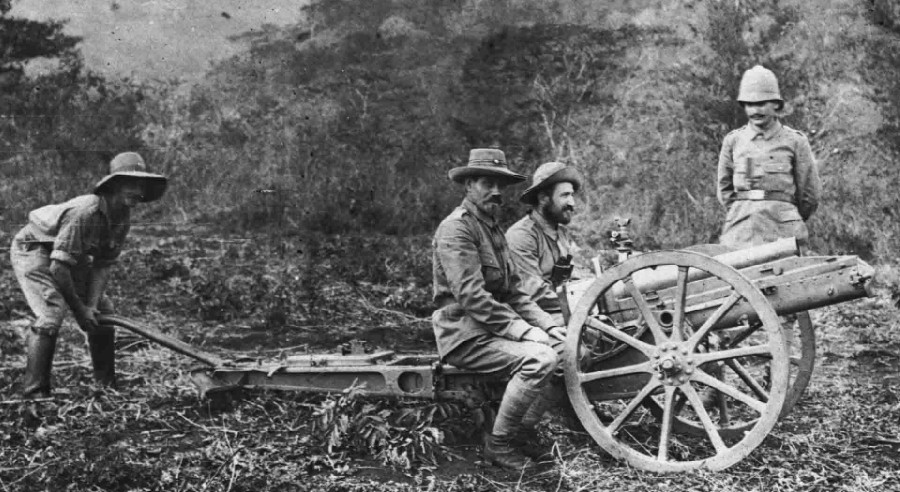
7.5cm Mountain Gun with crew in German
East Africa c1917
Photo by Wilhelm Erhart ©
Frankfurt University Koloniales Bildarchiv
The Battle of
Kibata
The Germans
had a fort at Kibata which with the mountainous
terrain made an allied assault on its position
difficult. Von Lettow-Vorbeck intended to fight a
delaying action here to halt the advance that
the allies had been making throughout 1916. With the
gun settled into its new position, it began to
sporadically shell allied positions to their north.
The shortage of ammunition available to the
Königsberg guns meant that they were never able to
provide constant bombardment of their targets.
"After the completion of a
telephone line through the densest bush to our main
control room, an enemy positions and supply routes
were then almost daily under fire. Over the Christmas holidays in
1916, it remained very quiet except for small
shootouts."
(Original quotation from
P41-44 "Lebensbericht
5. Die Schiffsgeschütze als Artillerie der
Kaiserlichen Schutztruppe" by Hans Apel, unpublished
personal memoirs)
What may have appeared
as a small shootout from Apel's point of view was
not reported as such on the receiving end. Major
Lewis of the British Indian 129th Baluchis wrote to
his mother after enduring shelling from the
Königsberg gun near Kibata-
“An
hour before dark, this developed into an intense
bombardment, and except for the size of the shells,
I never experienced such a hot one, even in France .
We lost heavily in the redoubt however our
men stuck it like heroes, though there was little
left of the trenches”.
(Original
Quotation from the Letters of Major Lewis on
Kaiser's Cross)
Kibata was
never intended as a divisive battle by von
Lettow-Vorbeck, only a delaying action and if he
maintained his force there, they risked be
outflanked and encircled. He therefore withdraw much
of his army further south. Apel described it-
"Then Oberst
von Lettow-Vorbeck was forced
to march with the majority of his companies to stop
enemy's advance elsewhere. The few remaining
companies and our 10.5 cm gun could only stay a
short time with our opponents reinforcing."
(Original quotation from
P41-44 "Lebensbericht
5. Die Schiffsgeschütze als Artillerie der
Kaiserlichen Schutztruppe" by Hans Apel, unpublished
personal memoirs)
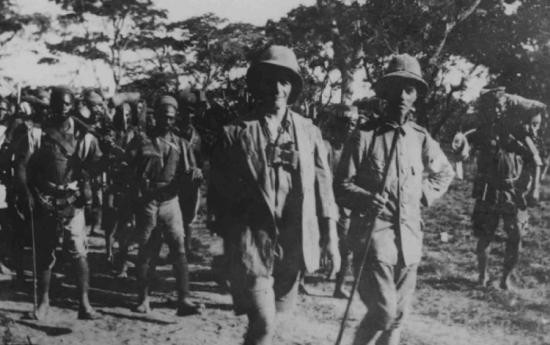
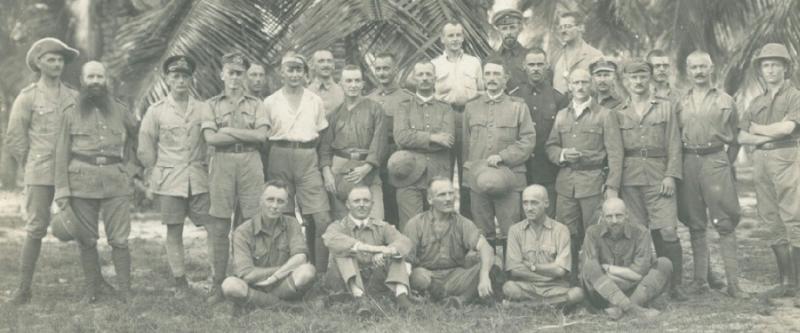
German Officers, NCOs
and Askaris on the march
Photo ©
Frankfurt University Koloniales Bildarchiv
By this time
the British had moved their artillery into superior
positions and were able to shell the German fort
which was not constructed to withstand shellfire.
The fort was abandoned.
"We were
eventually forced to abandon our positions under
sustained nightly battles. Since a road was not
available, our blacks pitched a path through the
dense bush, and then dragged the gun into a new
position in the late afternoon. Since we were in a
wild poor area, we were no longer able to send the
necessary meat diet to these hard-working natives.
Thus their strength was sapped and I was forced
after several days to blow up the gun."
(Original quotation from
P41-44 "Lebensbericht
5. Die Schiffsgeschütze als Artillerie der
Kaiserlichen Schutztruppe" by Hans Apel, unpublished
personal memoirs)
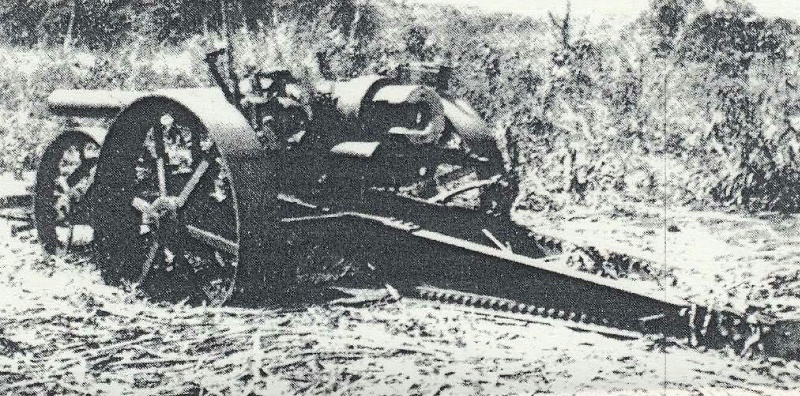
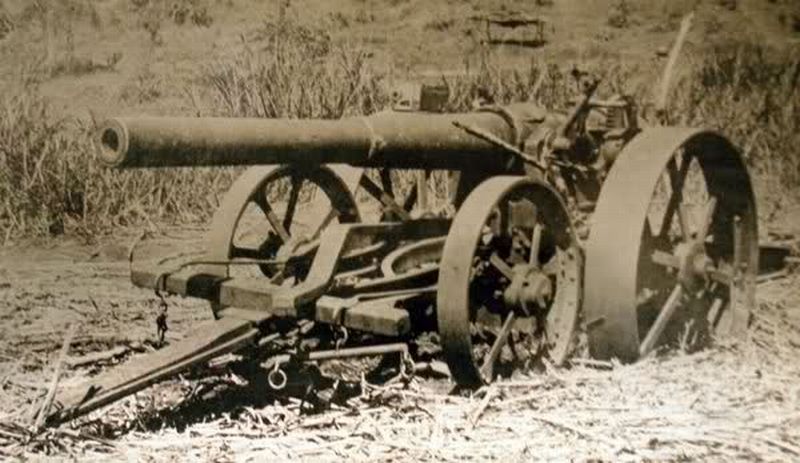
The gun as it was
found near Kibata, January 1917
Capture of the Gun
The gun was found by soldiers of the 129th
Duke of Connaught’s Own Baluchi Regiment, a British
Indian unit. A report in the London Gazette recorded
that "Our troops reached Mohoro on the South
Rufiji Delta on 16th January and found a 4.1inch
naval gun abandoned by the enemy some distance South
of it".
(Original
quotation from Supplement to the London
Gazette, 18th April 1917)
Although the
gun appears from photographs to have been captured
in a relatively intact condition it does not seem to
have been used for display unlike many of the other
guns. It was perhaps deemed too heavy to move and
simply left where it was found. According to the
local historian Kevin Patience-
"Stories
circulated for years of other guns seen in remote
areas of the bush. In the 1970's the author heard
the story of an abandoned gun that had been found by
a game warden in a river bed in one of the Tanzanian
Parks, but its inaccessibility meant that it
remained where it was".
(Original quotation from "Königsberg- A German East
African Raider" by Kevin Patience, Zanzibar Press
2001)
It is
possible that some small parts
of Apel's gun may have been salvaged as trophies
but as the gun had no barrel flange and had a
locally made carriage we know for certain that it
does not constitute any major part of the guns
currently on display in either Pretoria or Mombasa.
|